New York Stock Market Falls on Trump-Induced Tariff War Concerns... GM Plummets 5.7%
25% Tariffs on Mexico and Canada Take Effect from Midnight on the 4th
Additional 10% Tariff on China Raises Total to 20%
Three Countries Signal Immediate Retaliation... Fears of Trade War Spread
Key Employment Data to Be Released This Week... Focus on Jobs Report on the 7th
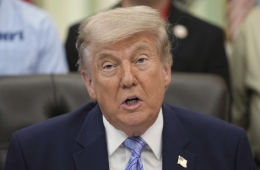
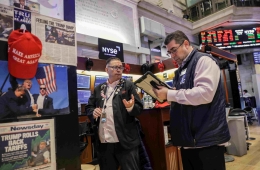
The three major indices of the U.S. New York stock market all opened lower on the 4th (local time). President Donald Trump pushed ahead with tariffs on Mexico, Canada, and China, and the three countries retaliated, triggering a wave of sell-offs amid fears of a trade war.

As of 9:58 a.m. in the New York stock market that day, the Dow Jones Industrial Average (Dow), which focuses on blue-chip stocks, was trading at 42,623.98, down 1.31% from the previous day. The S&P 500, centered on large-cap stocks, was down 1.19% at 5,780.04, and the tech-heavy Nasdaq was trading at 18,176.222, down 0.95%.
By stock, U.S. automakers General Motors (GM) and Ford, which have production bases in Mexico, were down 5.7% and 2.5%, respectively. Mexican food chain Chipotle was down 2.45%. Chipotle sources half of its avocados from Mexico, raising concerns that tariff hikes will reduce profit margins. AI leader Nvidia was down 0.9%.
The tariffs on Mexico, Canada, and China, as announced by President Trump, took effect from midnight on the 4th. He abruptly implemented the 25% tariffs on Mexico and Canada, which had been postponed for a month from the original February 4 date. For China, in addition to the existing 10% additional tariffs, another 10% was added this time, raising the total additional tariff rate to 20%.
The three countries immediately indicated retaliatory measures. Canada announced it would impose 25% retaliatory tariffs on U.S. imports worth a total of 155 billion Canadian dollars (about 156 trillion won), with tariffs on imports worth 30 billion Canadian dollars (about 30 trillion won) starting from that day. China will implement tariffs of up to 15% on U.S. imports starting from the 10th. Mexico also announced retaliatory tariffs. Mexican President Claudia Sheinbaum said that day, "We have decided to respond with tariff and non-tariff measures," adding, "We will announce them on Sunday (the 9th)."
Initially, the market had hoped for a last-minute deal in tariff negotiations. However, President Trump dismissed the possibility of negotiations the day before and proceeded with the planned 'tariff bomb,' increasing concerns about a trade war. Especially since the U.S., Mexico, and Canada have applied tariff-free treatment to most traded goods under the United States-Mexico-Canada Agreement (USMCA), a trilateral free trade agreement, and their supply chains are highly integrated, there is a high possibility of significant disruption.
However, some on Wall Street caution against excessive pessimism, believing there is still a possibility of future negotiations.
Clark Gerenan, Chief Market Strategist at Calvey Investment, said, "It is very uncertain how long the tariffs imposed on Tuesday will last," adding, "We tend to believe this is closer to a negotiation tactic and not the start of a long and tedious mutual trade war." He added, "Investors tend to sell first and ask questions later in such situations."
As investors focus on the direction of the Trump-led tariff war, key employment data is also scheduled to be released this week. The U.S. Department of Labor will release the February employment report on the 7th. Nonfarm payrolls are expected to have increased by 156,000 last month, surpassing January's figure of 143,000. Two days earlier, on the 5th, ADP, a private U.S. labor market research firm, will release its February nonfarm employment report. With the Federal Reserve (Fed) repeatedly confirming a cautious stance on interest rate cuts, labor market conditions, along with inflation, are key economic indicators closely watched by monetary authorities. The Fed's Beige Book, a report on economic conditions, will also be released on the same day.
Hot Picks Today
 "Only Two Per Person" Garbage Bag Crisis Was Just Yesterday... Japan Also Faces Shortage Anxiety
- Weekly U.S. New Jobless Claims Fall to 209,000 from Previous Week
- Lived as Family for Over 30 Years... Daughter-in-Law Cast Aside After Husband's Death
- 'Will Demand Finally Decline Due to High Prices?'... "I'll Just Enjoy Nearby Trips" as Japan and China See a Surge
- "Wore It Once, Then This? White Spots All Over 4.15 Million Won Prada Jacket... 'Full Refund Ordered'"
U.S. Treasury yields are declining. The 10-year U.S. Treasury yield, a global bond yield benchmark, fell 4 basis points (1bp=0.01 percentage point) from the previous trading day to 4.13%, while the 2-year U.S. Treasury yield, sensitive to monetary policy, plunged 9 basis points to 3.89%.
© The Asia Business Daily(www.asiae.co.kr). All rights reserved.