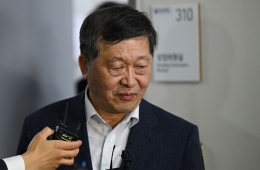
Sangmin Lee "Resigns to Minimize Government Vacuum"...Concerns Over Weakening Momentum of Key Policies (Comprehensive)
Former Minister Sang-min Lee Resigns on 8th... Acting Vice Minister
Attention on Budget and Execution of Key Policies Next Year
The Ministry of the Interior and Safety has once again become a 'headless ministry.' With the president accepting the resignation of former Minister Lee Sang-min, key tasks such as budget restoration and administrative system reform will be prepared under an acting leadership system. The former minister explained his resignation by saying, "I cannot allow the disruption of the ministry's work caused by my absence due to last year's impeachment trial to happen again."
On the first day after accepting former Minister Lee's resignation, on the 9th, the Ministry of the Interior and Safety began operations under the acting leadership of Vice Minister Ko Ki-dong. Former Minister Lee delivered a farewell message on the ministry's internal network. He said, "In this serious situation, I am stepping down from my position as minister with a heavy heart to minimize the national governance gap caused by the impeachment indictment," and added, "Even in difficult circumstances, I ask Vice Minister Ko Ki-dong and Director Lee Han-kyung of the Disaster and Safety Headquarters to steadfastly fulfill their duties for the people without any wavering."

He also emphasized the need to ensure that the ministry's work proceeds without disruption in the future. Former Minister Lee stated, "The Ministry of the Interior and Safety, responsible for public safety and encompassing both central and local governments to serve all citizens happily and comfortably, is the driving force behind South Korea's new leap forward," and stressed, "We must establish scientific response measures for abnormal weather and new complex disasters, and seek a future-oriented administrative system reform to overcome the crisis of local extinction." He also said, "Fundamental innovation to transform the government's structure is necessary amid the AI revolution, global conflicts, and economic uncertainties."
Former Minister Lee abruptly resigned the day before the opposition party's planned impeachment vote. The opposition pushed for impeachment on charges that he supported the declaration of martial law and attempted to block lawmakers' entry into the National Assembly through the police. The fact that former Minister Lee was part of the so-called 'Chungam faction' along with President Yoon Seok-yeol and former Defense Minister Kim Yong-hyun, key figures in the martial law incident, intensified the allegations of collusion.
Vice Minister Ko held a meeting with deputy heads of cities and provinces that day and said, "I feel very heavy-hearted and bear a grave sense of responsibility in facing the current situation," adding, "In times like these, public officials must maintain their focus and faithfully perform their duties at every moment to ensure that residents' daily lives remain undisturbed."
This is not the first time the Ministry of the Interior and Safety has experienced a 'leadership vacuum.' The Democratic Party passed an impeachment motion against former Minister Lee in the National Assembly, holding him accountable for the Itaewon tragedy. His duties were suspended, and after the Constitutional Court unanimously dismissed the impeachment motion, he returned to work about five months later. During the period when his duties were suspended, there were criticisms regarding the ministry's and local governments' disaster response amid flood damage nationwide, including in Chungnam.
Concerns are emerging that the momentum for major policies mentioned by former Minister Lee in his farewell message may weaken due to the ministerial vacancy. Key policies targeted for implementation in 2025 are expected to be delayed. The future-oriented administrative system reform committee under the ministry had collected related opinions nationwide last month and was scheduled to announce recommendations this month, but this is likely to be postponed. The administrative integration of Daegu and Gyeongbuk, planned to have a bill submitted to the National Assembly within this year, is also uncertain due to confusion inside and outside the ministry and the legislature. Discussions on the government organization law, which centers on establishing a Population Department, may also slow down.
Hot Picks Today
 "Stocks Are Not Taxed, but Annual Crypto Gains Over 2.5 Million Won to Be Taxed Next Year... Investors Push Back"
- [Breaking] Central Labor Relations Commission: "Second Post-Mediation Fails for Samsung Electronics"
- "Not Jealous of Winning the Lottery"... Entire Village Stunned as 200 Million Won Jackpot of Wild Ginseng Cluster Discovered at Jirisan
- "Looks Even More Like Him in Person": Crowds Gather to See 'Trump Lookalike' Albino Buffalo
- "Even With a 90 Million Won Salary and Bonuses, It Doesn’t Feel Like Much"... A Latecomer Rookie Who Beat 70 to 1 Odds [Scientists Are Disappearing] ③
Attention is also focused on whether the budget cuts made by the opposition party on police security and special activity expenses can be restored. The opposition fully cut 3.16 billion won for police special activity expenses and 107 million won for the basic expenses of the Police Bureau at the Budget and Accounts Committee. With the political situation frozen due to martial law, the Democratic Party has declared additional budget cuts, making related negotiations expected to be difficult.
© The Asia Business Daily(www.asiae.co.kr). All rights reserved.