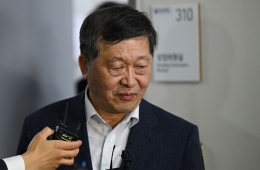
Next Korean Medical Association President Candidates Say "No Deadline for Struggle"... Firm on 'Withdrawal of Increase' in Interview with Our Paper
Reviewing the Pledges of 5 Medical Association President Candidates
Announcing a Hardline Struggle to Reset Medical Reform
Promise to Expand Participation of Residents and Medical Students
The ongoing conflict between the political sphere and the medical community throughout this year has worsened due to President Yoon Seok-yeol's emergency martial law situation and the failure of the impeachment vote. As the government's medical reform has effectively lost its momentum, the most important role of the new Korean Medical Association (KMA) president, to be elected in early January next year, has become how to address the medical community's demands to reset all issues from medical school expansion to the return of residents back to square one.

Since the outline of candidates for the KMA presidential by-election began to emerge on the 25th of last month, Asia Economy interviewed five candidates in succession: former KMA president Joo Su-ho (representative of the Future Medical Forum), Kang Hee-kyung, chairperson of the Emergency Committee of the Seoul National University College of Medicine and Seoul National University Hospital Professors' Council (pediatric professor), Lee Dong-wook, president of the Gyeonggi-do Medical Association, Kim Taek-woo, chairman of the 16 metropolitan city and provincial medical association chairpersons' council (president of the Gangwon Special Self-Governing Province Medical Association), and Choi Anna, KMA planning director and spokesperson.
They argued that to resolve the medical crisis, the medical community must unite as one and put a brake on the government's unilateral policy implementation. There had been criticism that because the KMA, medical school professors, and residents each voiced different claims, the medical community failed to set a clear goal for the direction it should take, resulting in a loss of a central point of cohesion. Candidate Choi Anna said, "The fact that there are diverse opinions actually shows the medical community's strong will to solve the problem," adding, "We need to listen to various opinions and reach conclusions through discussion."
However, there were some differences in views on how to execute this. Candidates Lee Dong-wook and Joo Su-ho, classified as 'hardliners' for calling for full-scale struggle from the early stages of the medical crisis, declared they would continue to uphold the principles as a medical organization without a deadline and pursue struggles with mid- to long-term measures in mind. Candidates Kim Taek-woo and Choi Anna also spoke of fighting against the government but left the possibility of negotiation open.
On the other hand, Kang Hee-kyung, the only current medical school professor among the candidates, argued that a process of sufficient exchange of opinions and understanding is necessary, as she had previously attempted dialogue by holding a debate with the presidential office. She said, "If the government cannot present proper medical policies, a system where the medical community proposes policies is also needed," adding, "The opinions of the public receiving medical services must also be reflected."
The candidates commonly promised to expand the participation of residents and young doctors in the association and grant them more authority. This aims to resolve the disappointment younger doctors felt toward the government and senior doctors during the medical crisis and to restore trust. Candidate Joo Su-ho said, "Whether it is a consultative body or a struggle body, decisions will be made with the opinions of residents and medical students at the center," and candidate Kim Taek-woo said, "If necessary, we will discuss granting associate membership status to medical students." These remarks are also interpreted as considering the influence of the opinions and support of young doctors, including residents, on the election outcome.
They consistently insisted that the only way to end the current medical crisis is to "halt medical school admissions in 2025." They made it clear that the government is fully responsible, as the resumption of classes for the 2024 academic year entrants is uncertain, and conditions for next year's new students to attend classes have not been established. However, candidate Kang Hee-kyung stated, "Since the admissions schedule has already progressed considerably, all parties including the government, universities, professors, resigning residents, students, examinees, and parents should come together to discuss."
Hot Picks Today
 "Stocks Are Not Taxed, but Annual Crypto Gains Over 2.5 Million Won to Be Taxed Next Year... Investors Push Back"
- [Breaking] Samsung Electronics Union: "Mediation Ends Due to Management's Rejection... General Strike Tomorrow"
- "Not Jealous of Winning the Lottery"... Entire Village Stunned as 200 Million Won Jackpot of Wild Ginseng Cluster Discovered at Jirisan
- "Looks Even More Like Him in Person": Crowds Gather to See 'Trump Lookalike' Albino Buffalo
- "Even With a 90 Million Won Salary and Bonuses, It Doesn’t Feel Like Much"... A Latecomer Rookie Who Beat 70 to 1 Odds [Scientists Are Disappearing] ③
With the impeachment motion discarded due to the ruling party's absence from the vote, the candidates unanimously demand President Yoon's resignation. Some in the medical community analyze that this might increase the possibility of resolving the medical-government conflict. Because of this, the candidates' struggle against the government is expected to intensify further. Candidate Kim Taek-woo issued a statement saying, "I am appalled by the 'punishment of residents' clause in the proclamation. President Yoon Seok-yeol must immediately step down," and candidate Choi Anna argued, "A regime that turns the medical community, responsible for the lives of the people, into an enemy is not worth maintaining regardless of political orientation."
© The Asia Business Daily(www.asiae.co.kr). All rights reserved.