"It Is Not a Matter of Blocking Traditional Financial Institutions from Participating in Cryptocurrency"
NYSBA Seoul Global Conference
'Brave New World: The Frontline of Cryptocurrency Regulation'
Regulation as Viewed by the U.S. Securities and Exchange Commission (SEC)
Crypto Winter. It refers to a period in the cryptocurrency market when prices plummet sharply and enter a prolonged state of stagnation. As cryptocurrency investors suffered losses and the market contracted last year, voices calling for stronger regulations grew louder amid debates over the lack of norms. How do SEC commissioners and global legal experts view the cryptocurrency regulatory controversies that have emerged as a result?
At the 2024 Seoul Global Conference held on the 18th, an in-depth discussion took place under the theme "Brave New World: New Frontiers in Regulations of Crypto," focusing on the latest trends in the cryptocurrency market and regulatory measures.
![[Image source=Beomryul Newspaper]](http://www.asiae.co.kr/news/img_view.htm?img=2024102114324466580_1729488765.jpg)
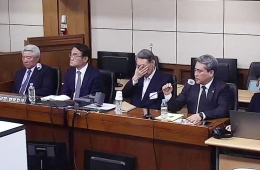
The event featured Hester M. Peirce (pictured above), an SEC commissioner, as a speaker, with panelists including Professor Ryu Kyung-eun from Korea University Law School, Professor Emma Lee from Kyung Hee University International College, and Senior Research Fellow Kim Gap-rae from the Korea Capital Market Institute. The discussion was conducted via video conference, moderated by New York attorney Choi Hyun-seok, with New York attorney Howard A. Fischer and Kim Min-seung, head of the Korbit Research Center, serving as co-chairs.
The panelists discussed topics such as △ the integration of cryptocurrencies with the traditional financial system △ cryptocurrency regulation and legal issues △ the role of stablecoins △ the role and future of the SEC △ and international regulatory approaches.
SEC Commissioner Hester Peirce emphasized, “While the SEC has taken an approach to regulate cryptocurrencies, I do not believe it is a method that helps industry participants grow. When dealing with new technologies and types of assets, we must first consider the unique issues these assets or technologies raise and pay attention to potential conflicts between the goals regulators aim to achieve and the technology.” She added, “When I first joined the SEC in 2018, I thought existing regulations could be directly applied to cryptocurrencies, but over time, I realized that cryptocurrencies are a technology with unique characteristics different from traditional assets.”
The SEC, where Commissioner Peirce serves, operates as a commission composed of five commissioners. New York attorney Howard Fischer (pictured above) explained, “Three of the SEC commissioners are appointed by the president, with three from the president’s party and the remaining two from the minority party. When there is a change in administration and party, the SEC shifts to the majority party, which can result in a change of the chairman.” Fischer is a former chief trial attorney at the SEC.
Questions also arose about how the SEC’s approval of spot exchange-traded funds (ETFs) might bring changes to cryptocurrency regulation.
Commissioner Peirce stated, “After approving the Bitcoin ETF, I believe Ethereum-based products were naturally approved as well. We confirmed that there is very high interest in these products within the market.” She added, “We will apply the same standards to other assets and make decisions based on the arguments presented in each application.”
Below is a Q&A session with the panelists and Commissioner Peirce.
Professor Ryu Kyung-eun, Korea University Law School Commissioner Peirce has expressed concerns about the SEC’s asset classification method and its reliance on law enforcement. In contrast, the European Union (EU), Japan, and Korea have adopted selective regulatory frameworks such as MiCA (Markets in Crypto Asset Regulation), the Financial Investment Services and Capital Markets Act, and the Act on the Protection of Virtual Asset Users, respectively. Considering these trends, do you think the U.S. also needs legislation for more efficient regulation instead of relying on the Howey Test (a legal standard established by the U.S. Supreme Court to determine whether digital assets like cryptocurrencies are securities)?
Commissioner Peirce I am deeply impressed by how other countries are addressing cryptocurrency regulation and developing comprehensive approaches. In my personal opinion, when building a regulatory framework, we should consider issues related to the information provided to people purchasing cryptocurrencies. We also need to consider the platforms where assets are traded and the cryptocurrency-related financial professionals who assist and advise on asset trading. Regulation of stablecoins is also an important task. There are many issues to consider regarding how such legal regulatory frameworks will be formed. This is a challenge that many lawyers need to think about deeply.
Professor Emma Lee, Kyung Hee University International College What role do you think BlackRock, the world’s largest asset management company, is playing in introducing and integrating cryptocurrencies into traditional financial markets? And what role do you think major financial institutions like BlackRock play in forming credit systems?
Commissioner Peirce I do not want to mention specific companies, but integrating cryptocurrencies with the traditional financial system seems like a natural progression. When new technologies emerge and attract a lot of interest, interaction with the traditional financial system becomes inevitable. For example, it can be beneficial to have experts with asset management experience involved. It is not a good idea to prevent traditional financial institutions from handling cryptocurrencies because their expertise is needed in auditing firms or banks. Of course, people who want to self-custody cryptocurrencies, storing digital assets like Bitcoin without relying on the traditional financial system, have no problem doing so. However, I believe it is inappropriate to block traditional financial institutions from participating in this process.
Senior Research Fellow Kim Gap-rae, Korea Capital Market Institute The SEC has tended to consider most cryptocurrencies as securities and has used terms like “Crypto Asset Security” or “Digital Asset Security.” Recently, I saw a footnote in litigation documents with Binance where the SEC expressed regret over using the term “Crypto Asset Security.” Does this suggest an internal shift within the SEC to change its enforcement-based regulatory approach?
Commissioner Peirce I do not think too much meaning should be attached to a specific footnote. The essence is to understand whether an asset is a security. The definition of securities in the U.S. is deliberately very broad. This led to the concept of an “investment contract,” and in the past, unusual assets like whiskey barrels or livestock were included under this concept. However, applying this to cryptocurrencies is becoming increasingly complex. For example, if someone says, “This token’s value might increase” or “I think I can make money,” there is a tendency to consider it an investment contract. Therefore, we need to think more clearly and precisely from a legal perspective.
Hot Picks Today
 "Parents Deposited 10 Million Won for Me"... Se...
- Chairman Chong Yongjin Restructures Shinsegae Group Management Strategy Office.....
- "SK Hynix Stock Windfall"... Teenager With Wads of Cash Turns Thief at Jewelry S...
- "Major Crash Is Coming... Buy Even If You Have to Skip a Meal" 'Rich Dad' Shares...
- "Save 30 Million Won, Grow It to 100 Million": Dramatic Pledge Sparks "Is This a...
Reporter Ahn Hyun, Legal Times
※This article is based on content supplied by Law Times.
© The Asia Business Daily(www.asiae.co.kr). All rights reserved.