Choi Sang-mok: "Complex redevelopment of aging downtown government buildings to supply rental housing for youth and low-income residents"
Partial Disclosure of Dynamic Economy Roadmap at Ministry of Economy and Finance Press Briefing

The government is planning to redevelop aging public office buildings in urban areas into mixed-use complexes to provide public rental housing for young people and low-income residents. As part of the corporate value-up plan, tax reforms including corporate tax reductions proposed by the government will be finalized after public hearings and consultations with various stakeholders.
Choi Sang-mok, Deputy Prime Minister for Economy and Minister of Strategy and Finance, revealed part of the government's envisioned 'Dynamic Economy Roadmap' during a press briefing held at the Government Complex Sejong on the afternoon of the 27th. The Dynamic Economy refers to an economic structure where social mobility circulates positively, the middle class expands, and mid-sized companies grow?forming the broad framework of the economic policy promoted by the Yoon Seok-yeol administration.
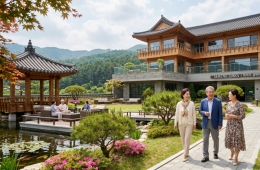
As one pillar of the Dynamic Economy Roadmap, Deputy Prime Minister Choi announced plans to expand short-term rental housing to alleviate housing instability for vulnerable groups. He stated, "We will include in the roadmap a plan to redevelop aging public office buildings in urban areas through public-private partnerships into rental housing for young people and low-income residents." This approach involves identifying aging public offices or unused national land in urban centers nationwide and developing them into mixed-use complexes comprising public rental housing, new office buildings, and community convenience facilities.

Deputy Prime Minister Choi emphasized, "Along with housing support measures for the middle class, we will prepare and present joint measures with relevant ministries to support the economic recovery and competitiveness enhancement of small business owners and self-employed individuals." The Ministry of Strategy and Finance plans to announce the Dynamic Economy Roadmap, including the redevelopment of aging public offices mentioned by Deputy Prime Minister Choi, in early next month.
Regarding tax incentives as part of the corporate value-up plan, he said, "It is time to discuss specific measures," adding, "We will hold two to three rounds of public hearings and other opinion-gathering procedures on corporate tax reductions for companies expanding dividends and on the scale of separate taxation on dividend income." Given the sharp opposition from opposition parties framing the issue as a 'tax cut for the rich,' the government intends to legitimize the legislation through public discourse.
On inheritance tax, he stated, "We will gather opinions on a few options, including abolishing the surcharge on major shareholders and increasing the deduction limit for business succession to reduce the burden." Specific application targets and tax rates will be disclosed in the 2025 tax revision bill to be released in July. Deputy Prime Minister Choi also mentioned, "There is a discussion about amending the Commercial Act to shift the duty of loyalty of the board of directors from the company to the shareholders regarding corporate governance. We will review opinions from public hearings and persuade the National Assembly accordingly."
He also expressed willingness to further expand the recently announced semiconductor industry support measures. Deputy Prime Minister Choi said, "We have announced a major framework this time and will disclose more detailed specifics in June," adding, "This is not the final step," implying that the scale of support could increase. He noted that the semiconductor materials, parts, and equipment (SoBuJang) fund size could be increased according to demand, and financial loan support conditions might also change.
He evaluated the inflation situation as not unfavorable. Regarding the recent drop in inflation to the 2% range, Deputy Prime Minister Choi said, "As supply-side factors ease, inflation has been gradually declining overall since peaking at 3.1% in March," and forecasted, "If there are no additional shocks, we expect to achieve a downward stabilization trend as initially projected." However, he added, "Since the accumulated high interest rates and high inflation continue to cause difficulties for people's livelihoods, we will maintain tariff quotas on inflation-sensitive items, monitor unfair practices in sectors closely related to people's lives, and simultaneously implement measures to improve agricultural productivity."
In response to criticisms about the government's tax revenue forecasting accuracy, he emphasized, "Many aspects have improved starting this year, including the advancement of tax revenue forecasting models." To reduce the margin of error in corporate tax forecasts, he mentioned that there will be changes such as conducting direct interviews with individual companies or industries, assuring, "There will be no large-scale tax revenue shortfall like last year."
Hot Picks Today
![[Exclusive] "What? I Used It for Fried Eggs and Kimchi Pancakes, but It Wasn't Edible?"... Raw Pork Lard Supplied to Department Stores, Causing Stir](https://cwcontent.asiae.co.kr/asiaresize/93/2026042216151436513_1776842114.png) [Exclusive] "What? I Used It for Fried Eggs and...
[Exclusive] "What? I Used It for Fried Eggs and...
- [Report] "Professionals in Their 30s and 40s With at Least 2 Billion Won in Cash...
- After Cheongung's Success, Now It's 'Haegung'... First Export Achievement Worth ...
- Republican Lawmakers Urge End to Discrimination Against U.S. Companies Like Coup...
- "Chairman Chey Tae-won's Warning Comes True"... Laptop Prices Already Up 1 Milli...
Regarding adjustments to the current $150 duty-free limit for overseas direct purchases, he avoided giving a direct answer. Deputy Prime Minister Choi said, "Since there are various stakeholders and complex impacts on our economy, it is difficult for the tax authorities to judge whether raising or lowering the duty-free limit better aligns with fairness," and refrained from elaborating further.
© The Asia Business Daily(www.asiae.co.kr). All rights reserved.