'Gopbeoseu' Dollar ETF Surges Betting on Weak Dollar Decline
Stock ETFs Are Leveraged Products Betting on Gains
Next Year, Won-Dollar Exchange Rate Expected to Shift from Around 1300 Won to Weakness
As the stock market rises recently, leveraged ETFs betting on gains are showing strength, while inverse ETFs betting on declines are showing weakness. Amid this, dollar ETFs are exhibiting the opposite movement. Although the dollar has been weakening recently, the 'Gopverseu' (double inverse) seeking twice the returns when the dollar value falls is recording high returns, whereas dollar leveraged ETFs are underperforming.

According to the Korea Exchange on the 23rd, among the top 20 ETFs with the highest decline rates this month, the only leveraged ETF was KOSEF US Dollar Futures Leverage. The rest were all inverse ETFs. KOSEF US Dollar Futures Leverage fell 8.62% this month. KODEX US Dollar Futures Leverage and TIGER US Dollar Futures Leverage also declined by 8.61% and 8.44%, respectively.
During the same period, dollar inverse ETFs showed strength. The double inverse ETFs KODEX US Dollar Futures Inverse 2X rose 9.04%, TIGER US Dollar Futures Inverse 2X increased 8.77%, and KOSEF US Dollar Futures Inverse 2X went up 8.64%.
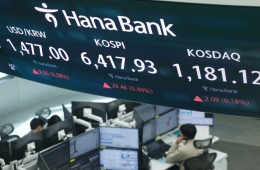
The reason dollar ETFs are showing opposite movements like this is due to the recent weakness of the dollar. The won-dollar exchange rate, which rose to 1360 won last month, has recently dropped to the 1200 won range. On the 21st, it closed at 1289.2 won, marking the first time since August 1 that it recorded the 1280 won range (it rebounded to 1301.50 won on the 22nd). Oh Chang-seop, a researcher at Hyundai Motor Securities, explained, "Since November, the won-dollar exchange rate has sharply fallen from the mid-1300 won range to the 1200 won range. Recently, in the international financial market, the US bond yields have plunged, and the stock market has shown strength, leading the dollar to shift to weakness." He added, "Especially, at the November US Federal Open Market Committee (FOMC) meeting held earlier this month, with two consecutive rate freezes, expectations for the end of US rate hikes emerged, the stock market turned bullish, and the won-dollar exchange rate entered the 1280 won range amid a risk asset preference atmosphere."
The direction of the won-dollar exchange rate is expected to be influenced by domestic and international monetary policies and economic conditions, and the possibility of a reversal cannot be ruled out. Jeon Gyu-yeon, a researcher at Hana Securities, said, "At the November FOMC, US Federal Reserve Chairman Jerome Powell stated in the press conference that financial conditions must remain persistently tight to reflect monetary policy in the financial conditions path, and with recent market rate declines, Fed officials are likely to maintain a tight stance. Concerns about tightening may periodically increase until the first half of next year, and reversals in interest rates and exchange rates may also occur."
Researcher Oh Chang-seop also said, "The strong US third-quarter GDP and expectations for the end of US rate hikes have been the biggest background for recent global risk asset preference," but he predicted, "After the US shopping season ends at the end of this year, weakening US consumption and delayed Fed rate cuts may lead to a weakening of risk asset preference and a possible return to dollar strength in the first half of next year."
Hot Picks Today
![[Exclusive] "What? I Used It for Fried Eggs and Kimchi Pancakes, but It Wasn't Edible?"... Raw Pork Lard Supplied to Department Stores, Causing Stir](https://cwcontent.asiae.co.kr/asiaresize/93/2026042216151436513_1776842114.png) [Exclusive] "What? I Used It for Fried Eggs and...
[Exclusive] "What? I Used It for Fried Eggs and...
- [Report] "Professionals in Their 30s and 40s With at Least 2 Billion Won in Cash...
- "375 Won Per Share" SK hynix to Pay 26.58 Billion Won Cash Dividend
- No More Updates on 'Star' Wolf Neugoo for Now... Was the Pressure from Fans Over...
- "Chairman Chey Tae-won's Warning Comes True"... Laptop Prices Already Up 1 Milli...
The dollar weakness is expected to become full-fledged in the second half of next year. Researcher Jeon Gyu-yeon said, "The dollar will show a slightly weak trend in the first half and then fall significantly in the second half, reflecting Fed rate cuts in June and September," adding, "The average won-dollar exchange rate next year is expected to be around 1286 won. In the first half, due to the Fed's stance on maintaining high rates and the slow recovery of the Chinese economy, the rate will explore direction around 1300 won, then show weakness as it moves into the second half."
© The Asia Business Daily(www.asiae.co.kr). All rights reserved.