Mega Science City Pohang, Full-Scale Launch to Draw Blueprint for 'Future Clean Energy'
On the 23rd, Pohang City and Gyeongbuk Province Host 'Pohang, the Giant Science City, Gyeongbuk Next-Generation Science Forum'
Pohang, the Optimal Site for Artificial Sun Realization, Differentiated Strategy... Full-Scale Launch of New Energy Indus
Pohang City is embarking on drawing the ‘K-Future Clean Energy’ industrial map with a differentiated strategy for carbon neutrality and a major transition to a new energy-based society.

On the 23rd, Pohang City jointly held the "Pohang, the Giant Science City, Gyeongbuk Next-Generation Science Forum" with Gyeongbuk Province.
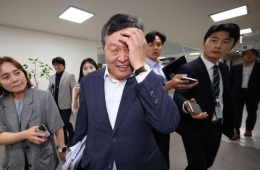
View original imageOn the 23rd, the city held the ‘Mega Science City Pohang, Gyeongbuk Next-Generation Science Forum,’ co-hosted with Gyeongbuk Province, attended by 150 experts from various sectors including industry, academia, research, and government such as Mayor Lee Kang-deok of Pohang, Jang Sang-gil, Director of the East Coast Strategic Industry Bureau of Gyeongbuk Province, Baek In-gyu, Chairman of Pohang City Council, Moon Chung-do, Chairman of Pohang Chamber of Commerce and Industry, Seo Seok-jong, Director of POSCO Research Institute, and Kim Geun-hwan, Director of the Convergence Innovation Research Institute at Pohang Institute of Industrial Science and Technology.
The first part of the forum, held under the theme ‘Finding the Path to Future Clean Energy Artificial Sun,’ began with a keynote lecture by Choi Chang-ho, Head of ITER Technology Division at the Korea Institute of Fusion Energy, titled ‘Future Clean Energy (Fusion Energy): Korean Superconducting Fusion Device & International Thermonuclear Experimental Reactor Construction and Our Future.’ This was followed by presentations on ‘Corporate Growth through Mega Science’ by Park Seon-soon, Chairman of Dawonsys, and ‘Roadmap Strategy for Korean Fusion Demonstration Reactor Development’ by Professor Hong Bong-geun of Jeonbuk National University.
In the second part, a panel discussion chaired by Professor Lee Jae-young of Handong Global University featured Kang Heung-sik, Director of Pohang Accelerator Laboratory, Professor Yoon Geon-su of POSTECH’s Department of Advanced Nuclear Engineering, Kim Yang-su, Head of Overseas Business at Korea Electric Power Technology, along with Choi Chang-ho, Park Seon-soon, and Hong Bong-geun. They engaged in in-depth discussions on topics including △Strategies for Realizing the Artificial Sun ▲Safety of Fusion Energy ▲Corporate Growth Directions ▲Development of the Mega Science City Pohang.
Notably, the discussion reached a consensus that securing new energy sources based on science and technology is paramount for future energy, and all agreed to unite efforts to build a mega science artificial sun ecosystem, one of these new energy sources.
The artificial sun refers to energy obtained through hydrogen nuclear fusion reactions, where light atoms like hydrogen fuse in a plasma state?where nuclei and electrons are separated?producing energy in a manner similar to the sun. It is highly efficient, capable of producing energy equivalent to about 8 tons of oil from just 1 gram of hydrogen, making the artificial sun a promising future eco-friendly energy source.
Pohang City possesses the 4th generation synchrotron light source, including the Pohang Light Source which led the emergence of Korea’s mega science sector, and is home to POSTECH, a world-class research-oriented university, and Handong Global University, a global talent nurturing institution.
Additionally, excellent infrastructure is concentrated here, including the Pohang Institute of Industrial Science and Technology, a specialized research institute for core technology commercialization, Pohang Technopark, an incubation and corporate support organization, and ‘Change Up Ground,’ Korea’s top startup space for fostering venture companies, giving Pohang a significant advantage in realizing the artificial sun compared to other regions.
Accordingly, experts at this forum evaluated Pohang as the optimal site where mega science can flourish from research to technology commercialization for realizing future clean energy artificial sun.
Pohang City plans to focus its capabilities on establishing a close cooperative system with Gyeongbuk Province, R&D research institutions, POSTECH, and others to promote ▲building an artificial sun ecosystem ▲joint cooperation in technology development ▲mutual support for human resource development ▲attracting energy-related institutions for the realization of future clean energy artificial sun (fusion energy).
Hot Picks Today
!["Rather Than Endure a 1.5 Million KRW Stipend, I'd Rather Earn 500 Million in the U.S." Top Talent from SNU and KAIST Are Leaving [Scientists Are Disappearing] ①](https://cwcontent.asiae.co.kr/asiaresize/93/2026051914165468840_1779167814.png) "Rather Than Endure a 1.5 Million KRW Stipend, I'd Rather Earn 500 Million in the U.S." Top Talent from SNU and KAIST Are Leaving [Scientists Are Disappearing] ①
"Rather Than Endure a 1.5 Million KRW Stipend, I'd Rather Earn 500 Million in the U.S." Top Talent from SNU and KAIST Are Leaving [Scientists Are Disappearing] ①
- Brilliant Korean Technology Flows Overseas... Subsidies Granted, but "No Product Launch Allowed"
- "If That's the Case, Why Not Just Buy Stocks?" ETFs in Name Only, Now 'Semiconductor-Heavy' and a Playground for Short-Term Traders
- Small Business Community Urges Samsung Electronics Union to Halt Strike, Citing Economic Damage
- "No Cure Available, Spread Accelerates... Already 105 Dead, American Infected"
Mayor Lee Kang-deok stated, “We will join forces with experts from R&D institutions, local universities, companies, and research institutes to build an innovative ecosystem for establishing the mega science city Pohang and create high-quality living conditions. We will spare no administrative support for realizing the artificial sun, an innovative future clean energy that will lead the next-generation energy industry cluster.”
© The Asia Business Daily(www.asiae.co.kr). All rights reserved.
![Cheaper Than Candy, Yet Impossible to Find... Fears of a 'Pediatric Medical Crisis' as Pharmaceutical Companies Halt Production [Why&Next]](https://cwcontent.asiae.co.kr/asiaresize/307/2026051910065268365_1779152813.jpg)