Deutsche Bank: "Germany's Recession is a Structural Problem... 'Sick Man of Europe' is Inevitable"
Christian Sewing, CEO of Deutsche Bank, Germany's largest bank, directly stated that "if the structural problems of the German economy are not resolved, it will inevitably become the 'Sick man of Europe'."
On the 20th (local time) at the annual financial conference held in Frankfurt, he said, "We are not the sick man of Europe. However, if we do not address the structural weaknesses currently holding back our economy, we will inevitably become the sick man of Europe."
He cited several reasons why Germany, once Europe's largest economic power, has suddenly become the center of the sick man debate: a high proportion of manufacturing, lagging competitiveness in the advanced IT sector, high external energy dependence, outdated infrastructure, an aging and unskilled labor market structure, and excessive bureaucracy.
This economic situation reflects structural problems that are difficult to improve in the short term, raising concerns that Germany could revert to being the sick man of Europe in the 1990s, when it suffered a prolonged recession due to the aftereffects of East and West Germany's reunification.
Germany, with weak advanced industry infrastructure such as semiconductors, has struggled to recover economically after the pandemic, and doubts are growing about whether it can maintain its dominant position from the internal combustion engine era amid a delayed transition to electric vehicles.
![[Image source=EPA Yonhap News]](http://www.asiae.co.kr/news/img_view.htm?img=2023092111483584572_1695264514.jpeg)
Earlier, major economic institutions forecasted that Germany would be the only major advanced country to experience negative growth this year. The International Monetary Fund (IMF) projected in its World Economic Outlook (WEO) report released in July that Germany's economic growth rate for this year would be -0.3%, making it the only G7 country to contract.
Germany experienced two consecutive quarters of negative growth in the fourth quarter of last year and the first quarter of this year, followed by zero growth (0%) in the second quarter of this year.
The German economy is rapidly cooling due to a combination of variables such as inflation, the energy crisis caused by the Ukraine war, and supply chain issues. As the largest importer of Russian natural gas, Germany faced a halt in gas supplies from Russia after the Ukraine war, and its manufacturing sector was hit hard by a slowdown in trade caused by reduced demand from China, its largest trading partner.
Private consumption is also decreasing due to high prices. Germany's Consumer Price Index (CPI) in July rose 6.7% compared to the same period last year. Although lower than the sharp increase in the second half of last year caused by the energy crisis, it remains high compared to three years ago when the increase was below 1%.
Hot Picks Today
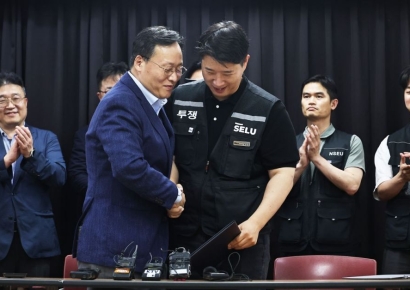 Up to 600 Million Won for Semiconductors, 160 Million Won Bonus for Loss-Making Non-Memory… Samsung Electronics Labor and Management Reach Tentative Deal on Unprecedented Performance Compensation (Comprehensive)
- "Could I Also Receive 370 Billion Won?"... No Limit on 'Stock Manipulation Whistleblower Rewards' Starting the 26th
- "From a 70 Million Won Loss to a 350 Million Won Profit with Samsung and SK hynix"... 'Stock Jackpot' Grandfather Gains Attention
- Opening a Bank Account in Korea Is Too Difficult..."It Costs 150,000 Won Just to Open a Child's Account or Check Card" [Foreigner K-Finance Status]②
- "Who Is Visiting Japan These Days?" The Once-Crowded Tourist Spots Empty Out... What's Happening?
Foreign media predicted, "As purchasing power declines, private consumption has decreased, leading to reduced government spending," and "high interest rates will further shrink private consumption capacity."
© The Asia Business Daily(www.asiae.co.kr). All rights reserved.
!["Please Help": How Much Do Those Bowing 90 Degrees Really Earn? [Data Pick]](https://cwcontent.asiae.co.kr/asiaresize/307/2026052010120870131_1779239528.png)