Presidential Office: "No Crisis... Real Estate Supply Activation Plan to Be Announced This Month"
Plans to Establish Supply Measures for Private and Public Sectors
Record High Foreign Investment in Second Half of Last Year and First Half of This Year
Economic Chief: "No Crisis in September"
The Presidential Office announced on the 1st that it plans to prepare and announce real estate supply measures and economic and livelihood policy plans within this month.
Choi Sang-mok, Senior Secretary for Economic Affairs, met with reporters at the Yongsan Presidential Office in the afternoon and said, "There are concerns about whether supply will be properly provided due to incidents like the LH (Korea Land and Housing Corporation) case," adding, "We will prepare and announce measures to revitalize real estate supply within September to ensure proper supply."
The announcement related to revitalizing real estate supply is expected to be divided into private sector supply and public sector supply such as LH. Senior Secretary Choi explained, "There may have been factors that caused supply to shrink in various ways in the private sector due to issues like real estate project financing (PF), so we are considering how to resolve these issues and promote supply," adding, "To complement this, we will discuss and announce ways for the public sector, including LH, to supplement supply."
He noted that over the past one year and four months since the Yoon Suk-yeol administration took office, punitive taxation and excessive regulations have been eased to induce a soft landing of the real estate market, and the real estate market is expected to maintain a firm trend for the time being.
Senior Secretary Choi said, "Although there are regional differences, the number of areas showing an upward trend, especially those that experienced significant declines, is increasing," adding, "Because the objective interest rate level is high, transaction volume is still only about 50-60% of previous years. Experts forecast a stable market with both upward and downward possibilities open."
He continued, "In other words, I would like to evaluate this as a normalization process of the real estate market," and added, "We see it as a normalization process moving according to market supply and demand, and the government will continue to promote regulatory normalization."
![[Image source=Yonhap News]](http://www.asiae.co.kr/news/img_view.htm?img=2023083116540359210_1693468444.jpg)
He also forecasted that the economy will enter a recovery phase in September to October. Regarding the economic outlook, Senior Secretary Choi said, "Despite the industrial activity trends in July, I cautiously expect indicators to show a 'low in the first half and high in the second half' pattern, with a recovery trend appearing from September and October."
He explained the basis by saying, "Compared to last year, it is negative, but the rate of decline is continuously decreasing, which means the improvement trend is continuing," adding, "The most problematic areas were exports to China and semiconductor exports, but semiconductor exports have generally been improving since January, and exports to China are also showing a basic reduction in the rate of decline." He expressed hope, saying, "From around October, I expect and hope to put an end to the 11-month continuous negative export trend."
Regarding the September crisis theory circulating in some quarters, he refuted it based on increased foreign investment in industrial facility investment and Korean corporate investment in Korea. He argued that it is illogical for foreign investment to increase if a crisis is coming to the domestic economy.
Foreign investment in the second half of last year was $19.36 billion, and in the first half of this year, it was $17.09 billion, ranking first and second historically. Senior Secretary Choi said, "Normally, a year is from January to December, but if calculated from July last year to June this year, the total was $36.45 billion," adding, "The maximum annual attraction amount was in 2022, which was $30.45 billion, more than $6 billion higher."
He also emphasized, "We self-assess that the increase in foreign investment to a record high in history reflects combined trust in the mid- to long-term outlook of our economy and the government's policy direction."
Regarding the September crisis theory raised by some, he firmly stated, "I don't know how widespread the September crisis theory is, but I can say first that there is no September crisis," and about China's economic crisis theory, he said, "The general view is that China is not experiencing a crisis," adding, "However, China may be experiencing a slowdown in economic growth, but we will respond by combining changes in global trade and China's domestic demand."
Regarding the maturity of loans for self-employed and small business owners in September, he said, "As of September last year, loans for self-employed and small business owners were about 100 trillion won, and about 90% of them have been paying interest well and repaying normally, so we extended the repayment period by three years as of September last year," adding, "For the remaining 10%, we either deferred principal repayment or interest repayment and asked them to submit a repayment plan."
Hot Picks Today
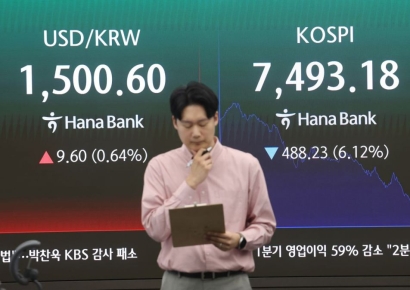 After Topping 8,000 Instead of Hitting 10,000... KOSPI Plunges—When Will It Rebound?
- "Samsung and Hynix Were Once for the Underachievers"... Hyundai Motor Employee's Lament
- [Breaking] Court Rules Against Samsung Electronics Union...1 Billion Won per Day Penalty for Exceeding Strike Scope
- Six Economic Organizations Urge Withdrawal of Samsung Electronics Strike Plan...Warn of National Loss of Opportunity
- "That? It's Already Stashed" Nightlife Scene Crosses the Line [ChwiYak Nation] ③
He continued, "The principal amount of 100 trillion won has decreased to about 76 trillion won this year, and more than 70 trillion won of that is under the three-year extension and is normal loan credit," adding, "About 5 to 6 trillion won worth of people need to submit repayment plans, and 98% of them have already submitted their plans."
© The Asia Business Daily(www.asiae.co.kr). All rights reserved.







