"Public Investment Ban Applies to Companies Earning Half of Sales from Semiconductors and AI"
There is a prospect that the U.S. investment ban on advanced Chinese industries currently being prepared will apply to American companies investing in Chinese firms that generate more than half of their revenue from advanced technologies such as semiconductors and artificial intelligence (AI). As the path for U.S. capital to invest in China's advanced industries narrows, limited damage is expected.
Bloomberg reported on the 8th (local time) that the scope of the investment ban on China is expected to be slightly narrower than initially disclosed.
Accordingly, the investment targets in China's advanced technology industries for major U.S. private equity (PE), venture capital (VC), and joint venture investments are likely to decrease. Bloomberg stated, "This is intended to block and isolate China from developing advanced technologies that threaten U.S. national security by utilizing American capital," and added, "President Biden is expected to announce a proposal containing these measures through an executive order and will begin gathering opinions from various stakeholders."
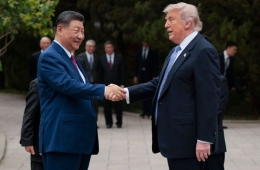
![[Image source=Reuters Yonhap News]](http://www.asiae.co.kr/news/img_view.htm?img=2023080907311034266_1691533870.jpeg)
The British publication The Economist reported, "Although the scope of the investment ban is still unclear, it will affect some investments in Chinese companies with a corporate value exceeding $1 trillion as of the end of 2021." According to market research firm Rhodium Group, U.S. companies have made $120 billion in foreign direct investment (FDI) and $62 billion in venture investments in China over the past decade. Of the total $110 billion investment raised by Chinese AI companies from 2015 to 2021, about 37% ($40.7 billion) was reportedly attracted from U.S. companies such as Intel and Qualcomm’s VC affiliates.
Bloomberg expects this measure to apply only to new investments. President Biden previously stated that this executive order would be limited in scope and would not affect the deterioration of relations with China, nor would it be applied retroactively. U.S. Treasury Secretary Janet Yellen also said that the executive order would be "limited in scope" and "would not fundamentally affect China's investment environment."
President Biden is expected to sign the executive order regarding this measure soon. Although a White House announcement was initially expected on this day, major foreign media including Bloomberg reported that the announcement timing could be delayed. It is also anticipated that it will take about a year for this measure to be implemented.
This measure was prepared to prevent large U.S. capital from flowing into Chinese startups in advanced fields. The Biden administration has sought to implement this measure since its early days, but it failed to pass through the U.S. Congress due to opposition to government regulation of private investments.
Hot Picks Today
 "Do We Need to Panic Buy Again?" War Drives 30% Price Surge... Even the Bedroom Feels the Impact
- "Suspicious Timing?"...Trump Traded Stocks After Praising Wartime Capabilities
- There Is a Distinct Age When Physical Abilities Decline Rapidly... From What Age Do Strength and Endurance Drop?
- "Anyone Who Visited the Room Salon, Come Forward"… Gangnam Police Station Launches Full Staff Investigation After New Scandal
- "Contact Me First If Houses Are Built": Wealthy Clients Eyeing... Will Ultra-High-End Residences Worth 20 Billion Won Be Developed? [Real Estate AtoZ]
Meanwhile, ahead of President Biden’s executive order announcement, China strongly opposed the move. Mao Ning, spokesperson for the Chinese Ministry of Foreign Affairs, criticized, "We oppose the U.S. politicizing and weaponizing trade and technology issues."
© The Asia Business Daily(www.asiae.co.kr). All rights reserved.