Democratic Party Launches Fierce Attack on IAEA Director General for "Avoiding Answers" and "Report Losing Neutrality" (Comprehensive)
Request to Japanese Government for Alternatives to Discharge
Schedule of Ocean Discharge and Cooperation with Other International Organizations
Communicated to IAEA but No Response Received
The Democratic Party of Korea invited Rafael Grossi, Director General of the International Atomic Energy Agency (IAEA), to the National Assembly on the 9th for a closed-door meeting, but they did not receive clear solutions regarding the Fukushima nuclear power plant contaminated water issue.
The Democratic Party's "Countermeasure Committee to Prevent the Ocean Dumping of Fukushima Nuclear Power Plant Contaminated Water" stated after the closed-door meeting with Director General Grossi that he avoided answering most related questions and said, "We plan to propose follow-up dialogues and discussions."
Lee So-young, spokesperson for the Democratic Party, told reporters, "(Director General Grossi) consistently responded by saying he would continue to answer in writing later rather than giving direct answers to the questions."
Spokesperson Lee added, "There are various alternatives being considered besides ocean discharge, including a proposal to request the Japanese government to re-examine five alternatives, postpone the ocean discharge schedule, and create new governance with several international organizations related to health, environment, and human rights such as the World Health Organization (WHO), United Nations (UN) Environment Programme, International Maritime Organization, and the UN Human Rights Council to analyze and verify the long-term impacts of contaminated water discharge on the marine ecosystem, human rights, and human health."
![Wi Seong-gon, Chairman of the Democratic Party of Korea's Countermeasures Committee Against the Ocean Disposal of Fukushima Nuclear Wastewater, and Rafael Grossi, Director General of the International Atomic Energy Agency (IAEA) (right), shake hands before a meeting on the morning of July 9 at the National Assembly in Yeouido, Seoul. 2023.7.9 [Joint Coverage] [Image Source=Yonhap News]](http://www.asiae.co.kr/news/img_view.htm?img=2023070914360191214_1688880962.jpg)
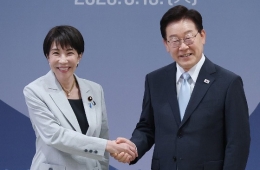
Wi Seong-gon, Chairman of the Democratic Party of Korea's Countermeasures Committee Against the Ocean Disposal of Fukushima Nuclear Wastewater, and Rafael Grossi, Director General of the International Atomic Energy Agency (IAEA) (right), shake hands before a meeting on the morning of July 9 at the National Assembly in Yeouido, Seoul. 2023.7.9 [Joint Coverage] [Image Source=Yonhap News]
View original imageShe also pointed out that the report omitted the fact that Japan’s Advanced Liquid Processing System (ALPS), which is key to treating contaminated water, is operating normally from a technical perspective.
However, the IAEA side only responded to the new governance proposal, according to the spokesperson. She said, "The IAEA side avoided answering proposals to consider alternatives other than ocean discharge and to postpone the contaminated water discharge schedule," adding, "Regarding the new governance proposal, they agreed on its necessity and responded that they would seriously consider it."
The Democratic Party announced that it plans to continue follow-up discussions at the special committee level starting with this meeting.
Before the meeting, the Democratic Party launched a fierce attack against Director General Grossi, accusing him of conducting a Japan-biased verification that lost neutrality and objectivity from the start.
Wi Seong-gon, head of the committee to prevent ocean dumping of contaminated water, said, "As a neighboring country sharing the sea with Japan, we express serious concerns about 1.33 million tons being dumped into the sea over more than 30 years," and pointed out, "85% of the South Korean public opposes the ocean dumping of Fukushima nuclear power plant contaminated water." He added, "We deeply regret the conclusion that the contaminated water discharge plan meets international safety standards," emphasizing, "We cannot help but point out the inadequacy of the IAEA final report."
Wi said, "The IAEA report did not verify the performance of the Advanced Liquid Processing System, nor did it review the long-term impact of contaminated water discharge on the marine ecosystem." He also pointed out that since the contaminated water comes from the accident nuclear power plant, it is effectively nuclear waste.
He continued, "The countermeasure committee officially requests Japan to postpone the contaminated water dumping and consider other alternatives with the international community," adding, "Other alternatives can be created."
![[Image source=Yonhap News]](http://www.asiae.co.kr/news/img_view.htm?img=2023070914361791216_1688880978.jpg)
U Won-sik, a lawmaker who is on a hunger strike opposing the contaminated water discharge, said, "I am very concerned after seeing Director General Grossi say in a media interview that nuclear contaminated water is drinkable and safe for swimming," and questioned, "If he is so confident that it is safe, why not use it as drinking water or for agricultural or industrial purposes in Japan, a country facing water shortages, instead of dumping it into the sea?" U criticized, "Concluding without investigating the impact of ocean discharge on neighboring countries is self-verification and a Japan-tailored investigation."
Hot Picks Today
!["Rather Than Endure a 1.5 Million KRW Stipend, I'd Rather Earn 500 Million in the U.S." Top Talent from SNU and KAIST Are Leaving [Scientists Are Disappearing] ①](https://cwcontent.asiae.co.kr/asiaresize/93/2026051914165468840_1779167814.png) "Rather Than Endure a 1.5 Million KRW Stipend, I'd Rather Earn 500 Million in the U.S." Top Talent from SNU and KAIST Are Leaving [Scientists Are Disappearing] ①
"Rather Than Endure a 1.5 Million KRW Stipend, I'd Rather Earn 500 Million in the U.S." Top Talent from SNU and KAIST Are Leaving [Scientists Are Disappearing] ①
- "No Cure Available, Spread Accelerates... Already 105 Dead, American Infected"
- Suspicious Starbucks Numbers?... 'Tank Day' Controversy Spreads from May 18 to Sewol Ferry and Park Geun-hye
- "Wild Ginseng Discovered on Jirisan Slopes: 12 Cheonjong Sansam Roots Appraised at 243 Million Won"
- "How Did an Employee Who Loved Samsung End Up Like This?"... Past Video of Samsung Electronics Union Chairman Resurfaces
Earlier, Director General Grossi said, "The IAEA plans to be stationed in Japan to review whether the discharge plan is properly followed," adding, "We will be stationed for years, even decades, to review all aspects such as procedures and functions to ensure the contaminated water discharge meets international safety standards."
© The Asia Business Daily(www.asiae.co.kr). All rights reserved.