'Business Wind-Down Theory' LG Chem... "Is it Holding Back the Successful LG Energy Solution?" Controversy
"Reviewing Various Measures to Enhance the Value of the Seokhwa Business"
Vice Chairman Shin Hak-cheol Drives 'Strengthening Non-Seokhwa Business'
LG Energy Solution Conflict... "Grew for 20 Years but Results Monopolized"

Factory shutdowns, workforce reallocations, and even business divestitures. As a recession hits the petrochemical industry, warning lights have turned on at LG Chem. Despite concerns over deficits, funds are needed for transitioning to new businesses such as battery materials. With the subsidiary LG Energy Solution also affected, there is turmoil both inside and outside the company.
LG Chem has reached a critical point between business restructuring and downsizing. Earlier this month, it sold its diagnostic business under the Life Sciences division to Glenwood PE for about 150 billion KRW, and recently began restructuring its petrochemical division. Noh Guk-rae, head of LG Chem’s Petrochemical Business Division, stated in a recent email to employees, "We cannot delay restructuring of uncompetitive marginal businesses within our commodity operations."

LG Twin Towers building lit up on the night of the 27th. Photo by Hyunmin Kim kimhyun81@
View original imageDue to the sluggish petrochemical market, LG Chem is lowering factory operating rates and pursuing production line efficiency. Earlier this year, it halted operations of the high-value-added synthetic resin (ABS) production line at the Iksan plant and relocated personnel to the Yeosu plant. The Iksan cathode material plant was also consolidated into Cheongju.
Although the regular major maintenance that began in April ended, the factory remains idle due to losses. Only the first naphtha cracker (NCC) plant is operating to meet demand, while the second NCC plant, which has been shut down, is rumored to be up for sale. Regarding the sale of NCC Plant 2, LG Chem announced on the 3rd, "No concrete decisions have been made yet," adding, "We are reviewing various options to strengthen competitiveness and enhance business value in the petrochemical sector."
Since the appointment of Vice Chairman Shin Hak-cheol, LG Chem has been pushing for a business transformation from its core petrochemical operations to new growth engines such as battery materials, eco-friendly technologies, and global new drugs. CFO Cha Dong-seok stated during the Q1 conference call, "We will accelerate the pace of business structure transformation and focus on nurturing new growth engines." As the market downturn continues, this pace appears to be quickening.
In particular, with urgent cash needs at the company level for new business investments, the industry expects LG Chem to adopt a "sell what’s profitable" strategy. Approximately 4 trillion KRW is planned to be spent on new growth engines this year alone. However, LG Chem’s Q1 EBITDA fell 70% year-on-year to 297.5 billion KRW. Cash assets also decreased from 1.4138 trillion KRW to 681 billion KRW.

To overcome the shortage of funds, the sale of a stake in LG Energy Solution is considered a likely option. This involves selling part of LG Chem’s 81.84% stake in LG Energy Solution. Investment banking circles estimate that LG Chem is pursuing block trades and EB issuances worth about 2 trillion KRW of LG Energy Solution shares.
Internal turmoil caused by restructuring is also growing. Conflicts between LG Chem and LG Energy Solution have surfaced during this process. A recent example is the pricing dispute between the two companies. LG Chem insists on receiving fair prices reflecting raw material cost increases when supplying battery materials such as cathode materials to LG Energy Solution, whereas LG Energy Solution seeks price adjustments due to the burden of rising costs, leading to conflict.
Recently, labor union conflicts have also raised concerns. After LG Energy Solution’s independence, LG Chem’s labor union has continued joint negotiations without splitting the unions, but differences have emerged during this year’s collective bargaining. LG Energy Solution’s union is demanding higher wage increases than LG Chem, reflecting record-high performance. Inside LG Chem, there are complaints that profits earned from petrochemicals were used to grow the battery business, but now LG Energy Solution is solely reaping the benefits.
Related Articles
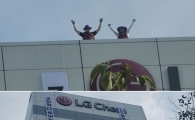 "Implement the Agreement"... LG Chem Union's High-Altitude Protest at Cheongju Plant
![[Image source=Yonhap News]](http://www.asiae.co.kr/news/img_view.htm?img=2022120309122739045_1670026346.jpg)
© The Asia Business Daily(www.asiae.co.kr). All rights reserved.







