[Q&A] Lee Chang-yong "Korea Already in Long-Term Low Growth Structure... Labor and Pension Structural Reforms Needed"
![Lee Chang-yong, Governor of the Bank of Korea, is speaking at the Monetary Policy Direction press conference held at the Bank of Korea in Jung-gu, Seoul on the 25th. [Image source=Yonhap News]](http://www.asiae.co.kr/news/img_view.htm?img=2023052513431043155_1684989790.jpg)
Lee Chang-yong, Governor of the Bank of Korea, is speaking at the Monetary Policy Direction press conference held at the Bank of Korea in Jung-gu, Seoul on the 25th. [Image source=Yonhap News]
View original imageLee Chang-yong, Governor of the Bank of Korea, emphasized that old-age poverty will become a social issue within the next 5 to 10 years, and structural reforms in pensions and labor are necessary to address these problems. He stated that trying to revive the economy through fiscal and monetary policies while postponing structural reforms is a "shortcut to the country's ruin."
At a press conference following the Monetary Policy Committee meeting on the 25th, Governor Lee said, "I believe our country is already in a long-term low-growth structure," and pointed out, "The problem in our country is that although everyone knows reforms are necessary, progress is stalled because social compromise among stakeholders is very difficult."
Governor Lee stressed, "Since structural difficulties cannot be resolved, the tendency is to ask for solutions by loosening fiscal policy and lowering interest rates, but that must never happen," adding, "Fiscal and monetary policies are for stabilizing our economy in the short term, but for the economy to do well, structural reforms must be implemented."
Regarding the possibility of an interest rate cut within this year, Governor Lee maintained that it is still 'premature.'
He said, "Until there is clear evidence that the inflation rate converges to the target level of 2%, it is premature to consider a rate cut," and added, "Based on the Consumer Price Index (CPI), the likelihood of the inflation rate converging to around 3% by the end of the year has become clearer than last month, but confidence that it will drop from 3% to our target of 2% has rather decreased."
Governor Lee forecasted that the Korean economy will show a 'low in the first half, high in the second half' pattern. He explained, "We see the semiconductor industry's bottom in the fourth quarter, and the Chinese economy is expected to recover in the second half. It seems the 'low-high' pattern will be maintained."
Below is a Q&A with Governor Lee
![Lee Chang-yong, Governor of the Bank of Korea, is holding a press conference after the regular Monetary Policy Committee meeting held on the 25th at the newly constructed Bank of Korea headquarters in Jung-gu, Seoul. <br>[Image source=Yonhap News]](http://www.asiae.co.kr/news/img_view.htm?img=2023052513431843156_1684989798.jpg)
Lee Chang-yong, Governor of the Bank of Korea, is holding a press conference after the regular Monetary Policy Committee meeting held on the 25th at the newly constructed Bank of Korea headquarters in Jung-gu, Seoul.
[Image source=Yonhap News]
- There have been changes in the composition of the Monetary Policy Committee. What are the members' forecasts for the final interest rate level?
▲ Regarding the final interest rate level, all six committee members are open to the possibility of maintaining it at 3.75% per annum. The first reason is that although the consumer price inflation rate is slowing as expected, the core inflation slowdown is slower than anticipated, so further review is necessary. The second reason is the need to observe whether the U.S. Federal Reserve (Fed) will pause or continue raising rates and how this will affect the domestic foreign exchange market.
- Do you still consider it premature to cut the base rate within this year? If so, why not rule out a rate cut within the year as the U.S. has done?
▲ I have said that the market's expectation of a rate cut within this year is excessive. The committee members share this view. Although the U.S. has not firmly ruled out a rate cut, the reason we do not rule out a rate cut within the year is that we have already raised rates by more than 300 basis points (1bp = 0.01 percentage point), and we need to observe how the increased rates affect inflation and the economy. Also, there is uncertainty about how the U.S. Fed will decide on rates. It is better to observe and decide rather than rush. If rates are lowered hastily, there is a risk of triggering financial instability again, so we need to consider this in the medium to long term before thinking about cuts. In conclusion, until there is clear evidence that inflation converges to the target of 2%, it is premature to consider a rate cut.
- Compared to the last Monetary Policy Committee meeting, has confidence increased that inflation is converging to the target level?
▲ Based on the Consumer Price Index (CPI), the possibility of inflation converging to around 3% by the end of the year has become clearer than last month. However, confidence that it will drop from 3% to our target of 2% after the year-end has somewhat decreased. The reason is that much of the current inflation slowdown is due to the base effect from the sharp rise in oil prices since June-July last year. Once the base effect passes, consumer price inflation and core inflation are expected to move together, but currently, core inflation is forecasted to rise to 3.3%. There is less confidence that it will converge to the policy target.
- What is the main reason for lowering this year's growth forecast to 1.4%?
▲ The biggest reason is that the recovery of the IT and semiconductor industries is delayed more than we expected. We thought China's recovery would have several positive effects on neighboring countries, but the recovery speed seems slower than expected. Growth is also centered on domestic demand, so the positive effects from neighboring countries are limited. However, we still expect the 'low in the first half, high in the second half' pattern to be maintained. Growth is expected to rise in the second half.
- You previously mentioned that short-term interest rates had fallen excessively, but recently the Bank of Korea increased the issuance of Monetary Stabilization Bonds, causing short-term rates to rise somewhat. Do you think the current level of short-term rates is no longer excessively low?
▲ We intervened in ultra-short-term rates to raise short-term rates to secure the effectiveness of monetary policy. We monitor ultra-short-term rates, CDs, and call rates through repurchase agreements (RPs), but our system is structured so that RP transactions are mainly conducted by banks. Normally, this is not a problem, but as funds move from banks to non-bank institutions, many non-bank institutions that cannot participate in RP operations manage large amounts of funds through Monetary Stabilization Bonds, causing a divergence in short-term rates. Since the Bank of Korea should be able to adjust short-term rates but was unable to, we intervened to raise short-term rates to the base rate level. Going forward, we plan to discuss with the market whether it is desirable to adjust through Monetary Stabilization Bonds and expand RP counterparties, reflecting the reality that non-bank financial institutions have grown larger than before when the financial structure was bank-centered, and to improve the structure accordingly.
- Household loans steadily decreased but turned to increase last month after eight months. How do you view the possibility of household debt rising again due to the recent stabilization of real estate prices?
▲ Lowering household loans to about 80% of GDP is a medium- to long-term policy. It cannot be reduced overnight through short-term monetary policy. Since household loans are related to real estate policies, it cannot be done by the Bank of Korea alone; the Ministry of Economy and Finance, Financial Services Commission, Financial Supervisory Service, and the Bank of Korea are discussing how to reduce household loans and improve the structure comprehensively. Household loans showed a slight increase in May. This is due to real estate stabilization and policy-driven increases in housing mortgage loans and jeonse (key money) loans, such as special home purchase loans. This is positive in terms of helping vulnerable groups and maintaining financial market stability. However, in the medium to long term, we cannot ignore the possibility of household loans rising again. Of course, since interest rates remain high, the possibility of real estate overheating again in the short term is low.
- Do you think additional extensions are needed for funding market support measures, including the expansion of collateral bond types introduced at the end of last year?
▲ We need to discuss maturity extensions with the Monetary Policy Committee in July. We are considering various institutional issues related to this. Currently, there is no bank run problem in Korea. However, if a similar situation occurs, digital banking has advanced significantly, so deposits could be withdrawn quickly. Even if a bank is not at risk of bankruptcy, if deposits are withdrawn, it will need substantial liquidity from the central bank. If eligible collateral for such liquidity provision is limited, there will be restrictions on the amount. Therefore, we are considering structural improvements using discount window facilities, which we have not used much before, and will discuss with the financial sector and committee members before deciding.
- How do you view the possibility of prolonged low-growth in the long term? The government is pushing structural reforms such as pension and labor reforms; how do you evaluate the progress?
▲ Personally, I believe our country is already in a long-term low-growth structure. Low birth rates and aging are so severe that we must respond quickly. Currently, low growth causes many social problems such as youth unemployment and irregular employment, but within 5 to 10 years, old-age poverty will become a social issue. To solve this, structural reforms in pensions and labor are necessary. The problem in our country is that although everyone knows reforms are needed, social compromise among stakeholders is very difficult, so progress is stalled.
Also, discussions are centered on suppliers rather than beneficiaries, so no progress is made. This is not a government problem but a social problem. For example, in education reform, students choose their lifelong major in their senior year of high school, which is unreasonable. They should decide after entering university, but each department's quota is set by suppliers, and stakeholders cannot agree, so nothing moves. France has at least started pension reform, but we want to exclude all parameters and then say no reform. Considering low birth rates and elderly care, discussions on how to utilize immigrants or foreign workers are needed, but there is no progress.
People say semiconductor exports are not doing well, but from my perspective, Korea has a lot to export in services. Especially, how much has our medical industry developed? I have advocated for internationalizing the medical industry to develop the service sector for over 10 years, but while we have not moved forward, Thailand and Singapore have become medical hubs. Since structural difficulties cannot be resolved, the tendency is to ask for solutions by loosening fiscal policy and lowering interest rates. That must never happen. Fiscal and monetary policies stabilize the economy in the short term, but for the economy to do well, structural reforms must be implemented. Asking fiscal and monetary policies to solve problems that cannot be resolved structurally is a shortcut to the country's ruin.
![Lee Chang-yong, Governor of the Bank of Korea, is holding a press conference after the regular meeting of the Monetary Policy Committee held at the newly constructed Bank of Korea headquarters in Jung-gu, Seoul on the 25th. <br>[Image source=Yonhap News]](http://www.asiae.co.kr/news/img_view.htm?img=2023052513433943158_1684989819.jpg)
Lee Chang-yong, Governor of the Bank of Korea, is holding a press conference after the regular meeting of the Monetary Policy Committee held at the newly constructed Bank of Korea headquarters in Jung-gu, Seoul on the 25th.
[Image source=Yonhap News]
- What is your outlook on China's reopening in the second half of the year? Also, when do you expect the semiconductor industry's bottom, which is a key export sector for Korea?
▲ First, China is recovering with a domestic demand focus, and it is difficult to predict what will happen in the second half. The number of Chinese tourists traveling abroad has increased by about 18% compared to before COVID-19, and this pace has recently accelerated. Once China exhausts inventory, manufacturing will increase, and pent-up consumption will rise. Although delayed, we expect China to recover in the second half. Uncertainty remains high. The semiconductor industry's bottom was initially expected in the third quarter but is now seen in the fourth quarter, with some positive signs emerging. The recent rise in Samsung Electronics' stock price and foreign capital inflows reflect expectations of the semiconductor industry's bottom.
- The market says rate hikes are over and that the Bank of Korea will find it difficult to do much with monetary policy going forward. What is the Bank of Korea's direction for the second half?
▲ I have heard market opinions that the Bank of Korea will never raise rates and is just bluffing. We will make decisions based on inflation. For reference, the Reserve Bank of Australia also paused rate hikes and said it would observe, so people thought rates would not rise, but it raised rates last month. Please do not assume the Bank of Korea will never raise rates.
- Regarding financial stability, there have been concerns about real estate project financing (PF) and jeonse accidents. What is the current situation and outlook for Korea's residential real estate market?
▲ The jeonse issue became a social problem because housing prices rose significantly over the past few years, creating a bubble, and rapid rate hikes caused side effects. When assessing risk, at the end of last year, there were concerns about a hard landing due to rapid price drops, but now, with rate adjustments, the possibility of a soft landing has increased. In fact, the soft landing talk has accelerated to the point where there are concerns that household debt might increase. We are making policy efforts to manage liquidity issues in institutions that might face problems so that these do not spread into a systemic crisis. If current interest rates are maintained, delinquency rates will continue to rise until early next year. Even if they rise, they will remain lower than past delinquency rates. Considering financial institutions' reserves, loan loss provisions, and capital ratios, we do not expect a major crisis due to delinquency rates.
- Recently, the risk of U.S. debt default has surged. What domestic impact do you expect if a U.S. default materializes?
▲ A similar situation occurred in 2011, but the U.S. political system resolved it quickly due to market pressure. If the U.S. financial market shakes, the political system will not remain passive, so it will be resolved. June 1 is called the 'X-day' for default, and uncertainty during this period could increase financial market volatility. We are cautious about this. However, this is not a real economy or fundamental issue.
- There are concerns about tax revenue shortfalls and slowing growth this year. How do you evaluate calls from some political circles for supplementary budgets?
▲ Regarding tax revenue shortfalls, we need to analyze the impact on growth and inflation based on future tax revenues and decisions by the Ministry of Economy and Finance. If there is a shortfall, the government may adjust spending, issue bonds, or raise funds through other means as the Deputy Prime Minister mentioned. The impact on inflation and growth depends on how funds are raised, so we need to see that first.
Hot Picks Today
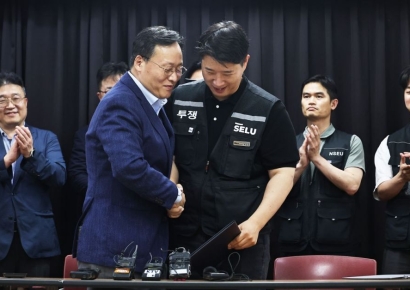 Up to 600 Million Won for Semiconductors, 160 Million Won Bonus for Loss-Making Non-Memory… Samsung Electronics Labor and Management Reach Tentative Deal on Unprecedented Performance Compensation (Comprehensive)
- "Could I Also Receive 370 Billion Won?"... No Limit on 'Stock Manipulation Whistleblower Rewards' Starting the 26th
- "From a 70 Million Won Loss to a 350 Million Won Profit with Samsung and SK hynix"... 'Stock Jackpot' Grandfather Gains Attention
- Hyundai Mobis, Key Supplier for Hyundai’s Atlas, Target Price Raised [Click eStock]
- "Who Is Visiting Japan These Days?" The Once-Crowded Tourist Spots Empty Out... What's Happening?
![Lee Chang-yong, Governor of the Bank of Korea, is holding a press conference after the Monetary Policy Committee meeting held on the 25th at the Bank of Korea in Jung-gu, Seoul. [Image source=Yonhap News]](http://www.asiae.co.kr/news/img_view.htm?img=2023052513434943160_1684989829.jpg)
Lee Chang-yong, Governor of the Bank of Korea, is holding a press conference after the Monetary Policy Committee meeting held on the 25th at the Bank of Korea in Jung-gu, Seoul. [Image source=Yonhap News]
View original image© The Asia Business Daily(www.asiae.co.kr). All rights reserved.







