Positive Assessment of Labor-Management Rule of Law One Year After 'Labor Reform'... "Lack of Public Discussion on Issues"
Labor Reform Seminar Held on the 9th Hosted by Yeouido Institute
Kim Ki-hyun: "Public Agrees There Is No Future Without Labor Reform"
The Yeouido Institute, the think tank of the People Power Party, evaluated the first year of the Yoon Suk-yeol administration's 'labor reform' on the 9th. While it viewed the government's response to labor-management conflicts based on law and principles positively, it classified the lack of public discussion on reform tasks such as improving the flexible working hours system as a remaining challenge.
On the same day, the Yeouido Institute held a seminar titled "One Year of the Yoon Suk-yeol Government: Achievements and Future Tasks of Labor Reform" at the National Assembly main building.

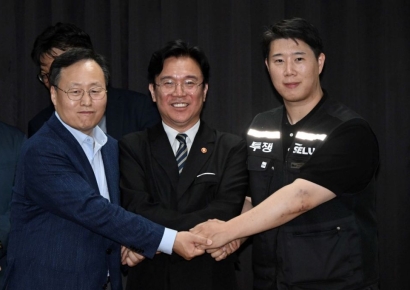
Kim Ki-hyun, leader of the People Power Party, is speaking at the discussion forum titled "One Year of the Yoon Suk-yeol Government - Labor Reform Achievements and Future Tasks" held at the National Assembly on the 9th. Photo by Kim Hyun-min kimhyun81@
View original imageSeonghee Lee, a senior research fellow at the Korea Labor Institute who delivered the presentation, analyzed that interest and support for labor reform increased following the government's principled response to last year's Cargo Solidarity strike. Lee said, "Seeing this (the response to the Cargo Solidarity strike), the public formed trust that 'the Yoon Suk-yeol government has a firm will to push forward labor reform,'" adding, "I think this trust translated into support for labor reform."
Lee Jiman, a professor in the Department of Business Administration at Yonsei University and a discussant, also positively evaluated the emphasis on 'labor legalism.' Professor Lee analyzed, "The Ministry of Employment and Labor's declaration and implementation to eradicate five major illegal acts (misuse of comprehensive wages, wage arrears, unfair labor practices, unfair hiring, workplace harassment) are highly appreciated."
From the government side, Sujin Kim, Director General of Labor Reform at the Ministry of Employment and Labor, also stated, "The foundation of labor-management legalism at the field level has been established," adding, "Measures such as voluntary inspections of union accounting documents to strengthen union accounting transparency, amendments to the Labor Union Act, eradication of employment succession, enhancement of fairness in hiring order, and operation of an online labor-management misconduct reporting center have been promoted."
Problems cited included the lack of public discussion on labor market reform tasks and insufficient social dialogue among labor, management, and government. Research fellow Lee pointed out, "Issues of labor market structural reform, such as improving the flexible working hours system and reforming the seniority-based wage system, were led by the government," adding, "There was a lack of substantial policy consultations involving labor and management organizations and 'serious' public discussions."
A representative example mentioned was the suspension of the 'maximum 69-hour workweek system.' Lee explained, "Because sufficient public discussion of the issues did not take place during the policy consultation process involving labor and management, the understanding of the reform proposal among labor, management, and the public was low," adding, "This contributed to misunderstandings about the '69-hour system' after the legislative notice."
Regarding this, Siyoung Song, Chairman of the Correct Union at Seoul Metro, also criticized, "It is regrettable that this proposal, which should have been preceded by sufficient social grand compromise, came out first while the government left aside several issues that need to be resolved through labor reform."
Hot Picks Today
 Samsung Electronics Introduces New "Special Performance Bonus" for Semiconductors, Paid Entirely in Company Shares
- "Could I Also Receive 370 Billion Won?"... No Limit on 'Stock Manipulation Whistleblower Rewards' Starting the 26th
- "From a 70 Million Won Loss to a 350 Million Won Profit with Samsung and SK hynix"... 'Stock Jackpot' Grandfather Gains Attention
- "US-Iran: Patch-Ups More Likely Than Settlement... Unlikely to Resolve Within 6 Months" [Economic Policy Zoom-In]
- "Who Is Visiting Japan These Days?" The Once-Crowded Tourist Spots Empty Out... What's Happening?
Kim Ki-hyun, leader of the People Power Party who attended the seminar, said about labor reform policies: "The establishment of legal order through firm measures against illegality, eradication of corruption at construction sites, and enhancement of union accounting transparency are directly linked to job issues and are very closely connected to the national economy, so I am confident these are tasks that must be solved," adding, "I believe many people agree that there is no future or growth without labor reform."
© The Asia Business Daily(www.asiae.co.kr). All rights reserved.







