Restoring Shuttle Diplomacy with Historical Background... Water Glass Half Full Yet
Japanese Kishida Offers Apology in Lieu of Formal Apology
Interest Grows Over Prospective Expressions at G7
Progress Seen in Dispatching Fukushima Inspection Team and Other Areas
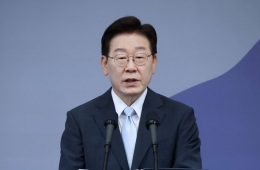
Japanese Prime Minister Fumio Kishida expressed regret instead of an apology regarding the forced labor issue, the biggest conflict in Korea-Japan relations. He mentioned, "My heart aches that you experienced sad events in harsh conditions." Although it appears to be a more progressive statement on the surface, since it was based on personal opinion and omitted the responsible party for the "harsh conditions" without specifying the subject, it has been evaluated as insufficient to be seen as a "sincere responsive measure."
At a press conference on the 7th, Prime Minister Kishida said, "I was impressed that many people, while recalling painful memories of the past, opened their hearts for the future amid efforts by the Korean government regarding the measures (solutions for compensation for forced labor) announced on March 6, following President Yoon's decision," and added, "I also feel deeply saddened that many people who worked under harsh conditions at that time had difficult and sad experiences."
Judging solely by the explicit expressions, these remarks fall short of the "clearer apology stance from the Japanese side" that many domestic public opinions have demanded since the Korean government's announcement of the forced labor compensation solution in March. Prime Minister Kishida did not clearly answer the question, "Are those who were under difficult conditions victims of forced labor?" He said, "I honestly expressed my personal feelings." While maintaining the position of expressing regret, it is interpreted as somewhat downplaying the significance by framing it as a "personal thought." There was no separate mention of Japan's participation in compensation, which was a matter of intense interest.
![[Image source=Yonhap News]](http://www.asiae.co.kr/news/img_view.htm?img=2023050721402922575_1683463228.jpg)
Glass Half Empty Still... More Progressive Remarks Possible at G7 Summit
Experts have offered contrasting evaluations. Professor Hosaka Yuji of Sejong University assessed, "He prefaced it as a 'personal story' and did not specify the subject like 'about Korean people.' It was quite insufficient content." On the other hand, former First Vice Foreign Minister Choi Jong-geon said on the radio that day, "From Kishida's perspective, he visited Korea as Foreign Minister in December 2015 and reached an agreement for an irreversible resolution of the comfort women issue, and under the Yoon Seok-yeol administration, the forced labor issue was resolved without Japan's government paying costs." Former Vice Minister Choi said about Kishida's remarks, "Although it is quite insufficient from Korea's standpoint, Kishida can now tell the international community that he has done his best sincerely."
Some expect that since the Korea-Japan leaders plan to visit the memorial for Korean atomic bomb victims during the G7 summit in Hiroshima from the 19th to the 21st, a more progressive expression of recognition from Prime Minister Kishida might emerge then.
There has been progress in areas excluding historical issues. The two leaders agreed to expand economic and security exchanges between the two countries. The finance ministers' meeting between the two countries resumed after seven years, and the economic security council and security dialogue have also started.
![[Image source=Yonhap News]](http://www.asiae.co.kr/news/img_view.htm?img=2023050809461522962_1683506775.jpg)
Fukushima Visit by Korean Experts Reflects Consideration of Our Position... Expansion of Economic Exchange
Additionally, regarding the discharge of contaminated water from Fukushima, the dispatch of a Korean expert inspection team is evaluated as Japan partially considering Korea's position. The International Atomic Energy Agency (IAEA) has formed a task force (TF) including experts from 11 countries, including Korea, to verify the safety of the contaminated water treatment process at the Fukushima Daiichi Nuclear Power Plant. Separately, Korean experts were allowed to visit the site. Related to this, Seong Il-jong, a member of the People Power Party, said, "It is an achievement that the Japanese government accepted Korea's opinion on the Fukushima contaminated water and allowed Korean experts to be dispatched," adding, "This was initiated by President Yoon Seok-yeol's decisive leadership."
Meanwhile, after discussing bilateral issues between the two governments at the Korea-Japan summit with President Yoon the previous day, Prime Minister Kishida met consecutively with politicians and business leaders from the morning of the following day, discussing cooperation at the parliamentary and corporate levels before returning to Japan in the afternoon. Kishida's first schedule that day was a meeting around 9 a.m. at a hotel in Seoul with Chung Jin-suk, chairman of the Korea-Japan Parliamentary Union and member of the People Power Party, and Yoon Ho-jung, secretary-general of the Democratic Party of Korea, discussing cooperation measures between the two parliaments to strengthen Korea-Japan economic and security cooperation.
Then, at a private meeting hosted by the Embassy of Japan in Korea at 10:15 a.m., he met with six heads of economic organizations: Choi Tae-won, chairman of the Korea Chamber of Commerce and Industry; Kim Byung-joon, acting chairman of the Federation of Korean Industries; Koo Ja-yeol, chairman of the Korea International Trade Association; Sohn Kyung-shik, chairman of the Korea Employers Federation; Kim Ki-moon, chairman of the Korea Federation of SMEs; and Choi Jin-sik, chairman of the Korea Association of Small and Medium Business, as well as Kim Yoon, chairman of Samyang Holdings and president of the Korea-Japan Economic Association.
Hot Picks Today
 "Stocks Are Not Taxed, but Annual Crypto Gains Over 2.5 Million Won to Be Taxed Next Year... Investors Push Back"
- "Groups of 5 or More Now Restricted"... Unrelenting Running Craze Leaves Citizens and Police Exhausted
- Despite Warnings of "Do Not Enter, You May Not Make It Out Alive"... Foreign Tourist Stranded After Unauthorized Climb on Jeju Sanbangsan
- AI Bubble or Real Growth? All Eyes on NVIDIA's Q1 Earnings
- "Even With a 90 Million Won Salary and Bonuses, It Doesn’t Feel Like Much"... A Latecomer Rookie Who Beat 70 to 1 Odds [Scientists Are Disappearing] ③
Prime Minister Kishida and the business leaders reaffirmed their willingness to revitalize economic exchanges between Korea and Japan following the restoration of "shuttle diplomacy." They also discussed cooperation plans between companies of both countries in advanced fields such as core minerals development for electric vehicle batteries, space, quantum technology, artificial intelligence (AI), digital bio, and future materials. Japanese media reported that Kishida told reporters before departing on the 8th, "I want to further strengthen the trust relationship with President Yoon and join forces to open a new era."
© The Asia Business Daily(www.asiae.co.kr). All rights reserved.