[New York Stock Market] First Republic Plummets, Closes Lower... Nasdaq Down 1.98%
The three major indices of the U.S. New York stock market all closed lower on the 25th (local time) as they digested corporate earnings, including those of First Republic Bank, and economic indicators. The sharp plunge in First Republic Bank's stock price reignited concerns surrounding the U.S. banking sector, delivering a direct blow to investor sentiment. After the market close, Microsoft (MS) and Google Alphabet are scheduled to release their earnings.
At the New York Stock Exchange (NYSE) that day, the Dow Jones Industrial Average fell 344.57 points (1.02%) from the previous close to finish at 33,530.83. The large-cap focused S&P 500 index dropped 65.41 points (1.58%) to 4,071.63, while the tech-heavy Nasdaq index declined 238.05 points (1.98%) to close at 11,799.16.
All sectors in the S&P 500 declined. First Republic Bank, which has been engulfed in crisis rumors since the collapse of Silicon Valley Bank (SVB), closed down 49.38% compared to the previous close after announcing a roughly 41% plunge in deposits in the first quarter. UPS fell nearly 10% after reporting earnings per share of $2.20, falling short of Wall Street expectations. On the other hand, PepsiCo rose 2.27% after beating earnings forecasts. MS and Alphabet, which are set to release earnings, closed the regular session down 2.25% and 2.0%, respectively. Leading tech stocks such as Tesla (-1.16%), Nvidia (-2.96%), Amazon (-3.43%), and Apple (-0.94%) also declined.
![[Image source=Yonhap News]](http://www.asiae.co.kr/news/img_view.htm?img=2023042605204611028_1682454047.jpg)
Investors are closely watching the flood of major corporate earnings and economic indicators this week. First Republic Bank’s first-quarter revenue and net income, released the previous day, fell 13% and 33% year-over-year, respectively. Deposits shrank by 40.8% to $104.5 billion. After the market close that day, big tech companies including MS, Alphabet, Meta Platforms (Facebook’s parent company), and Amazon are scheduled to release their first-quarter results throughout the week. Following First Republic Bank, earnings from other U.S. regional banks are also expected to pour in. The number of companies reporting earnings this week is estimated to be about one-third of the S&P 500-listed firms.
Last week’s strong earnings from major banks drove the New York stock market, so this week, earnings and future outlooks centered on big tech are expected to steer the market direction. According to FactSet, as of that morning, 76% of S&P 500-listed companies that had reported earnings exceeded expected earnings per share (EPS). However, according to Refinitiv, the overall net income of S&P 500 companies is expected to decline by 5.2% in the first quarter.
David Donabedian, Chief Investment Officer at CIBC Private Wealth US, assessed that how well big tech companies respond to high interest rates and signs of economic slowdown will be key to the market’s direction. George Ball, Chairman of Sanders Morris Harris, said, "Large tech stocks may not lead the remaining market," adding, "Economic concerns and cost-cutting due to profit margins are common themes, but earnings so far have been mixed."
With the May Federal Open Market Committee (FOMC), which sets the benchmark interest rate, approaching and officials entering a blackout period, this week will also see the release of the March Personal Consumption Expenditures (PCE) price index, a preferred inflation gauge of the Federal Reserve, along with growth rate data. Wall Street experts expect the core PCE to rise 4.5% year-over-year and 0.3% month-over-month. According to the Chicago Mercantile Exchange (CME) FedWatch, the federal funds futures market currently reflects about a 74% probability that the Fed will implement a baby step (a 0.25 percentage point rate hike) in May.
The Philadelphia Federal Reserve’s April non-manufacturing index released that day fell to -16.2, down from -0.1 the previous month. This is the worst since December 2020, and the negative figure indicates economic contraction. With inflation still high and new orders declining, the negative reading worsened. The previously released manufacturing index was -31.3.
On the same day, housing sales showed a surprising increase despite high mortgage rates. According to seasonally adjusted data from the Department of Commerce, new home sales in March rose 9.6% to 683,000 units. The S&P CoreLogic Case-Shiller February seasonally unadjusted national home price index rose 0.2% from the previous month, marking a rebound after eight months.
Additionally, the U.S. first-quarter Gross Domestic Product (GDP), scheduled for release later this week, is expected to show growth around 2%. Greg Basak, CEO of AXS Investment, said, "One reason for focusing on economic data is that investors’ narratives still revolve around the Fed and interest rates," adding, "The economic reports coming out over the next 7 to 10 days will guide what the Fed ultimately does." He also predicted that mixed economic indicators will continue to sustain uncertainty.
Concerns about the U.S. banking sector resurfaced, confirming a preference for safe-haven assets. The dollar index, which measures the value of the dollar against six major currencies, rose more than 0.5% to around 101.8. Gold futures also edged up, reaching the $2,000 per ounce level. In the New York bond market, U.S. Treasury yields fell. The 10-year Treasury yield hovered around 3.4%, while the 2-year yield, sensitive to monetary policy, was around 3.94%. The decline in Treasury yields indicates a rise in prices of these safe-haven bonds.
Hot Picks Today
!["Stock Set to Double: This Company Smiles Every Time a Data Center Is Built [Click e-Stock]"](https://cwcontent.asiae.co.kr/asiaresize/93/2026050416112750184_1777878687.jpg) "Stock Set to Double: This Company Smiles Every...
"Stock Set to Double: This Company Smiles Every...
- "Continuous Groundwater Extraction Causes Mexico City of 22 Million to Sink by 2...
- “Did They Bet Too Early?” Losses Snowball for ‘Geopverse Ants’ as KOSPI Soar...
- "Going to Seongsu-dong?" Japanese Girl Group Faces Taxi Refusal in Seoul
- "Prime Minister in Underwear?"... Italy's Meloni Posts Herself to Warn of Deepfa...
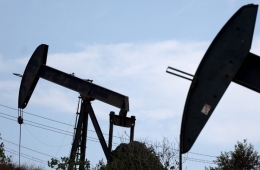
Meanwhile, risk aversion led to a drop in oil prices. On the New York Mercantile Exchange, June delivery West Texas Intermediate (WTI) crude oil closed at $77.07 per barrel, down $1.69 (2.15%) from the previous close. This is the lowest closing price since March 31.
© The Asia Business Daily(www.asiae.co.kr). All rights reserved.