Joo Ho-young Requests Yoon to Exercise Veto on Grain Management Act... "Must Prevent Malpractices"
Opposition Due to Fiscal Deterioration and Declining Agricultural Competitiveness
"It Will Ruin South Korea's Agriculture in the Long Term"
Joo Ho-young, the floor leader of the People Power Party, requested President Yoon Suk-yeol on the 29th to exercise his veto power on the amendment to the Grain Management Act.
On the same day, at the party-government council held at the Prime Minister's official residence in Samcheong-dong, Jongno-gu, Seoul, Joo said, "To prevent the adverse effects of this bill (the amendment to the Grain Management Act) and to protect both the people and farmers, I have no choice but to earnestly ask the President to exercise the constitutional right of reconsideration, which is the last remaining presidential authority," adding, "I request the President's decisive action."

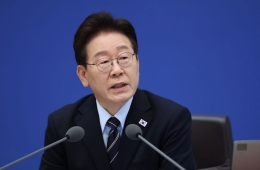
Joo Ho-young, floor leader of the People Power Party, is speaking at the party-government meeting on the Grain Management Act held at the Prime Minister's official residence in Jongno-gu, Seoul, on the 29th. Photo by Yoon Dong-joo doso7@
View original imageThe amendment to the Grain Management Act is the 'No. 1 livelihood bill' proposed by Lee Jae-myung, the leader of the Democratic Party of Korea, which mandates the government to compulsorily purchase surplus rice production when the surplus exceeds 3-5% of rice demand or when rice prices fall by 5-8% compared to the average year.
The ruling party opposes the bill, citing reasons such as fiscal deterioration due to rice purchases and a decline in agricultural competitiveness. Floor leader Joo explained, "Rice is already in a state of overproduction, and if this bill is implemented, rice production will increase even more," adding, "The government will have to compulsorily buy more and more rice, and accordingly, more and more fiscal resources will have to be投入."
He continued, "If the surplus rice continues to accumulate, the government will have to sell it off at almost throwaway prices after several years," pointing out, "This means wasting a huge amount of taxpayers' money."
Furthermore, Joo said, "If rice production increases significantly, the diversity of other grains will naturally decrease, making food security inevitably vulnerable," and added, "This bill will result in the long-term ruin of South Korea's agriculture. That is why more than 40 farmers' organizations are also opposing this bill."
Hot Picks Today
 "Stocks Are Not Taxed, but Annual Crypto Gains Over 2.5 Million Won to Be Taxed Next Year... Investors Push Back"
- "Don't Throw Away Coffee Grounds" Transformed into 'High-Grade Fuel' in Just 90 Seconds [Reading Science]
- Signed Without Viewing for 1.6 Billion Won... Jamsil and Seongbuk Jeonse Prices Jump 200 Million Won in a Month [Real Estate AtoZ]
- "Groups of 5 or More Now Restricted"... Unrelenting Running Craze Leaves Citizens and Police Exhausted
- "Even With a 90 Million Won Salary and Bonuses, It Doesn’t Feel Like Much"... A Latecomer Rookie Who Beat 70 to 1 Odds [Scientists Are Disappearing] ③
He also criticized the Democratic Party for submitting the bill directly to the plenary session on the 23rd without going through the Legislation and Judiciary Committee's resolution and passing it unilaterally. Floor leader Joo said, "Throughout the 21st National Assembly, the Democratic Party, leveraging its seats ranging from 180 to 169, has repeatedly engaged in legislative rampages," and criticized, "The victims of these rampages have been the people, but it seems they still do not fully recognize this."
© The Asia Business Daily(www.asiae.co.kr). All rights reserved.