Kim Min-seok: "'1,000 Won School Meal' Is a Democratic Party Initiative"… Urges Expansion to More Universities
Kim Min-seok, Democratic Policy Committee Chair's Debut
"Should Expand to Include Colleges up to Junior Colleges"
Proposes Local Government Contingency Fund Support and Supplementary Budget Measures
The Democratic Party of Korea has called for an expansion of the universities covered by the government and ruling party's plan to increase the budget for the '1,000 won school meal' program. Recently appointed Kim Min-seok, the new chairman of the Policy Committee following demands for personnel reform from the non-Lee Jae-myung faction within the party, made his policy debut with the issue of 'university breakfast.'
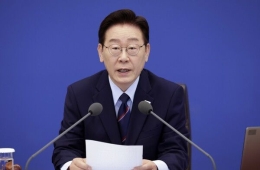
On the afternoon of the 29th, Chairman Kim held a press briefing at the National Assembly and said, "From the Democratic Party's standpoint, we welcome the normalization and restoration of the 1,000 won school meal issue," adding, "We need to expand the target schools, make the application times more flexible, and as a result, significantly increase the budget."
The government and ruling party are reportedly discussing a plan to nearly double the current project support budget from about 720 million won to approximately 1.57 billion won. Regarding this, Chairman Kim explained that the 1,000 won breakfast project has been ongoing since 2017, with the government proposing 500 million won and the Democratic Party proposing 1.5 billion won in support last year, but ultimately a budget of 1.1 billion won was passed by the standing committee (the Agriculture, Food, Rural Affairs, Oceans and Fisheries Committee). He stated, "Due to the government and ruling party's non-cooperation, the budget was cut from the main budget, so this time the government is effectively restoring what it originally should have provided."
He further argued that the budget should be expanded beyond the government's proposed 1.5 billion won.
![[Image source=Yonhap News]](http://www.asiae.co.kr/news/img_view.htm?img=2023032915131771220_1680070398.jpg)
Chairman Kim pointed out, "Including junior colleges, there are about 200 to 350 universities, but currently this project supports only around 40 schools," adding, "At this level, most schools are not covered."
He said that to expand the support budget, not only the central government but also local governments need to participate in the financial burden. He stated, "If the central government increases the budget and local governments also increase their share, universities facing financial difficulties will find it much easier to participate, allowing the program to expand nationwide," and added, "We will consult with local government-related organizations within the party."
As a plan to expand local government support, he proposed using contingency funds and supplementary budget allocations. He explained, "I think it would be good to discuss specifics such as the central government contributing slightly more than a 1:1 ratio with local governments, and among local governments, metropolitan governments bearing a bit more than a 1:1 ratio with basic local governments."
Hot Picks Today
 "Stocks Are Not Taxed, but Annual Crypto Gains Over 2.5 Million Won to Be Taxed Next Year... Investors Push Back"
- "Don't Throw Away Coffee Grounds" Transformed into 'High-Grade Fuel' in Just 90 Seconds [Reading Science]
- Signed Without Viewing for 1.6 Billion Won... Jamsil and Seongbuk Jeonse Prices Jump 200 Million Won in a Month [Real Estate AtoZ]
- [Breaking] President Lee: "Sharing operating profit before taxes are deducted?... I don't understand"
- "Even With a 90 Million Won Salary and Bonuses, It Doesn’t Feel Like Much"... A Latecomer Rookie Who Beat 70 to 1 Odds [Scientists Are Disappearing] ③
Chairman Kim emphasized, "This issue is commonly linked to the expansion of basic services, which is a challenge our society must address," and added, "Its expansion in our society is inevitable, and we will develop interest in this short-term policy into a long-term advancement."
© The Asia Business Daily(www.asiae.co.kr). All rights reserved.