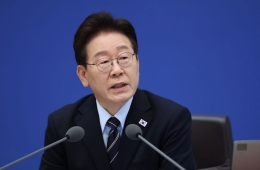
Cha Sun-do, Director of the Korea Health Industry Development Institute, "Concerns about telemedicine eased after trying it during COVID-19, many advantages found"

Cha Sun-do, President of the Korea Health Industry Development Institute, commented on the institutionalization of telemedicine amid divided opinions within the medical community, stating, "After actually implementing telemedicine in medical settings over the three years of the COVID-19 pandemic, many advantages have been discovered," and added, "I believe it will become one way for the public to receive medical benefits while reducing inconvenience." This statement was made during the first meeting held on the 7th since Cha, who has worked as a physician for over 40 years, took office last December, in response to a question about his stance on the institutionalization of telemedicine.
"Telemedicine during COVID-19 clearly has benefits"

The government temporarily allowed telemedicine at the end of 2020 through amendments to the Infectious Disease Control and Prevention Act during crisis alert levels of 'serious' or higher. Telemedicine has become a familiar scene since COVID-19, but if the World Health Organization (WHO) lifts the Public Health Emergency of International Concern (PHEIC) around the end of next month, telemedicine will become 'illegal.' This is why the government aims to institutionalize telemedicine through legal amendments by June this year. However, there is opposition from the medical community due to concerns such as misdiagnosis and deterioration of revenue structures.
President Cha said, "Doctors need to directly observe patients through auscultation, inspection, and palpation when treating them, so there is a negative sentiment toward telemedicine, and it is difficult to replace all medical care with telemedicine." However, he predicted, "Given the global disaster of COVID-19, telemedicine will definitely move in a positive direction."
President Cha also stated, "We will resume the foreign patient attraction business, which was stagnant due to COVID-19, to firmly establish Korea's status in global healthcare." This includes telemedicine options for foreign patients. Cha emphasized that Korea has indirectly provided telemedicine to foreigners based on his experience as the former head of the Daegu Medical Tourism Promotion Agency. For example, plastic surgeons in Korea observed the appearance of local Thai patients via video, and the final treatment stage was conducted in person.
President Cha said, "At least in the screening stage (checking for the presence or absence of disease), telemedicine can be a very advantageous method," adding, "Once stabilized, follow-up examinations could also be conducted." Currently, telemedicine for foreign patients is conducted mainly for pre-consultation and post-management based on the Medical Overseas Expansion Act. President Cha added, "Since telemedicine is legalized in many countries overseas, there are many requests to allow telemedicine for foreign patients in Korea as well."
"We will spare no effort to help the health industry lead in the global market competition"
Furthermore, President Cha said, "We will actively support the development of advanced healthcare technologies and strengthen the global competitiveness of our companies so that Korea's health industry can lead in global market competition." The government presented a goal last month on the 28th to become one of the six major powers in the bio-health sector through regulatory improvements, R&D support, and workforce training. The institute's health and medical research and development (R&D) budget for this year amounts to 724.4 billion KRW.
To this end, the institute plans to conduct a digital healthcare industry survey and telemedicine service policy research to foster new industries and services in response to digital transformation. They also promised to strengthen global capabilities to support overseas expansion of medical devices and pharmaceuticals and to help overcome export barriers so that the health industry can become a leading export industry in Korea. They will focus investments on next-generation core technologies such as innovative new drugs, digital therapeutics, and regenerative medical treatments, and will also undertake a national integrated bio big data construction project. Additionally, they emphasized efforts to train medical scientists and physician-scientists who will lead innovation in the future health industry.
Hot Picks Today
 "Stocks Are Not Taxed, but Annual Crypto Gains Over 2.5 Million Won to Be Taxed Next Year... Investors Push Back"
- "Don't Throw Away Coffee Grounds" Transformed into 'High-Grade Fuel' in Just 90 Seconds [Reading Science]
- Signed Without Viewing for 1.6 Billion Won... Jamsil and Seongbuk Jeonse Prices Jump 200 Million Won in a Month [Real Estate AtoZ]
- "Groups of 5 or More Now Restricted"... Unrelenting Running Craze Leaves Citizens and Police Exhausted
- "Even With a 90 Million Won Salary and Bonuses, It Doesn’t Feel Like Much"... A Latecomer Rookie Who Beat 70 to 1 Odds [Scientists Are Disappearing] ③
President Cha emphasized, "Despite the global infectious disease crisis and economic slowdown, last year the health industry achieved record-high export performance, maintaining the 7th place in export items for three consecutive years," and added, "We will do our best to successfully address the challenges facing the health industry in 2023 as well."
© The Asia Business Daily(www.asiae.co.kr). All rights reserved.