Private Academies Instead of Schools... Private Education Expenses Reach 26 Trillion Won, Highest for 2 Consecutive Years
Ministry of Education Announces 2022 Private Education Expenses Survey Results
Record High Participation Rate of 78% Among Elementary, Middle, and High School Students
Average Monthly Private Education Cost per Student 520,000 Won
Last year, both the total private education expenses and the average monthly private education expenses per person reached record highs once again since the statistics survey began. This is attributed to growing anxiety over learning deficits due to the prolonged COVID-19 pandemic.
According to the 2022 private education expenses survey conducted by Statistics Korea and the Ministry of Education on 74,000 students from 3,000 elementary, middle, and high schools, the total private education expenses amounted to 26 trillion won, an increase of 10.8% compared to the previous year. This surpassed the previous record of 23.4 trillion won set last year within just one year. The participation rate in private education also rose by 2.8 percentage points from 2021 to 78.3%.

The average monthly private education expenses per person also increased by 11.8% to 410,000 won compared to the previous year. For students participating in private education, the expenses were 524,000 won per month, up 7.9% from the previous year.
Among students participating in private education, elementary school students spent an average of 437,000 won per month (9.2% increase), middle school students 575,000 won (7.4% increase), and high school students 697,000 won (7.3% increase). Notably, the proportion of students spending more than 700,000 won per month increased by 3.3 percentage points compared to the previous year.
By school level, the total private education expenses for elementary schools (11.9 trillion won) increased by 13.1% compared to the previous year. Middle schools saw an 11.6% increase to 7.1 trillion won, and high schools a 6.5% increase to 7 trillion won.
The participation rate in private education increased by 3.2 percentage points to 85.2% for elementary schools, by 3.0 percentage points to 76.2% for middle schools, and by 1.4 percentage points to 66.0% for high schools.
![[Image source=Yonhap News]](http://www.asiae.co.kr/news/img_view.htm?img=2022082714063911223_1661576799.jpg)
Expenses for private education in general academic subjects also showed a steady increase. The average monthly expenses for general academic subjects were 310,000 won, up 10.2% from the previous year. Among all students, the subject-wise private education expenses were highest for English (123,000 won), followed by Mathematics (116,000 won), Korean (34,000 won), and Social Studies & Science (18,000 won).
For students participating in private education, the average monthly expenses for general academic subjects were 490,000 won, an increase of 6.5%. The order of expenses by subject was English (236,000 won), Mathematics (220,000 won), Korean (137,000 won), and Social Studies & Science (128,000 won).
Across elementary, middle, and high schools, the increase in private education expenses was most significant for the Korean subject. The average monthly private education expenses per person increased by 13.0% for Korean, 10.2% for English, and 9.7% for Mathematics compared to one year ago.
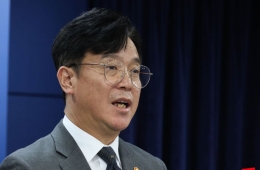
Shim Min-cheol, Director of Digital Education Planning at the Ministry of Education, analyzed, “During the COVID-19 period, elementary students’ language acquisition and literacy skills (affected by this) led to writing short texts, and the demand for compensating for learning gaps during the (face-to-face class) hiatus seems to have influenced parents.”
Looking at types of participation in general academic private education, the average monthly expenses per person for paid internet and telecommunications courses increased by 17.7% to 15,000 won last year. This growth rate was higher than that of academy attendance (13.3%) and private tutoring (2.5%).

With the 2021 College Scholastic Ability Test just three days away on the 30th, the spread of COVID-19 has not slowed, increasing anxiety among test-takers. On this day, tension fills the academy district in Daechi-dong, Gangnam-gu, Seoul. Photo by Mun Ho-nam munonam@
View original imageWhen examined by income level, households with higher average monthly incomes spent more on private education and had higher participation rates.
Households with a monthly income of 8 million won or more spent the most on private education at 648,000 won, while those with less than 3 million won spent the least at 178,000 won.
The participation rate in private education was also highest at 88.1% among households earning 8 million won or more per month, and lowest at 57.2% among those earning less than 3 million won.
The purpose of private education for general academic subjects was mainly to supplement school classes (50.0%) and for advanced learning (24.1%), while for arts and physical education-related subjects, the highest proportion was for hobbies, cultural enrichment, and talent development (63.4%).
Total spending on after-school programs was 688.6 billion won, an increase of 55.3% from the previous year, and spending on language study abroad programs was 37.6 billion won, up 205.2%.
Hot Picks Today
 "Stocks Are Not Taxed, but Annual Crypto Gains Over 2.5 Million Won to Be Taxed Next Year... Investors Push Back"
- "Don't Throw Away Coffee Grounds" Transformed into 'High-Grade Fuel' in Just 90 Seconds [Reading Science]
- Signed Without Viewing for 1.6 Billion Won... Jamsil and Seongbuk Jeonse Prices Jump 200 Million Won in a Month [Real Estate AtoZ]
- "Groups of 5 or More Now Restricted"... Unrelenting Running Craze Leaves Citizens and Police Exhausted
- "Even With a 90 Million Won Salary and Bonuses, It Doesn’t Feel Like Much"... A Latecomer Rookie Who Beat 70 to 1 Odds [Scientists Are Disappearing] ③
Meanwhile, as private education expenses set record highs for two consecutive years, the Ministry of Education plans to prepare related measures for the first time in nine years. A Ministry of Education official stated, “We will carefully analyze the results of this private education expenses survey and announce measures to reduce private education expenses within the first half of the year.”
© The Asia Business Daily(www.asiae.co.kr). All rights reserved.