Concerns Over Radiation Exposure at Punggye-ri Nuclear Test Site... Ministry of Unification Announces Full Investigation
Jeonhwangi Definition Working Group Raises Concerns in Special Report
Prosecutor from Moon Era... "Lack of Control Group and Confounding Variable Information"
As concerns were raised that radioactive materials released from North Korea's 'Punggye-ri Nuclear Test Site' could spread to hundreds of thousands of residents through groundwater, the Ministry of Unification announced plans to conduct a full survey within the year targeting North Korean defectors who may have been exposed to radiation.
Lee Hyo-jung, deputy spokesperson for the Ministry of Unification, revealed this policy during a regular briefing at the Government Seoul Office on the 24th, stating, "The government is closely monitoring the recent concerns about possible radioactive leakage around the Punggye-ri nuclear test site with great concern."
![In May 2018, North Korea's Nuclear Weapons Research Institute carried out demolition work to close the Punggye-ri nuclear test site in Kilju County, North Hamgyong Province. The photo shows the command post and construction workers' barracks being demolished. Photo by [Photographer's Name]](http://www.asiae.co.kr/news/img_view.htm?img=2023022414413435675_1677217294.jpg)
In May 2018, North Korea's Nuclear Weapons Research Institute carried out demolition work to close the Punggye-ri nuclear test site in Kilju County, North Hamgyong Province. The photo shows the command post and construction workers' barracks being demolished. Photo by [Photographer's Name]
View original imageThe Ministry of Unification plans to target 881 North Korean defectors from Kilju County, North Hamgyong Province, and nearby areas who defected after the first nuclear test in 2006. With the consent of the individuals involved, radiation exposure tests will be conducted, with the examinations expected to begin as early as the first half of this year.
An official from the Ministry of Unification explained, "At present, only the basic direction and policy have been established, but we will strive to start the survey within the first half of the year. The tests will be commissioned to specialized institutions, and we expect to have opportunities to gather opinions from related organizations during the process."
Previously, during the Moon Jae-in administration in 2017 and 2018, the Ministry of Unification conducted radiation exposure tests twice on defectors from areas near the Punggye-ri nuclear test site. The results concluded that no cases of radiation exposure requiring separate treatment or with a clear causal relationship to the nuclear tests were found.
However, the previous surveys were criticized for lacking a control group and having a limited sample size of 40 people. Additionally, the Ministry explained that it was difficult to generalize the results due to insufficient information to identify confounding variables such as smoking and heavy metal exposure.
Deputy spokesperson Lee Hyo-jung stated, "To obtain more meaningful survey results, we plan to proceed with a full radiation exposure survey starting this year with the consent of individuals from the relevant areas. The survey will be conducted alongside general health check-ups to confirm the radiation impact and health status of defectors."
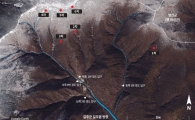
![Confluence point of surface water around the Punggye-ri nuclear test site [Provided by the Transitional Justice Working Group (TJWG)]](http://www.asiae.co.kr/news/img_view.htm?img=2023022104192130331_1676920760.jpg)
Confluence point of surface water around the Punggye-ri nuclear test site [Provided by the Transitional Justice Working Group (TJWG)]
View original imageEarlier, the transitional justice human rights organization Transition Justice Working Group (TJWG) warned in a special report titled 'Risk and Impact Mapping of Groundwater Contamination by Radioactive Materials from North Korea's Punggye-ri Nuclear Test Site' on the 21st that radioactive materials from the nuclear test site pose a risk of spreading to hundreds of thousands of residents through groundwater. This is the first comprehensive overview addressing concerns about radioactive leakage mediated by 'water.'
In particular, during the sixth nuclear test on September 2017, multiple natural earthquakes and surface deformation with ground subsidence of about 50 cm were confirmed. Professor Lee Soo-gon of the University of Seoul, who appeared as an expert witness before the National Assembly at the time, expressed concern, stating, "The continuous earthquakes after the nuclear test suggest ground fissures and radioactive leakage," adding, "The scary thing is the groundwater. It is out of control."
Furthermore, the report pointed out that smuggling and distribution of agricultural and marine products produced near the nuclear test site expose neighboring countries such as South Korea, China, and Japan to radiation risks. Pine mushrooms are the most representative example. Former President Moon Jae-in caused controversy in 2018 when he distributed 2 tons of pine mushrooms received from Chairman Kim Jong-un in Pyongyang as gifts of 500g each to about 4,000 elderly separated family members without radiation testing.
![Areas within a 40 km radius of the Punggye-ri nuclear test site and the Jangheungcheon~Namdaecheon danger zones [Provided by the Transitional Justice Working Group (TJWG)]](http://www.asiae.co.kr/news/img_view.htm?img=2023022104215530332_1676920916.jpg)
Areas within a 40 km radius of the Punggye-ri nuclear test site and the Jangheungcheon~Namdaecheon danger zones [Provided by the Transitional Justice Working Group (TJWG)]
View original imageMeanwhile, on the 24th (local time), the Transition Justice Working Group plans to attend a seminar hosted by the research foundation Forum for Reforms, Entrepreneurship, and Sustainability (FORES) in Stockholm, Sweden, where they will introduce this special report to Swedish government officials, diplomats, and researchers from various countries. Kerstin Lundgren, Vice Speaker of the Swedish Parliament, will moderate, and Lee Young-hwan, representative of the Transition Justice Working Group, and legal analyst Shin Hee-seok will present.
Related Articles
 Radioactive Materials from North Korea's Nuclear Test Site... Threat of Contamination Reaching South via Groundwater
Lee Young-hwan, representative of the Transition Justice Working Group, said, "North Korea's nuclear program has long been regarded solely as a security issue, but through this report, I hope it is recognized as a 'human rights issue' that threatens the right to life of residents and people in surrounding countries including South Korea." He emphasized, "The government must provide accurate information to defectors showing symptoms of radiation exposure and, based on the test results, urgently and thoroughly demand an investigation from North Korea."
© The Asia Business Daily(www.asiae.co.kr). All rights reserved.







