[MarketING] KOSPI Falls Below 2300 Due to Institutional Change of Heart on Ex-Dividend Date
Ex-Dividend Date Sees Institutional Selling Shift
US Tech Stocks Weakness and Tesla's Sharp Drop Also Impact Negatively
![[Image source=Yonhap News]](http://www.asiae.co.kr/news/img_view.htm?img=2022122810223766403_1672190557.jpg)
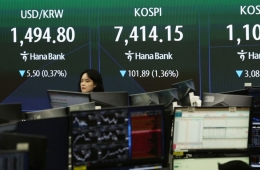
[Asia Economy Reporter Song Hwajeong] On the ex-dividend date of the 28th, the KOSPI started lower as it fell below the 2300 level during the session. Institutions turned to selling after six consecutive trading days of buying, dragging the index down along with foreign investors.
Institutions That Were Buying Hard Switch Stance on Ex-Dividend Date
As of 10:10 a.m. on the 28th, the KOSPI was at 2,280.71, down 52.08 points (2.23%) from the previous day. The KOSPI falling below the 2300 level during the session is the first time in about two months since the 3rd of last month. The KOSDAQ also gave up the 700 level in just one day, closing at 694.82, down 1.33%.
The change of heart by institutions influenced the index decline. This day was the ex-dividend date, and institutions, which had been buying for six consecutive trading days until the previous day to gain dividend profits, switched to selling immediately on the ex-dividend date. Institutions are currently net selling 591.6 billion KRW. Every year, institutions buy up until the day before the ex-dividend date and then flood the market with sell orders on the ex-dividend date. Last year, institutions bought 2.239 trillion KRW on December 28, the day before the ex-dividend date, but sold 2.3525 trillion KRW on the ex-dividend date, the 29th. They continued a six-day consecutive net buying streak until the ex-dividend date but switched to selling on the ex-dividend date and recorded nine consecutive trading days of net selling. In 2020, institutions also net bought 2.8 trillion KRW for three consecutive trading days before the ex-dividend date but net sold 2.2181 trillion KRW on the ex-dividend date.
On the other hand, individual investors, who had been selling to avoid major shareholder capital gains tax, switched to buying after six days. They are currently net buying 1.0051 trillion KRW.
Han Ji-young, a researcher at Kiwoom Securities, said, "There is downward pressure due to the release of dividend arbitrage trading volume that flowed in the previous day. However, it is necessary to consider the technical price decline adjustment due to the ex-dividend date and the reversal of individual net selling following the end of the major shareholder capital gains tax event."
Weakness in US Tech Stocks and Tesla’s Sharp Drop Also Increase Downward Pressure
The overnight weakness in tech stocks caused the US Nasdaq to fall more than 1%, and Tesla’s drop of over 11% also negatively affected stock prices.
On the 27th (local time) in the US New York stock market, the Dow Jones Industrial Average rose 0.11%, but the S&P 500 index fell 0.40%, and the Nasdaq index dropped 1.38%.
As analyses emerged that China’s easing of COVID-19 restrictions could stimulate inflation, US Treasury yields rose sharply, which negatively impacted tech stocks.
Due to news of production suspension at Tesla’s Shanghai factory, Tesla closed at $109.10, down 11.41% from the previous session. This closing price is the lowest since August 2020. Tesla’s stock price has been declining for seven consecutive trading days, marking the longest losing streak since September 2018.
Under these influences, secondary battery stocks such as LG Energy Solution and LG Chem fell more than 4%, and Samsung SDI also showed a decline in the 3% range. On the KOSDAQ, L&F fell more than 5%, Cheonbo declined in the 4% range, and EcoPro BM dropped in the 2% range.
Hot Picks Today
!["Rather Than Endure a 1.5 Million KRW Stipend, I'd Rather Earn 500 Million in the U.S." Top Talent from SNU and KAIST Are Leaving [Scientists Are Disappearing] ①](https://cwcontent.asiae.co.kr/asiaresize/93/2026051414165763158_1778735817.jpg) "Rather Than Endure a 1.5 Million KRW Stipend, I'd Rather Earn 500 Million in the U.S." Top Talent from SNU and KAIST Are Leaving [Scientists Are Disappearing] ①
"Rather Than Endure a 1.5 Million KRW Stipend, I'd Rather Earn 500 Million in the U.S." Top Talent from SNU and KAIST Are Leaving [Scientists Are Disappearing] ①
- [Breaking] Park Sukeun, Central Labor Relations Commission Chair: "Some Gaps Narrowed Between Samsung Electronics Labor and Management"
- "If That's the Case, Why Not Just Buy Stocks?" ETFs in Name Only, Now 'Semiconductor-Heavy' and a Playground for Short-Term Traders
- "I Take Full Responsibility"... Chung Yongjin Issues Direct Apology for Starbucks 'May 18 Controversy' (Update)
- "No Cure Available, Spread Accelerates... Already 105 Dead, American Infected"
Seo Sang-young, a researcher at Mirae Asset Securities, analyzed, "The decline in the Nasdaq due to the overall weakening of investor sentiment in the electric vehicle sector in the US stock market is a burden on the Korean stock market. China’s 'With Corona' move can generally have a positive effect on risk assets as it alleviates global recession concerns, but conversely, it cannot exclude the negative effect of potentially raising the globally stabilizing inflation again."
© The Asia Business Daily(www.asiae.co.kr). All rights reserved.