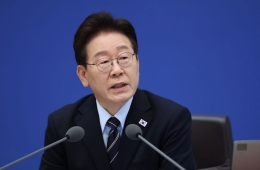
Ambassador Hwang Jun-guk to the UN: "Security Council Reform Should Expand Non-Permanent Members Through Regular Voting"

[Asia Economy New York=Special Correspondent Joselgina] The South Korean government has proposed expanding the number of non-permanent members elected by vote as part of the United Nations Security Council (UNSC) reform plan. It expressed opposition to the idea of increasing the number of permanent members with permanent status, arguing that it would rather undermine the representativeness of the UN Security Council.
Hwang Jun-guk, South Korea's Ambassador to the UN, stated at the UNSC reform-related general assembly held at the UN Headquarters in New York on the 17th (local time), "Simply increasing the number of permanent members would, in the long term, undermine the flexibility, sustainability, and representativeness of the Security Council."
Ambassador Hwang first emphasized the necessity of reform by noting that countries have found at least three points of consensus based on discussions about UNSC reform. These are: ▲agreement on the need to expand the membership of the Security Council, ▲acknowledgment of the reality that abolishing or even slightly changing the privileges of the five permanent members (P5), whether liked or not, is extremely difficult, and ▲agreement on the need to improve working methods to enhance transparency and efficiency.
However, he expressed opposition to expanding the number of permanent members. Currently, the permanent members are the United States, China, Russia, the United Kingdom, and France. Once a country becomes a permanent member, it maintains that status indefinitely. Since any one of them can veto a resolution, it effectively holds absolute power.
Ambassador Hwang pointed out, "Expanding the permanent members essentially means adding specific country names to Article 23 of the UN Charter," and "Once a name is added, it cannot be changed." For example, China and Russia are currently listed in the Charter as the Republic of China and the Soviet Union, respectively. He questioned, "Who can predict the future of international politics and the rise and fall of major powers over decades?" He noted that the permanent status would make it difficult to keep up with future changes in international affairs.
Accordingly, Ambassador Hwang proposed expanding the number of non-permanent members of the Security Council through regular elections as an alternative. He said, "If the Security Council wants to continuously reflect the evolving international reality, it must hold regular elections," adding, "Some countries say permanent members will be 'elected,' but selecting seats guaranteed permanently through a one-time vote is not a true election."
Ambassador Hwang assessed that all UN member states face the ultimate choice of whether ▲to add specific country names to Article 23 of the Charter, leaving those names permanently, or ▲to hold regular elections in an expanded council to reflect realities according to changes in international affairs. He added, "South Korea holds a flexible stance on the specific methods of elections but cannot accept the concept of adding permanent members."
He emphasized, "The Security Council must continuously reflect the changing international reality and become more sustainable and legitimate in the long term."
Currently, the push to expand permanent members is led by countries known as the G4 within the UN, including Germany, Japan, India, and Brazil. Barbara Woodward, the UK Ambassador to the UN, mentioned specific countries such as Germany, Japan, India, and Brazil during the meeting and proposed expanding the permanent members.
On the other hand, countries like Italy, Spain, Canada, Mexico, and Argentina oppose expanding permanent members like South Korea and advocate for expanding the non-permanent members instead.
Hot Picks Today
 "Stocks Are Not Taxed, but Annual Crypto Gains Over 2.5 Million Won to Be Taxed Next Year... Investors Push Back"
- "Don't Throw Away Coffee Grounds" Transformed into 'High-Grade Fuel' in Just 90 Seconds [Reading Science]
- Signed Without Viewing for 1.6 Billion Won... Jamsil and Seongbuk Jeonse Prices Jump 200 Million Won in a Month [Real Estate AtoZ]
- "Groups of 5 or More Now Restricted"... Unrelenting Running Craze Leaves Citizens and Police Exhausted
- "Even With a 90 Million Won Salary and Bonuses, It Doesn’t Feel Like Much"... A Latecomer Rookie Who Beat 70 to 1 Odds [Scientists Are Disappearing] ③
At the meeting, Linda Thomas-Greenfield, the US Ambassador to the UN and a permanent member, reaffirmed that the US position is to increase both permanent and non-permanent members. Meanwhile, China, another permanent member, insisted on maintaining the existing system, stating, "UN reform should not be exploited to serve the selfish interests of certain countries."
© The Asia Business Daily(www.asiae.co.kr). All rights reserved.