Choo Kyung-ho "Next Year's Economy Will Get Tougher... Russia's War and US Tightening Are Major Variables"
![Deputy Prime Minister and Minister of Economy and Finance Choo Kyung-ho attended a press briefing held at a hotel in Manhattan, New York, on the 11th (local time), where he shared his views on the outlook for the Korean economy. <br>[Photo by Ministry of Economy and Finance]](http://www.asiae.co.kr/news/img_view.htm?img=2022101203542864973_1665514468.jpg)
Deputy Prime Minister and Minister of Economy and Finance Choo Kyung-ho attended a press briefing held at a hotel in Manhattan, New York, on the 11th (local time), where he shared his views on the outlook for the Korean economy.
[Photo by Ministry of Economy and Finance]
[Asia Economy New York=Special Correspondent Joselgina] "It is a complex economic crisis situation. Especially, I think next year will be more difficult." On the 11th (local time), Deputy Prime Minister and Minister of Economy and Finance Choo Kyung-ho cited Russia's invasion of Ukraine, the U.S.'s high-intensity monetary tightening, and the Chinese economy as the biggest variables, stating that the current difficult economic situation is "likely to continue until next year."
Deputy Prime Minister Choo attended a press briefing held at a hotel in Manhattan, New York, and said, "It is not a situation where foreign currency funds are immediately short or financing is difficult like a foreign exchange crisis in the short term," but made this assessment. He explained, "The outlook for economic slowdown next year is overwhelmingly high," adding, "We define the current economic situation as a 'complex economic crisis' and are monitoring it 24 hours a day."
As the background for judging it a complex economic crisis, he first pointed to the sharply increased global uncertainty. He then pointed out that the macroeconomic situation is not good in a situation where high inflation is expected to lead to an economic slowdown. Lastly, he cited structural debt problems.
In particular, Deputy Prime Minister Choo said, "The biggest concerns are how the war between Russia and Ukraine will unfold and when the U.S. will stop its high-intensity tightening," and added, "China can act as a major variable for the domestic economy." Considering the characteristics of the Korean economy, which is highly dependent on external factors, he diagnosed that these variables could directly hit the economy. There is also concern that the complex economic crisis situation could expand beyond the currently expected one year and become prolonged. He expressed concern, saying, "If it remains at the current level, it is bearable, but if uncertainty amplifies, we do not know how much it will expand."
He maintained the existing forecast that domestic inflation will peak in October. Deputy Prime Minister Choo said, "Domestic grocery prices, that is, agricultural product prices, have started to stabilize considerably," but added, "However, public utility charges, personal services, dining out, etc., have downward rigidity, and the oil price part due to the Russia-Ukraine war remains uncertain." He pointed out, "From next year, inflation will stabilize, and then concerns about economic slowdown will follow."
On the same day, the International Monetary Fund (IMF) released the 'World Economic Outlook Report,' raising South Korea's economic growth forecast for this year to 2.6%, up 0.3 percentage points from the previous forecast in July. Regarding this, Deputy Prime Minister Choo said, "The second-quarter economic growth was announced after the last forecast was released, and it seems to have been revised based on that," evaluating, "Exports are not good, but consumption is solid."
The IMF's forecast for next year was lowered by 0.1 percentage points to 2.0%. Deputy Prime Minister Choo said, "Our government forecasted 2.5%, but it will be lower than that next year," effectively acknowledging that the forecast is approaching those of major institutions including the IMF. Earlier, the Organisation for Economic Co-operation and Development (OECD) also lowered South Korea's growth forecast from 2.5% to 2.2% for next year.
Deputy Prime Minister Choo also stated that he is closely watching the increasing economic instability in major advanced countries including the United Kingdom. He emphasized, "When a major economy fluctuates, it affects the global economy in various ways," adding, "We are keeping various possibilities in mind. Countries like South Korea, with an external trade dependence rate of over 70%, are inevitably exposed to greater volatility."
Regarding the soundness of the Korean financial market amid the recent surge in the won-dollar exchange rate, he said, "There is no immediate big problem," but responded, "The biggest issue is whether it will turn into a systemic risk. Uncertainty is high, so we are closely monitoring how it will spread." Regarding the Korea-U.S. currency swap, he avoided giving a specific answer but mentioned, "There is very strong trust in economic and financial cooperation between Korea and the U.S.," explaining that cooperation in the foreign exchange market is ready at any time.
When asked to compare the current economic situation with the 2008 global financial crisis, Deputy Prime Minister Choo drew a line, saying, "At that time, there was a short-term foreign currency procurement supply problem, but now that part is okay." However, he added, "It does not mean there is no sense of crisis at all. There are differences in various indicators compared to 1997 and 2008, and we are responding with our learning effects."
Deputy Prime Minister Choo will hold his first Korean economic briefing since taking office in New York on the same day. Afterwards, he will attend the G20 Finance Ministers' Meeting and the International Monetary and Financial Committee (IMFC) meeting held in Washington D.C. from the 12th to the 14th.
Hot Picks Today
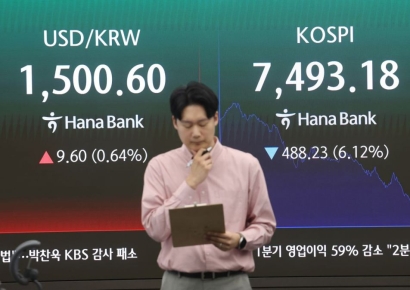 After Topping 8,000 Instead of Hitting 10,000... KOSPI Plunges—When Will It Rebound?
- "Samsung and Hynix Were Once for the Underachievers"... Hyundai Motor Employee's Lament
- [Breaking] Court Rules Against Samsung Electronics Union...1 Billion Won per Day Penalty for Exceeding Strike Scope
- Six Economic Organizations Urge Withdrawal of Samsung Electronics Strike Plan...Warn of National Loss of Opportunity
- "That? It's Already Stashed" Nightlife Scene Crosses the Line [ChwiYak Nation] ③
Deputy Prime Minister Choo emphasized again the need for structural reform, saying, "While managing the current uncertainties and increasing volatility so that they do not escalate into a short-term crisis, we must support the downward trend of growth potential and increase productivity through a structural approach," adding, "For this, fiscal soundness, labor, services, and education must go together."
© The Asia Business Daily(www.asiae.co.kr). All rights reserved.