[Good Morning Stock Market] Apple Collapses, 'Crash'... KOSPI Starts Lower Followed by Stock-Specific Movements
![[Image source=Yonhap News]](http://www.asiae.co.kr/news/img_view.htm?img=2022091422011732373_1663160477.jpg)
[Asia Economy Reporter Lee Seon-ae] On the 30th, the domestic stock market is expected to start lower. Following the collapse of the U.S. stock market, it is anticipated to open down and then show a stock-specific market trend.
The U.S. New York stock market, which had briefly rebounded the day before, collapsed again. Along with the recurrence of financial instability in the UK, the market-wide investor sentiment deteriorated as Apple, Alphabet (Google's parent company), Meta (Facebook's parent company), and Tesla wavered. The possibility that the monetary tightening policy will continue unwaveringly due to stronger-than-expected employment data also had an impact. On the 29th (local time) at the New York Stock Exchange, the Dow Jones Industrial Average, which gathers blue-chip stocks, closed at 29,225.61, down 1.54% from the previous trading day. The Standard & Poor's (S&P) 500 index, centered on large-cap stocks, recorded 3,640.47, down 2.11%, marking the lowest point of the year. The Nasdaq index, focused on technology stocks, plunged 2.84% to close at 10,737.51. Additionally, the Russell 2000 index, which focuses on small and mid-cap stocks, fell 2.35% to 1,674.93.
The decline in the stock prices of Apple, the largest market cap company, and electric vehicle maker Tesla led the index down. Apple’s stock plummeted unusually as Bank of America (BoA) downgraded both its recommendation and target price, citing a slowdown in iPhone 14 demand. Apple closed at $142.48, down $7.36 (4.91%). Tesla dropped $19.60 (6.81%) to $268.21, triggered by Piper Sandler’s pessimistic outlook on Tesla’s Q3 and Q4 shipments.
Last week, the number of new unemployment claims in the U.S. was recorded at 193,000, the lowest in five months, which ironically caused concern among investors. This result suggested that the labor market remains strong despite aggressive interest rate hikes and economic uncertainties, reinforcing expectations that the Fed will continue its high-intensity monetary tightening stance.
Meanwhile, many on Wall Street have come to believe that a recession has already engulfed the economy. Credit Suisse (CS) warned that "the worst is yet to come" and that the global economy could slow sharply. It forecasted that the U.S. growth rate this year would approach zero. Earlier, the Federal Reserve (Fed) significantly lowered its growth forecast for this year from 1.7% to 0.2% in its economic outlook released this month.
Seo Sang-young, Researcher at Mirae Asset Securities
The U.S. stock market declined as recession concerns were highlighted through high German inflation and negative earnings reports from CarMax (-24.60%) and Apple (-4.91%) with downgraded investment opinions. Additionally, UK Prime Minister Truss strongly defended government policies, stirring market anxiety, while warnings from Putin to Western countries and aggressive rate hike comments from Fed and ECB officials further dampened investor sentiment, leading to a disappearance of buying interest and an expanded decline. However, considering the weak dollar, limited rate retracement, and the robustness of commodity markets, panic selling did not escalate.
The sharp decline in the U.S. stock market, despite the weak dollar, due to negative news from some individual companies highlighting recession issues, is expected to have a negative impact on the Korean stock market. Particularly, the Philadelphia Semiconductor Index’s 3.2% drop due to the slowdown in the PC industry is a burden. However, the potential inflow of a won appreciation trend is positive. Moreover, although the U.S. stock market fell sharply, the stability shown in foreign exchange, bond, and commodity markets is noteworthy. There is a possibility that month-end and quarter-end portfolio rebalancing caused the sharp decline in the U.S. stock market, as some have suggested.
Furthermore, Micron, which announced earnings after the market close, showed improved corporate profits but missed revenue and guidance expectations. This was largely priced in due to recent declines, resulting in a sideways movement, which is positive. The Korean stock market is expected to start with a relatively mild decline of around 1% compared to the U.S. market, followed by a stock-specific market trend where rebound buying sentiment and recession concerns collide.

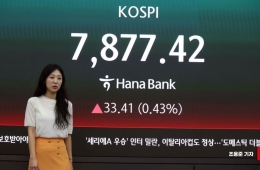
On the 29th, dealers were working in the dealing room of Hana Bank in Euljiro, Seoul. On this day, the KOSPI index opened at 2,197.75, up 28.46 points (1.31%) from the previous trading day. The won-dollar exchange rate opened at 1,424.5, down 15.4 won. Photo by Moon Honam munonam@
View original imageHan Ji-young, Researcher at Kiwoom Securities
The U.S. stock market closed sharply lower, reversing the previous day’s gains, as negative factors such as Apple’s (-4.9%) downgrade, concerns over U.S. economic contraction, hawkish remarks from Fed officials, and UK-originated instability weighed on the market despite the easing of dollar strength and rapid interest rate rises. The Dollar Index, which once exceeded 114, fell to around 111, and the U.S. 10-year Treasury yield, which had entered the 4% range, dropped to the 3.7% range, indicating that the dollar strength and rapid rate hikes are partially subsiding due to policy anticipation and recognition of a peak.
However, despite the Bank of England’s (BOE) intervention, concerns over tax revenue shortfalls and economic instability related to the UK government’s tax cut plan remain unresolved, and contrary to market expectations, Fed officials are strengthening their hawkish stance, applying downward pressure on the stock market.
James Bullard, President of the Federal Reserve Bank of St. Louis, indicated that significant inflation reduction will likely occur after next fall and emphasized a swift monetary policy response to avoid repeating the 1970s scenario. Loretta Mester, President of the Federal Reserve Bank of Cleveland, also stated that the current benchmark interest rate is not at a level that restricts the economy and that there is no visible financial distress risk to warrant halting tightening, effectively ruling out a policy shift.
The weekly initial jobless claims (193,000, consensus 215,000) came in lower than expected, indicating continued labor market strength, which supports the Fed’s rationale for high-intensity tightening. However, with two consecutive quarters of negative growth confirming a technical recession and increasing chances of Q3 contraction, official recession risks are rising, and the stock market is increasingly expecting that the tightening will be difficult to endure.
Nonetheless, since much of this has already been priced in, the optimal approach at this point appears to be adjusting portfolio weights while monitoring upcoming data such as employment (7th) and CPI (13th), rather than joining a sell-off.
Yesterday, the domestic stock market rose until mid-session, supported by external positive factors such as the surge in the U.S. stock market and a sharp drop in the exchange rate, but closed giving up gains due to individual investors’ risk-averse selling and ongoing UK-originated instability (KOSPI +0.1%, KOSDAQ +0.2%).
Today, although there are upward factors such as a falling exchange rate, declining U.S. interest rates, and recognition of bad news being priced in, the market is expected to open lower due to existing downward pressures including the Fed’s tightening-driven U.S. stock market plunge and domestic individual investors’ margin call selling. Additionally, after-hours stock prices of major U.S. semiconductor and consumer goods companies such as Micron (-1.9%, around -1% in after-hours) and Nike (-3.4%, around -9% in after-hours), which reported weak guidance and mentioned sales declines in China and cost burdens from supply shortages, are weak, likely restraining investment sentiment in related domestic stocks.
Hot Picks Today
 At President Lee's Call to "Give Enough to Shock," Whistleblower Rewards Become a Real Lottery
- If They Fail Next Year, Bonus Drops to 97 Million Won... A Closer Look at Samsung Electronics DS Division’s 600M vs 460M vs 160M Performance Bonuses
- Lived as Family for Over 30 Years... Daughter-in-Law Cast Aside After Husband's Death
- Opening a Bank Account in Korea Is Too Difficult..."Over 150,000 Won in Notarization Fees Just for a Child's Account and Debit Card" [Foreigner K-Finance Status]②
- "Who Is Visiting Japan These Days?" The Once-Crowded Tourist Spots Empty Out... What's Happening?
© The Asia Business Daily(www.asiae.co.kr). All rights reserved.