Popular Semiconductor Asset ARM...Why the Acquisition Is Not Attractive (Comprehensive)
ARM: Attractive Yet Hard to Embrace in Semiconductor Design

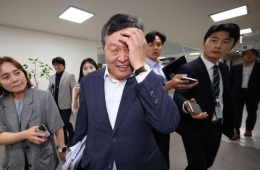
[Asia Economy Reporters Sunmi Park and Chaeseok Moon] As Samsung Electronics Vice Chairman Lee Jae-yong is expected to pursue the acquisition of the UK fabless semiconductor design company ARM during his current European trip, opinions in the semiconductor industry increasingly suggest that such a move would be realistically difficult. While the acquisition target is sufficiently attractive for domestic semiconductor companies like Samsung Electronics and SK Hynix, it is considered practically challenging to acquire and difficult to create synergy with existing businesses.
The Frequent ARM M&A Speculations
According to the semiconductor industry on the 20th, global semiconductor-related companies recently interested in acquiring the UK-based ARM are summarized domestically as Samsung Electronics and SK Hynix, and internationally as US companies Qualcomm and Intel. Previously, Nvidia attempted to acquire ARM directly but the deal fell through due to antitrust issues.
ARM, established in 1990, is a UK semiconductor intellectual property (IP) company. Its business structure focuses on designing and licensing core components such as mobile application processors (AP) and graphics processing units (GPU), which serve as the brains of smartphones. Leading global fabless companies pay royalties to ARM and use ARM's architecture to manufacture their products. ARM holds a 90% market share in mobile chip design.
The acquisition of ARM is regarded as a key to supplementing one of the major weaknesses of the Korean semiconductor industry: semiconductor design. Since the Korean semiconductor industry is strong in manufacturing but weak in design, packaging, and backend processes, voices are growing that leading Korean semiconductor companies like Samsung Electronics and SK Hynix should pursue the acquisition to achieve balanced development.
This is also why speculation about the possibility of acquiring UK-based ARM arises every time Vice Chairman Lee embarks on a European trip. Earlier this year, SK Hynix CEO Park Jung-ho publicly stated at a shareholders' meeting that they are considering securing shares in ARM.
However, the semiconductor industry places more weight on the view that it is realistically difficult for domestic companies to acquire ARM. Especially for Samsung Electronics, which serves fabless semiconductor companies as major customers and operates a foundry (semiconductor contract manufacturing) business, the immediate benefits of acquiring ARM are not significant.
Global fabless companies that pay royalties to ARM and design semiconductors may feel burdened by potential confidentiality exposure and could leave Samsung Electronics' customer base. The situation where customers would have to pay royalties to Samsung Electronics instead of ARM for semiconductor design could also be a burden from the customers' perspective. An industry insider explained, "If Samsung Electronics acquires ARM, conflicts of interest with customers could arise," adding, "Fabless companies might find Samsung burdensome."

The Uncrossable Wall of Antitrust Regulations
Antitrust issues are also a difficult challenge to resolve during the ARM acquisition process.
In fact, Nvidia's attempt to acquire ARM was thwarted when competition authorities such as the US Federal Trade Commission (FTC) and the UK Competition and Markets Authority (CMA) cast veto votes. The UK government considers ARM's acquisition by foreign peer companies as an issue of industrial technology leakage and national security.
ARM's founder Hermann Hauser even requested former UK Prime Minister Boris Johnson to exercise a veto. After SoftBank acquired ARM in 2016, following the collapse of the Nvidia deal, the industry views ARM M&A as difficult, with SoftBank shifting its focus toward an initial public offering (IPO) targeting March next year instead of a merger and acquisition.
The recent surge in ARM's valuation, as global semiconductor companies express interest in acquiring it, is also cited as a factor reducing acquisition attractiveness. When Nvidia pursued the acquisition, ARM's price was around $40 billion (approximately 54.84 trillion KRW), but recently, valuations as high as $60 billion have been mentioned.
With antitrust regulations and rising valuations, it has become impossible for a single company to acquire ARM alone, leading the industry to discuss the possibility of a consortium-based joint acquisition. A semiconductor industry official said, "As ARM has grown larger, it has become burdensome to take on various risks and acquire it alone," adding, "Forming a consortium with multiple companies to acquire it is emerging as an option, but this too is difficult due to each company's interests and antitrust issues."
Hot Picks Today
 Given Grants, Then Says "No Launch" ... Innovative Korean Technology Ultimately Forced Overseas
- "Rather Than Endure a 1.5 Million KRW Stipend, I'd Rather Earn 500 Million in the U.S." Top Talent from SNU and KAIST Are Leaving [Scientists Are Disappearing] ①
- [Breaking] Chairman Park Sookeun: "Possibility of Agreement Instead of Samsung Electronics Labor-Management Mediation Proposal"
- "If That's the Case, Why Not Just Buy Stocks?" ETFs in Name Only, Now 'Semiconductor-Heavy' and a Playground for Short-Term Traders
- "No Cure Available, Spread Accelerates... Already 105 Dead, American Infected"
Even without acquiring the now more expensive ARM, the emergence of alternatives capable of semiconductor design is another factor reducing acquisition appeal. Efforts within the semiconductor industry to reduce dependence on ARM have advanced, with increasing moves to utilize the open-source RISC-V as an alternative to ARM.
© The Asia Business Daily(www.asiae.co.kr). All rights reserved.
![Cheaper Than Candy, Yet Impossible to Find... Fears of a 'Pediatric Medical Crisis' as Pharmaceutical Companies Halt Production [Why&Next]](https://cwcontent.asiae.co.kr/asiaresize/307/2026051910065268365_1779152813.jpg)