Jeong Cheong-rae's 'Endurance' Push Distances Science and ICT Committee Normalization... Growing Legislative and Audit Tasks Pose Challenges
Controversy Over Dual Positions: Jeong Cheong-rae Says, "Withdrawal of Lee Jae-myung's Lawsuit Is Also a Precedent, Hope They Follow the Law Well"
Opposition Continues to Boycott Meetings Demanding Resignation... "Shameless Resistance for Dual Positions"
Public Broadcasting Power Struggle and ICT Legislative Issues, National Audit Preparations Neglected

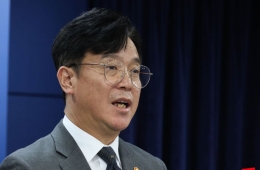
Jeong Cheong-rae, Supreme Council Member of the Democratic Party of Korea and Chairman of the National Assembly Science, Technology, Broadcasting, and Communications Committee.
View original image[Asia Economy Intern Reporter Yunjin Kim] Jeong Cheong-rae, chairman of the National Assembly Science, Technology, Information and Broadcasting and Communications Committee (STIBC), drew a line by stating that he has no intention of resigning from his chairmanship amid the controversy over holding concurrent positions as a top member of the Democratic Party of Korea.
On the 13th, Chairman Jeong appeared on MBC Radio's "Kim Jong-bae's Focus" and firmly stated, "I will not resign." This was in response to Jeong Jin-seok, the Deputy Speaker of the National Assembly, announcing his intention to resign from the Deputy Speaker position after taking on the role of emergency committee chairman of the People Power Party. On the same day, Chairman Jeong also posted on his Facebook, referring to the investigation of Democratic Party leader Lee Jae-myung by the prosecution and police, saying, "According to political customs, lawsuits and complaints during the presidential election process are usually withdrawn after the election," and retorted, "You who demand adherence to customs, please follow the law properly," emphasizing his lack of intention to resign.
The ruling party fiercely criticized Chairman Jeong, accusing him of "holding out to maintain concurrent positions." Heo Eun-ah, a People Power Party member of the STIBC, wrote on her Facebook on the 13th, "This is not about customs but about shamelessness," and pointedly said, "First, show respect to the ruling party members." Shin Ju-ho, deputy spokesperson for the People Power Party, issued a statement the same day, urging Chairman Jeong to resign from the STIBC chairmanship, saying, "Why ignore public sentiment that demands resignation not because of customs but because the chairman of a standing committee must maintain neutrality?"
The National Assembly STIBC has already been at a standstill, repeatedly holding half meetings since the first session due to extreme confrontation between the ruling and opposition parties. The People Power Party protested that Chairman Jeong operated the committee unilaterally by △ unilaterally notifying the schedule of the first plenary meeting and proceeding with the meeting △ forming a subcommittee solely with the Democratic Party without appointing a minority party secretary △ monopolizing the chairmanship of the STIBC and the 2nd subcommittee by the Democratic Party, and declared a boycott of the meetings. Chairman Jeong countered that the ruling party was insincere in schedule negotiations and blamed the People Power Party for causing disruptions by not attending meetings, which hindered the formation of the STIBC and policy discussions.
Furthermore, the conflict intensified when Chairman Jeong was elected as a top member of the Democratic Party on the 14th of last month, raising controversy over holding concurrent positions as a standing committee chairman and party leadership. People Power Party members of the STIBC took a strong stance by issuing a resolution on the 7th demanding Chairman Jeong’s resignation. In their collective statement, they declared, "He has abandoned his responsibilities as chairman and must be considered to have already lost that qualification," pressuring Chairman Jeong to step down.
The main reason why both ruling and opposition parties are putting all their efforts into gaining control of the STIBC is the bill to reform the governance structure of public broadcasting. The Democratic Party pointed out that the current structure allows the ruling party’s influence in recommending public broadcasting directors and presidents, and has proposed a bill as a party resolution to expand and reorganize the public broadcasting board into a "Public Broadcasting Operating Committee," including personnel from broadcasting-related academic societies and professional organizations. The People Power Party opposes this, claiming it is an attempt to permanently seize control of public broadcasting by using pro-Democratic civic groups.
The 2nd subcommittee of the STIBC (Information and Communications Broadcasting Bill Review Subcommittee), which handles the Broadcasting Communications Commission Act and the Korea Broadcasting Culture Promotion Foundation Act related to public broadcasting governance, is especially the focus of attention from both parties. On the 18th of last month, after People Power Party members left the STIBC plenary meeting, Democratic Party lawmaker Jo Seung-rae was appointed as the chair of the 2nd subcommittee, prompting strong opposition from the ruling party, which argued that "it is customary for the STIBC chair and the 2nd subcommittee chair to be held by different parties." However, Chairman Jeong made it clear that he would not relinquish the subcommittee chairmanship, stating, "During the first half of the 21st National Assembly, they held the 2nd subcommittee chair for two years, so the Democratic Party should take it in the second half."
Hot Picks Today
 "Stocks Are Not Taxed, but Annual Crypto Gains Over 2.5 Million Won to Be Taxed Next Year... Investors Push Back"
- "Don't Throw Away Coffee Grounds" Transformed into 'High-Grade Fuel' in Just 90 Seconds [Reading Science]
- Signed Without Viewing for 1.6 Billion Won... Jamsil and Seongbuk Jeonse Prices Jump 200 Million Won in a Month [Real Estate AtoZ]
- "Groups of 5 or More Now Restricted"... Unrelenting Running Craze Leaves Citizens and Police Exhausted
- "Even With a 90 Million Won Salary and Bonuses, It Doesn’t Feel Like Much"... A Latecomer Rookie Who Beat 70 to 1 Odds [Scientists Are Disappearing] ③
As the tug-of-war between the ruling and opposition parties intensifies, the STIBC’s tasks such as agenda review and preparation for the national audit remain neglected without even discussion. Aside from the public broadcasting governance reform bill, which is the main battleground for control, major ICT (Information and Communications Technology) issues such as preventing free-riding on telecommunications networks by large content providers (CPs) have not even begun legislative discussions. Although preparations for the national audit starting on the 4th of next month are necessary, it is expected that procedures requiring bipartisan agreement, such as witness selection, will be difficult.
© The Asia Business Daily(www.asiae.co.kr). All rights reserved.