Ministry of Agriculture, Food and Rural Affairs to Exceed 17 Trillion Won Budget for the First Time Next Year... 10.7 Billion Won Invested in Powdered Rice Project
[Asia Economy Sejong=Reporter Kim Hyewon] The Ministry of Agriculture, Food and Rural Affairs announced on the 31st that it has prepared next year's budget at 17.2785 trillion won, an increase of 2.4% compared to this year. This is the first time the ministry's annual budget has exceeded 17 trillion won.
The ministry focused its budget on increasing the self-sufficiency rate of major grains and strengthening food security functions to secure food sovereignty.
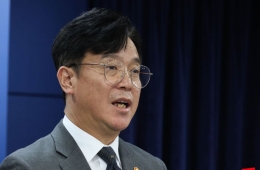
First, a total of 10.7 billion won (including 3.6 billion won from the Rural Development Administration) will be invested to revitalize the powdered rice industry. This is the first time a budget has been allocated for the powdered rice industry. The budget is allocated as follows: 3.1 billion won for fostering 40 specialized powdered rice cultivation complexes, 2.5 billion won for 15 manufacturing and processing companies to develop high-quality products using powdered rice, and 1.5 billion won for securing consumer distribution channels. Kim Injoong, Vice Minister of the Ministry of Agriculture, Food and Rural Affairs, said, "We plan to steadily promote related projects to replace 10% of imported wheat flour demand with powdered rice by 2027."
Wheat stockpiles have been increased (from 14,000 tons·15.6 billion won to 20,000 tons·24.5 billion won), and the purchase price for soybean stockpiles has been raised (from 4,032 won/kg·106.8 billion won to 4,489 won/kg·123.4 billion won). The scale of joint sorting cost support has been expanded (from 20,000 tons·1.1 billion won to 30,000 tons·1.7 billion won), increasing the budget for stabilizing wheat and soybean supply (from 193.5 billion won to 234 billion won). In addition, a strategic crop direct payment (72 billion won) has been introduced to expand wheat and soybean production and alleviate rice supply and demand issues. This is to increase the domestic self-sufficiency rate of wheat and soybeans, which have a high import ratio. A new loan fund totaling 50 billion won (with 1.3 billion won in interest subsidies) will also be provided to help private companies secure overseas food supply chains (one grain elevator).

The ministry also emphasized raising the added value of agriculture and developing new industries by fostering young farmers, spreading smart agriculture and digital transformation, and revitalizing the agricultural industry innovation ecosystem.
To actively promote the cultivation of 30,000 young farmers, the settlement support fund needed in the early unstable income farming stage will be increased from an average of 900,000 won to 1 million won, and the selection scale will be expanded from 2,000 people (38.9 billion won) to 4,000 people (55.1 billion won). The interest rate on start-up funds will be lowered by 0.5 percentage points from 2% to 1.5% to ease financial burdens.
A system will be introduced to lease farmland to young farmers for up to 30 years (20 hectares·8.2 billion won) and transfer ownership of the farmland after the lease period. In addition, idle farmland and public land will be maintained as cultivable farmland and provided (6 hectares·5.4 billion won) so that young farmers can utilize them, solving farmland acquisition issues.
Smart greenhouses will be installed on public rental stockpiled farmland and leased to young farmers (6 hectares·4.5 billion won), and the creation of public rental housing complexes equipped with convenience facilities for young households will be expanded (from 1 site·800 million won to 4 sites·4.8 billion won).
Additional installations will include rental-type smart farms (3 sites·57 billion won), smart horticulture complexes (20 hectares·5.9 billion won), and open-field smart farms (3 sites·5.7 billion won). To digitally transform the entire process of agricultural production, distribution, and consumption, a nationwide online wholesale trading platform for agricultural products (new·4.6 billion won) and an integrated support system for managing smart production and distribution facilities (new·3 billion won) will be established.
Furthermore, to reduce farmers' production cost burdens caused by rising raw material prices, fertilizer price increases will be discounted by 80% for sale (100 billion won·6 months' worth) following this year, and a total of 1 trillion won in feed purchase funds will be provided at low interest rates (1.8%).
The agricultural direct payment and agricultural disaster insurance systems will also be reformed. Direct payments will be provided to actual cultivators who were previously excluded due to eligibility restrictions (560,000 people·170,000 hectares·300 billion won), and the range of crops covered by agricultural disaster insurance will be expanded (from 67 crops·438.1 billion won to 70 crops·468.6 billion won) to support farmers' income stability.
To systematically support carbon neutrality in the agricultural sector, 2.1 billion won will be spent to establish the Agriculture and Food Climate Change Response Center.
The budget for fostering a healthy companion animal culture and the companion animal industry will also be expanded. To improve awareness and increase adoption rates of lost and abandoned animals, two adoption specialized centers (2 sites·200 million won) will be established in urban areas, and development of customized pharmaceuticals and medical services for companion animals (from 6.7 billion won to 9 billion won) and research on standardizing veterinary hospital treatment items will be expanded (from 400 million won to 1.8 billion won).
Hot Picks Today
 "Stocks Are Not Taxed, but Annual Crypto Gains Over 2.5 Million Won to Be Taxed Next Year... Investors Push Back"
- "Don't Throw Away Coffee Grounds" Transformed into 'High-Grade Fuel' in Just 90 Seconds [Reading Science]
- Signed Without Viewing for 1.6 Billion Won... Jamsil and Seongbuk Jeonse Prices Jump 200 Million Won in a Month [Real Estate AtoZ]
- "Groups of 5 or More Now Restricted"... Unrelenting Running Craze Leaves Citizens and Police Exhausted
- "Even With a 90 Million Won Salary and Bonuses, It Doesn’t Feel Like Much"... A Latecomer Rookie Who Beat 70 to 1 Odds [Scientists Are Disappearing] ③
The Ministry of Agriculture, Food and Rural Affairs will submit the budget proposal to the National Assembly on the 2nd of next month, and it is expected to be finalized at the end of the year after review and approval.
© The Asia Business Daily(www.asiae.co.kr). All rights reserved.