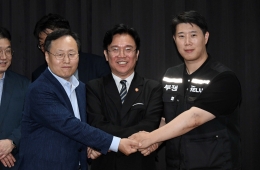
Yoon Chairs First Regulatory Innovation Strategy Meeting... 'Rationalizing Regulations in Veterans Affairs, Insurance, and Economy'
Meeting at a Robot Company in Daegu Seongseo Industrial Complex
943 Regulatory Innovation Tasks Identified, 194 Improved Since New Government Inauguration
Basic Pension for National Veterans Receiving Veterans' Compensation
Claims for Actual Expense Insurance Possible Without Hospital Visit
Yoon: "Regulatory Innovation Is a Livelihood and Economic Issue, Not Ideological or Political"
![[Image source=Yonhap News]](http://www.asiae.co.kr/news/img_view.htm?img=2022082612344410552_1661484884.jpg)
[Asia Economy Sejong=Reporters Kim Hyewon and Lee Gimin] From now on, national veterans who receive veterans' compensation will also be eligible for the basic pension. In addition, medical data can be transmitted to third-party institutions without visiting hospitals, enabling claims for actual expense insurance, among other benefits. Excessive economic penalty regulations that hinder business activities will be reduced to administrative sanctions or have their penalties rationalized. The waste recycling industry will switch to a negative regulation system, creating a new market worth over 200 billion KRW.
The Office for Government Policy Coordination reported these key points in the "Status of Regulatory Innovation Promotion and Future Plans" at the first Regulatory Innovation Strategy Meeting chaired by President Yoon Seok-yeol on the 26th.

◆Accelerating Regulatory Innovation by Amending Enforcement Decrees and Rules= Since the launch of the new government, a total of 943 regulatory innovation tasks have been identified, with 194 (21%) completed over three months. Of the 749 tasks currently being pursued by 39 ministries and agencies, 434 (58%) are planned to be completed by the end of the year. Among these, 583 are administrative legislative tasks involving amendments to enforcement decrees and rules, while 211 require legislative amendments that must pass through the National Assembly.
At 10 a.m. that day, President Yoon, presiding over the meeting at Ajinextek, a robot-specialized company located in the Seongseo Industrial Complex in Daegu, reiterated the "regulatory sandbag" metaphor, emphasizing that "regulatory innovation is not an ideological or political issue but a matter of people's livelihood and the economy." President Yoon also expressed his intention to negotiate with the National Assembly to introduce 'regulatory impact analysis' for member-initiated legislation on par with government-initiated legislation.
Among the major regulatory innovation tasks, the amendment of the Enforcement Decree of the Basic Pension Act stands out, expanding basic pension payments to national veterans and benefiting about 15,000 people. This was achieved by excluding a portion of veterans' compensation from the basic pension income calculation.
Additionally, the safety certification target for electric vehicle chargers will be expanded from 200kW or less to 400kW or less, which is expected to reduce charging time from about one hour to within 20 minutes. The Ministry of Trade, Industry and Energy plans to amend the Enforcement Rules of the Electrical Appliances Safety Control Act within the year.
The regulatory relaxation allowing personal medical data to be directly transmitted to third-party institutions upon individual request requires the Ministry of Health and Welfare to propose a bill and pass the National Assembly. The resolution of security processing requirements for satellite image distribution will be relaxed from a 4m to a 1.5m resolution standard, which is expected to promote investment and service development by related companies and help create new markets. The Ministry of Justice will revise guidelines in October to significantly ease visa issuance requirements for foreigners employed by companies returning to Korea.
◆Reexamining Economic Penalty Provisions and Switching Environmental Regulations to Negative Regulation= The task force for improving economic penalty provisions has prepared decriminalization and rationalization measures for 32 penalty provisions under 17 laws across 10 ministries. If the legislative purpose can be sufficiently achieved through administrative sanctions stipulated in existing laws, penalty provisions will be deleted or excluded.
Acts by food service operators to attract customers, which previously incurred penalties of up to three years imprisonment or fines up to 30 million KRW under the Food Sanitation Act, will be excluded from criminal penalties and replaced with permit or registration cancellations and business suspension regulations. Furthermore, minor administrative violations such as failure to report or notify changes will be considered non-criminal order violations and penalties will be converted to fines.
Hot Picks Today
!["It Has Now Crossed Borders": No Vaccine or Treatment as Bundibugyo Ebola Variant Spreads [Reading Science]](https://cwcontent.asiae.co.kr/asiaresize/93/2026052019230771274_1779272587.jpg) "It Has Now Crossed Borders": No Vaccine or Treatment as Bundibugyo Ebola Variant Spreads [Reading Science]
"It Has Now Crossed Borders": No Vaccine or Treatment as Bundibugyo Ebola Variant Spreads [Reading Science]
- Blue House Thanks Labor and Management of Samsung Electronics for Their Magnanimous Decision
- "From a 70 Million Won Loss to a 350 Million Won Profit with Samsung and SK hynix"... 'Stock Jackpot' Grandfather Gains Attention
- "Stocks Are Not Taxed, but Annual Crypto Gains Over 2.5 Million Won to Be Taxed Next Year... Investors Push Back"
- "Who Is Visiting Japan These Days?" The Once-Crowded Tourist Spots Empty Out... What's Happening?
Items with low harmfulness and good recyclability will be easily recognized as circulating resources and freed from waste regulations. This is achieved by introducing a waste regulation special exemption system (regulatory sandbox) and activating recycling environmental assessments, transitioning to an open (negative) regulation system that greatly expands recyclable targets. The government expects to save 211.4 billion KRW annually in waste disposal costs and create new value exceeding 200 billion KRW annually through expanded recycling.
© The Asia Business Daily(www.asiae.co.kr). All rights reserved.