[Weekly Review] Expected Inflation Hits Record High of 4.7%... Korea-US Base Interest Rate Inversion

On the 25th, as vegetable and fruit prices rise due to the heatwave and monsoon, citizens are shopping at a large supermarket in downtown Seoul. Photo by Moon Honam munonam@
View original image[Asia Economy Sejong=Reporter Dongwoo Lee] As the consumer price inflation rate entered the 6% range for the first time in 24 years, the expected inflation rate (the anticipated consumer price inflation rate for the next year) surged by 0.8 percentage points in just one month, reaching an all-time high. On the other hand, the housing price outlook index fell to a record low due to the impact of rising interest rates.
According to the "July Consumer Sentiment Survey Results" released by the Bank of Korea on the 27th, the expected inflation rate this month rose by 0.8 percentage points from the previous month to 4.7%, the highest level since the related statistics began in 2008. The expected inflation rate has been on the rise for seven consecutive months since January (2.6%). After entering the 3% range in April (3.1%) and rising to 3.9% in June, it soared to nearly 5% this month.
Although the expected inflation rate had previously risen to 4.6% and 4.3% during past periods of rapid inflation in 2008 and 2011 respectively, these levels were lower than this month's figure. In particular, the 0.8 percentage point increase is the largest since the related statistics began in 2008. The inflation perception index, which reflects the judgment on consumer price inflation over the past year, also rose sharply by 1.1 percentage points from the previous month to 5.1%, marking the largest increase on record.
![[Weekly Review] Expected Inflation Hits Record High of 4.7%... Korea-US Base Interest Rate Inversion](http://www.asiae.co.kr/news/img_view.htm?img=2022072710113965265_1658884300.jpg)
Q2 Economy Grows 0.7%... Annual Target Achievement 'Precarious' Due to Export Decline
South Korea's real Gross Domestic Product (GDP) growth rate for the second quarter of this year recorded 0.7%, supported by a recovery in private consumption. Although it outperformed market expectations, exports, which underpin the Korean economy, have slowed, and concerns about an economic downturn in the second half of the year are spreading, making it difficult to achieve the annual growth target.
According to the Bank of Korea on the 26th, South Korea's real GDP (preliminary figure) for the second quarter grew 0.7% quarter-on-quarter and 2.9% year-on-year. Despite a decrease in exports and other factors, private consumption increased due to the lifting of all social distancing measures since April 18, raising the growth rate by 0.1 percentage points compared to the first quarter (0.6%).
By sector, private consumption increased by 3.0%, driven by higher spending on semi-durable goods such as clothing and footwear, as well as services like food, accommodation, and entertainment. Government consumption rose by 1.1%, mainly due to social security benefits in kind, and construction investment increased by 0.6%, centered on building construction.
Hwang Sang-pil, Director of Economic Statistics at the Bank of Korea, said, "The contribution of net exports to growth turned negative from 1.7 percentage points in Q1 to -1.1 percentage points in Q2, while the contribution of domestic demand shifted from -1.1 percentage points to 1.8 percentage points during the same period."
Interest Rate Inversion Between Korea and the U.S... Bank of Korea Faces Deep Concerns Over 'Capital Outflow and Economic Slowdown'
With the inversion of benchmark interest rates between Korea and the U.S. for the first time in two and a half years, attention is focused on the potential impact on the Korean financial market. The Bank of Korea and the government expect the financial market impact from the rate inversion to be limited, citing past cases. However, concerns remain that the damage could be greater than before due to recent global inflation intensification and supply chain instability amid unfavorable domestic and international economic conditions. As major countries like the U.S. rapidly raise rates and economic slowdown forecasts grow, the Bank of Korea's deliberations ahead of next month's Monetary Policy Committee meeting are becoming more intense.
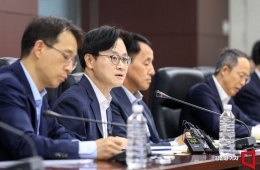
On the morning of the 28th, Deputy Prime Minister and Minister of Economy and Finance Choo Kyung-ho and Bank of Korea Governor Lee Chang-yong held an emergency macroeconomic and financial meeting at the Seoul Banking Hall with Financial Services Commission Chairman Kim Ju-hyun and Financial Supervisory Service Governor Lee Bok-hyun to discuss countermeasures against the U.S. Federal Reserve's giant step rate hike. Deputy Prime Minister Choo said in his opening remarks, "The recent Fed decision largely met market expectations," and "the impact on the domestic financial market is expected to be limited." He explained that despite the U.S. benchmark rate surpassing Korea's, the possibility of foreign capital outflow from Korea is not significant.
The Fed raised its benchmark interest rate by 0.75 percentage points at the Federal Open Market Committee (FOMC) overnight, from 1.50-1.75% to 2.25-2.50%, causing an inversion where the U.S. rate exceeded Korea's 2.25%. This is the first inversion in about two and a half years since February 2020 and the fourth time in history. Previous inversions occurred during June 1996 to March 2001, August 2005 to September 2007, and March 2018 to February 2020.
Deputy Prime Minister Choo said, "Although there have been three previous inversions, foreign securities investment funds actually maintained net inflows," adding, "Economic fundamentals and appropriate responses have a more significant impact on capital flows."
![[Weekly Review] Expected Inflation Hits Record High of 4.7%... Korea-US Base Interest Rate Inversion](http://www.asiae.co.kr/news/img_view.htm?img=2022072810175966905_1658971079.jpg)
Consumption Declines for Four Consecutive Months Amid 'High Inflation Shock'... First Time in 24 Years Since IMF Crisis
Domestic consumption has contracted for four consecutive months due to the sharp rise in prices. This is the first time in about 24 years since early 1998 that consumption has decreased for four straight months.
According to the "June Industrial Activity Trends" released by Statistics Korea on the 29th, the seasonally adjusted retail sales index for last month was 118.3 (2015=100), down 0.9% from the previous month. The retail sales index has declined for four consecutive months since March (-0.7%), continuing through April (-0.3%) and May (-0.2%). The last time consumption decreased for four consecutive months was from October 1997 to January 1998, about 24 years and 5 months ago.
Oh Woon-seon, Director of Economic Trends Statistics at Statistics Korea, explained, "There were some disruptions in vehicle deliveries due to freight transport issues in June," and "due to hotter-than-usual weather, demand for outdoor activities decreased, leading to a drop in semi-durable goods sales. Additionally, inflation and interest rate hikes somewhat dampened consumer sentiment."
The seasonally adjusted total industrial production index (excluding agriculture, forestry, and fisheries) for June was 117.9 (2015=100), up 0.6% from the previous month. This marks two consecutive months of increase following May's 0.8%. Manufacturing led the growth with a 1.8% increase, the largest since December last year (3.5%), driving the overall industrial production increase. Conversely, the service sector declined by 0.3%. Facility investment rose by 4.1%, while construction output decreased by 2.0%.
Minister of Industry Lee Chang-yang: "Utilize Nuclear Power to Address Climate Crisis... Proactively Foster New Industries"
On the 29th, Lee Chang-yang, Minister of Trade, Industry and Energy, stated, "We will actively utilize nuclear power to strengthen energy security and respond to the climate crisis."
During a briefing to the National Assembly's Industry, Trade, Small and Medium Enterprises Committee, Minister Lee said, "We will promptly restore the nuclear power industry ecosystem through nuclear power exports and early supply of orders, and proactively foster new industries in areas such as hydrogen and renewable energy." He also emphasized, "We will improve the energy-intensive and low-efficiency system through energy demand efficiency and rationalize the electricity market based on market principles."
Hot Picks Today
 Cerebras Soars 70% on IPO Debut: Is Nvidia's Reign Ending as a New AI Semiconductor Power Emerges?
- "After Vowing to Become No. 1 Globally, Sudden Policy Brake Puts Companies’ Massive Investments at Risk"
- Even the Wealthy Ask, "Is It Okay to Enter Now?"... Flocking In With Cash Bundles [Wealth Investment Strategies] ⑨
- "Will the Elevator Beep When I Get In?"... Larger Bodies, Unchanged Elevator Standards
- "He's Handsome, It's Such a Pity?"... Lawyer Responds to Bizarre 'Appearance Evaluation' of High School Girl Murder Suspect
Minister Lee stressed the need for a major industrial transformation considering difficult domestic and international conditions. He said, "Given the circumstances, it is time for an 'industrial transformation' that continuously creates future growth engines centered on advanced industries and innovates key industries into high value-added sectors," adding, "We will take the lead in realizing industrial transformation by mobilizing all policy tools in the industrial, trade, and energy sectors."

Minister Lee Chang-yang of the Ministry of Trade, Industry and Energy is attending the government questioning session on economic affairs held at the National Assembly on the 26th, responding to questions from lawmakers. Photo by Yoon Dong-joo doso7@
View original image© The Asia Business Daily(www.asiae.co.kr). All rights reserved.