[Good Morning Stock Market] Will the Recession Concerns Fired by Apple Stop KOSPI's Rally?
Concerns Over Job Cuts Cool Investor Sentiment
Apple Components and Semiconductor Stocks Expected to Decline
![[Good Morning Stock Market] Will the Recession Concerns Fired by Apple Stop KOSPI's Rally?](http://www.asiae.co.kr/news/img_view.htm?img=2022042709371645537_1651019836.jpg)
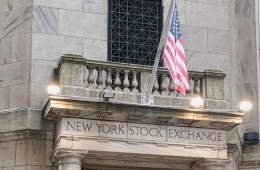
[Asia Economy Reporter Minji Lee] The US stock market closed lower, reflecting concerns about an economic recession. The announcement of employment reduction plans by global companies including Apple intensified economic uncertainty. On the 19th, the KOSPI is expected to open lower, influenced by the US stock market.
Sangyoung Seo, Researcher at Mirae Asset Securities: “US stock market decline due to Apple’s impact”
![[Image source=Yonhap News]](http://www.asiae.co.kr/news/img_view.htm?img=2022010308481484324_1641167294.jpg)
Among the three major US indices, the Dow Jones Industrial Average closed down 0.69% compared to the previous trading day. The Nasdaq fell 0.81%, and the S&P 500 dropped 0.84%.
In the early session, a surge in the cryptocurrency market expanded risk appetite. The cryptocurrency market had been in a steep decline due to the Terra and Luna incidents and the Fed’s rapid interest rate hikes. However, after the news that Ethereum will switch its consensus algorithm from Proof of Work (PoW) to Proof of Stake (PoS) on September 19, it continued to rise, leading to gains in Bitcoin and related stocks.
However, influenced by Apple, the US stock market ended the session lower. Apple closed down over 2% that day. News that the company would reduce employment and spending to respond to the economic recession triggered a sharp sell-off, turning the market downward. Recently, many companies including Alphabet announced plans to reduce employment citing recession concerns, and Apple’s participation added to the drag from recession fears. Nonetheless, considering that retail sales indicators were favorable, this trend is expected to be temporary rather than sustained.
The US stock market’s sell-off due to Apple’s employment cuts is negative for the domestic stock market. It could pressure semiconductor stocks and affect investor sentiment toward Apple’s component suppliers. Particularly concerning is that recession fears are impacting the stock market.
However, expectations remain for additional stimulus measures from China to stabilize the economy in the second half of the year, and some investment firms have expressed positive outlooks on the electric vehicle industry. Therefore, a solid trend centered on electric vehicles and secondary batteries is expected.
Jinwoo Lee, Researcher at Meritz Securities: “If a recession occurs, it will be short-lived... market resilience is improving”
We should focus not on whether a recession will occur, but on what kind of recession it will be if it does. Considering the current financial market environment, the possibility of a structural recession is low.
![[Good Morning Stock Market] Will the Recession Concerns Fired by Apple Stop KOSPI's Rally?](http://www.asiae.co.kr/news/img_view.htm?img=2022071908000954642_1658185210.png)
Gross Domestic Product (GDP) is calculated as the sum of consumption, investment, government spending, and net exports. During the 2008 financial crisis, prolonged burdens on consumption, investment, and inventory caused a complex shock. The 2000 recession caused by the IT bubble was more of a financial market shock than a real economy shock such as consumption or investment. The 1970 recession was marked by a significant shock to the consumption sector due to sustained high inflation.
Currently, there is no sharp decline in consumption or investment. It remains to be seen whether consumption contraction will deepen with a time lag, but unless high inflation like that of the 1970s persists for a long time or the crisis spreads due to debt issues, the likelihood of a recession similar to those in the 1970s or 2008 is low. If inflationary pressures begin to ease, a financial market shock similar to that in 2000 is more likely. This would result in a short recession, during which market resilience is expected to be faster.
![[Good Morning Stock Market] Will the Recession Concerns Fired by Apple Stop KOSPI's Rally?](http://www.asiae.co.kr/news/img_view.htm?img=2022071907595254641_1658185191.png)
The stock market shows a strong correlation with the depth of a recession. Based on the US S&P 500, it took more than two years to recover to previous highs after a structural recession, whereas a mild recession required less than one year for recovery.
Hot Picks Today
 "Stocks Are Not Taxed, but Annual Crypto Gains Over 2.5 Million Won to Be Taxed Next Year... Investors Push Back"
- "Not Jealous of Winning the Lottery"... Entire Village Stunned as 200 Million Won Jackpot of Wild Ginseng Cluster Discovered at Jirisan
- "Rather Than Endure a 1.5 Million KRW Stipend, I'd Rather Earn 500 Million in the U.S." Top Talent from SNU and KAIST Are Leaving [Scientists Are Disappearing] ①
- "How Did an Employee Who Loved Samsung End Up Like This?"... Past Video of Samsung Electronics Union Chairman Resurfaces
- "Even With a 90 Million Won Salary and Bonuses, It Doesn’t Feel Like Much"... A Latecomer Rookie Who Beat 70 to 1 Odds [Scientists Are Disappearing] ③
© The Asia Business Daily(www.asiae.co.kr). All rights reserved.