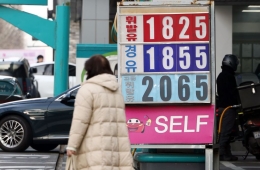
[Seungseop Song's Financial Light] The Terrifying Reason Why Stagflation Is So Frightening
Economic Boom - Rising Prices, Economic Recession - Falling Prices
Contrary to Economic Beliefs, Prices Rise Even During Recession
The Oil Shock, Marked by High Prices and Recession, Is a Representative Case
Unlike Inflation and Deflation, Solutions Are Also Difficult
![Traders on the floor of the New York Stock Exchange (NYSE) in early May. Due to fears of stagflation, the U.S. New York stock market retreated to levels seen about a year ago. <br>[Image source=Yonhap News]](http://www.asiae.co.kr/news/img_view.htm?img=2022051008094260532_1652137782.jpg)
Traders on the floor of the New York Stock Exchange (NYSE) in early May. Due to fears of stagflation, the U.S. New York stock market retreated to levels seen about a year ago.
[Image source=Yonhap News]
[Asia Economy Reporter Song Seung-seop] Concerns about 'stagflation' are growing. It is the worry that prices may soar even though the economy is struggling. Why is stagflation dangerous? And why are there warnings about stagflation now?
Stagflation is a compound word combining 'stagnation,' meaning economic recession, and 'inflation,' meaning rising prices. The term was first used in a 1965 speech by Ian Macleod, a Conservative Party member and then UK Chancellor of the Exchequer. At that time, the UK was experiencing high unemployment due to economic recession, but prices were also high.
This was a very unusual phenomenon in economics. Until then, economists believed that the economy (unemployment rate) and prices had an inverse relationship. It meant that during economic booms, prices were high, and during recessions, prices were low. When the economy was good or unemployment was low, increased demand and positive expectations pushed prices up, while during recessions and high unemployment, prices tended to fall or remain stable.
Imagine many people getting good jobs. More people earning money would increase consumption and investment. More people would want to buy houses and cars. More goods would be produced to sell to them. People would expect the economy to continue doing well, and real estate and stock prices would keep rising. The prices of daily necessities would also rise. This is why prices go up when the economy improves.
![[Seungseop Song's Financial Light] The Terrifying Reason Why Stagflation Is So Frightening](http://www.asiae.co.kr/news/img_view.htm?img=2022052408205677753_1653348057.jpg)
However, reality differed from theory. The 'oil shock' in the 1970s, which caused a global economic crisis, is a representative example. The oil shock began with the 'weaponization of oil' policy by Arab oil-producing countries and a reduction in oil production due to the Iranian Revolution. There was a high demand for oil, but production decreased, causing oil prices to skyrocket. Using transportation that relied on oil became extremely expensive, and many companies collapsed. The economy worsened. In other words, economic recession and high inflation occurred simultaneously.
South Korea was also severely affected. In 1978, South Korea's economic growth rate was about 8.7%, and inflation was around 14%. However, in the first quarter of 1980, South Korea recorded an economic growth rate of -1.6%, marking the first negative growth since its founding. As oil prices rose, inflation surged to 29%, forcing companies and citizens to endure hardship. Prices rising overnight led to panic buying, with people stockpiling daily necessities and bus tickets in advance.
Trying to Control Inflation Causes Economic Decline, Trying to Boost Economy Causes Inflation Surge
The real danger of stagflation lies in the difficulty of finding a solution. What happens if the government injects money and the central bank lowers the base interest rate to solve the recession? Inflation, already high, would soar even further. Conversely, if the central bank raises the base interest rate to stabilize prices, economic growth would likely decline, and unemployment would increase.
![[Seungseop Song's Financial Light] The Terrifying Reason Why Stagflation Is So Frightening](http://www.asiae.co.kr/news/img_view.htm?img=2010020308452924701_1.jpg)
The actual process of the United States resolving stagflation caused by the oil shock was not easy. Paul Volcker, then Chairman of the Federal Reserve (Fed), raised the policy interest rate by 4 percentage points at once from 11.2% to curb the 13% inflation rate in 1979. Half a year later, it was raised to 17.6%. The already poor unemployment rate rose to 10%. Due to this policy, Volcker received death threats and had to carry a pistol for protection.
Concerns about stagflation reemerging were raised earlier this month by the World Bank. It warned that recession and high inflation could occur. The reason cited was the war in Ukraine. While the 1970s oil shock began with reduced oil production in the Middle East, this time, disruptions in raw material supply caused by the Russia-Ukraine war could push prices up. The global economy is now expected to grow by 2.9%, about half of the growth rate forecasted in January.
What about South Korea? The Organization for Economic Cooperation and Development (OECD) lowered South Korea's growth forecast for this year by 0.3 percentage points from 3.0% to 2.7%. On the other hand, it raised the inflation forecast sharply by 2.7 percentage points to 4.8%. It expects growth to slow while inflation accelerates.
![Jerome Powell, Chairman of the Federal Reserve (Fed) [Image source=Yonhap News]](http://www.asiae.co.kr/news/img_view.htm?img=2021091108321725646_1631316736.jpg)
Central banks around the world are focusing first on controlling inflation. If inflation is not curbed, wage increase pressures intensify, leading to a vicious cycle where prices and wages keep rising. This would shrink consumption and investment, worsening the economic recession.
Of course, not all experts are certain stagflation will occur. Jang Min, Senior Research Fellow at the Korea Institute of Finance, said in this month's report titled 'Possibility of Stagflation Entry in Our Economy and Policy Implications' that “Considering recent economic conditions, the possibility of our economy entering stagflation like in the 1970s is limited.”
Hot Picks Today
 "Only Two Per Person" Garbage Bag Crisis Was Just Yesterday... Japan Also Faces Shortage Anxiety
- "Samsung Electronics Employee with 100 Million Won Salary Receiving 600 Million Won Bonus... Estimated Tax Revealed"
- Lived as Family for Over 30 Years... Daughter-in-Law Cast Aside After Husband's Death
- Former NIS Director Cho Taeyong Sentenced to 1 Year and 6 Months in First Trial for Perjury Before National Assembly
- "Wore It Once, Then This? White Spots All Over 4.15 Million Won Prada Jacket... 'Full Refund Ordered'"
© The Asia Business Daily(www.asiae.co.kr). All rights reserved.