"Basement Remaining KOSPI" Operating Profit Accounts for 31% Samsung Electronics and Hynix Plunge "No Strategy"

[Asia Economy Reporter Lee Seon-ae] Warning signs have been triggered for KOSPI earnings. This is due to the downward revision of consensus (market average forecast) for the semiconductor sector, which accounts for more than one-third of KOSPI's operating profit. As a result, concerns are emerging that the domestic stock market, shaken by various internal and external negative factors, will continue to face downward pressure.
Semiconductor Profits ↓ 'KOSPI to the Basement'
According to financial information firm FnGuide on the 21st, KOSPI's operating profit forecast had gradually risen for seven consecutive weeks since the end of April, but this week it slightly declined (-0.66%) compared to the previous week (271.1 trillion KRW), settling at 270.61 trillion KRW. This is due to the downward revision of the operating profit estimate for the semiconductor sector, which accounts for about 31% of KOSPI's operating profit (a decrease of 598.4 billion KRW compared to the previous week). The downward revision of profit forecasts can directly affect valuations using trading multiples, so concerns about consensus downward revisions amid recession fears are widespread.
Son Juseop, a researcher at Cape Investment & Securities, explained, "The operating profit forecast for the KOSPI semiconductor sector began to be slightly revised downward after the end of May," adding, "This means that the annual KOSPI operating profit forecast is being revised downward more broadly." Chae Hyunki, also a researcher at Cape Investment & Securities, said, "This year's KOSPI operating profit forecast remained steady without significant downward revision despite the surge in raw material prices and global supply chain disruptions caused by the Russia-Ukraine war, but it is expected to be revised downward around the Q2 earnings season," warning, "Even though the valuation (PER) of the domestic stock market has been significantly adjusted due to U.S. tightening policies, if the earnings forecast (EPS) is further revised downward, there is a possibility of additional decline, so this should be kept in mind." This implies that it is difficult to gauge the bottom of the KOSPI, which fell below 2400 the previous day.
In terms of valuation, KOSPI has practically reached an excessively low level, but the securities industry views it as a "falling knife." Accordingly, Oh Taedong, head of NH Investment & Securities Research Center, suggested keeping the KOSPI 2300 level open, while Yoon Jiho of Ebest Investment & Securities Research Center suggested the KOSPI 2200 level. Kim Hakgyun, head of Shin Young Securities Research Center, even raised his voice saying that discussing the bottom of KOSPI itself is meaningless.
There is also a gloomy view that the annual decline rate could reach the largest since the global financial crisis in 2008. At that time, KOSPI's annual decline rate was 40.7%. This year, KOSPI's decline rate is currently 19.7%.

Must Wait Until Samsung Electronics and SK Hynix Stabilize Their Bottoms
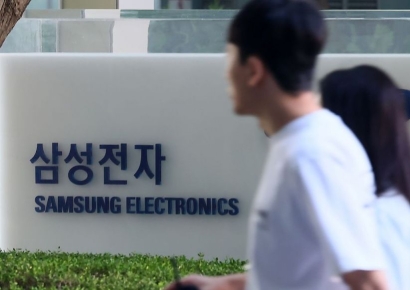
As the market plunge was attributed to the sell-off of semiconductor stocks such as Samsung Electronics and SK Hynix due to Intel's product launch delays and forecasts of DRAM price declines, voices in the securities industry are rising that a conservative approach is necessary until the bottom stabilization of major semiconductor stocks (Samsung Electronics and SK Hynix) is achieved. Kim Jang-yeol, head of the Research Center at Sangsangin Securities, emphasized, "More time is needed for the stock market to stabilize sufficiently, and first, Samsung Electronics and Hynix, which have fallen significantly, must show stabilization above the bottom line," adding, "There is no portfolio strategy until the major semiconductor stocks stabilize." This means responding with 'wait and see' rather than buying or selling.
Lee Kyung-min, head of the investment strategy team at Daishin Securities, advised, "Since the practical benefits of selling are not large, it is better to respond after some time has passed," and Heo Jaehwan, head of the investment strategy team at Eugene Investment & Securities, also emphasized, "It is better to endure rather than watch the market."
Attention is focused on the timing of bottom stabilization for Samsung Electronics and SK Hynix. Currently, consensus earnings estimates are expected to be revised downward by about -20% year-on-year for next year. However, this assumption is already reflected in the current stock prices. This is interpreted as the timing for their staggered bottom buying. Most securities firms expect Samsung Electronics to be in the low 50,000 KRW range and Hynix in the low 90,000 KRW range, predicting that further sharp declines are unlikely. Nevertheless, if the possibility of a global panic materializes, the price-to-book ratio (PBR) of 1x (Samsung Electronics) and 0.85x (SK Hynix) could be threatened, leading to further declines to the 40,000 KRW and 80,000 KRW levels, respectively.
Hot Picks Today
 "Samsung Electronics Employee with 100 Million Won Salary Receiving 600 Million Won Bonus... Estimated Tax Revealed"
- "Only Two Per Person" Garbage Bag Crisis Was Just Yesterday... Japan Also Faces Shortage Anxiety
- Lived as Family for Over 30 Years... Daughter-in-Law Cast Aside After Husband's Death
- Despite ‘Tank Day’ Controversy, Gwangju Schools Purchased Starbucks Gift Certificates
- "Wore It Once, Then This? White Spots All Over 4.15 Million Won Prada Jacket... 'Full Refund Ordered'"
Kim emphasized, "It is indeed the right time for staggered low-price buying of Samsung Electronics and SK Hynix in a mid-term investment strategy," but added, "However, until the major semiconductor stocks sufficiently stabilize, the timing for meaningful portfolio inclusion of other stocks should be postponed." He continued, "Because the possibility of additional declines in the U.S. stock market could lead to further declines in the Korean market, caution is needed regarding the timing of bottom buying."
© The Asia Business Daily(www.asiae.co.kr). All rights reserved.







