"Prepare for Economic Typhoon"... KOSPI Retraces to 2660 Amid Institutional Selling
Institutions Net Sell Over 400 Billion KRW in KOSPI Market
KOSDAQ Narrows Losses Compared to Early Session
![[Image source=Yonhap News]](http://www.asiae.co.kr/news/img_view.htm?img=2022052714032683707_1653627805.jpg)
[Asia Economy Reporter Ji Yeon-jin] The domestic stock market, which had been on a rebound since the end of last month, turned downward on the 2nd. Amid the continued rise in international oil prices, concerns about an economic recession due to the lack of inflation countermeasures in the U.S. resurfaced, seemingly dampening investor sentiment in the domestic market as well.
The KOSPI index was trading at 2,662.67 as of 9:30 a.m., down 23.23 points (0.86%) from the previous trading day. Institutions are leading the decline by net selling about 428.9 billion KRW. Foreigners are also net sellers by approximately 27.7 billion KRW, while individuals are net buyers with about 439.2 billion KRW. After opening down 0.56%, the index widened its losses but is fiercely battling around the 2,660 support level.
As debates over a recession in the U.S. intensified, selling pressure, mainly from institutions, emerged early in the session, causing the KOSPI to retrace its recent rebound. However, a wait-and-see attitude is also observed as investors monitor the effects of China's easing of COVID-19 lockdowns.
The U.S. stock market fell the previous day due to the Federal Reserve's Beige Book report mentioning weak demand, the burden of rising interest rates from quantitative tightening, and comments from Jamie Dimon, CEO of JP Morgan, the largest U.S. bank, warning to "prepare for the hurricane (typhoon) coming to the economy."
Han Ji-young, a researcher at Kiwoom Securities, said, "The domestic stock market is under bearish pressure due to U.S.-originated concerns such as the implementation of quantitative tightening and recession debates during the recent holiday period," but added, "Although South Korea's May export figures showed a larger trade deficit, they were better than expected, which should support the intraday bottom of the domestic market."
By sector on the KOSPI, only textiles and apparel rose by 1%, and non-metallic minerals showed a slight gain of 0.10%, buoyed by POSCO Chemical's strong performance exceeding 1%. All other sectors recorded declines.
Most of the top 10 KOSPI stocks by market capitalization, including Samsung Electronics, LG Energy Solution, SK Hynix, Hyundai Motor, LG Chem, Samsung SDI, and Kia, recorded losses in the 1% range. Samsung Biologics and NAVER showed slight gains. Kakao initially fell more than 2% but the selling pressure eased somewhat. Among the top 20 stocks by market cap, only POSCO Holdings (0.35%) and SK Innovation (0.23%) were on the rise.
The KOSDAQ index traded down 1.38 points (0.15%) at 891.98, with losses narrowing from the opening. Individuals were net buyers of about 60.4 billion KRW, while foreigners and institutions were net sellers of approximately 44.3 billion KRW and 15.4 billion KRW, respectively.
Hot Picks Today
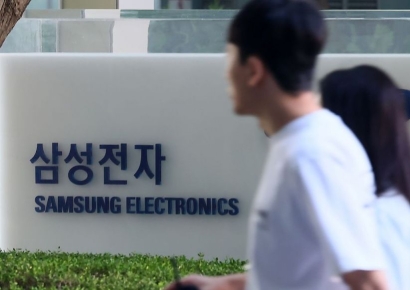 "Samsung Electronics Employee with 100 Million Won Salary Receiving 600 Million Won Bonus... Estimated Tax Revealed"
- Lived as Family for Over 30 Years... Daughter-in-Law Cast Aside After Husband's Death
- Lotte Pays Deposit First, Daewoo Responds: Seongsu District 4 Construction Rights Rematch [Real Estate AtoZ]
- Despite ‘Tank Day’ Controversy, Gwangju Schools Purchased Starbucks Gift Certificates
- "Wore It Once, Then This? White Spots All Over 4.15 Million Won Prada Jacket... 'Full Refund Ordered'"
On the KOSDAQ market, L&F (0.42%) and Cheonbo (0.74%) were the only gainers among the top 10 stocks by market capitalization. Wemade recorded a decline exceeding 5%, while Celltrion Healthcare, Kakao Games, HLB, and Pearl Abyss showed losses around 1%. Lee Kyung-min, a researcher at Daishin Securities, said, "Due to the sluggish U.S. stock market, the domestic market is showing an unstable trend," adding, "It appears that the KOSPI index is experiencing a retracement after a relief rally at the 2,650 support level."
© The Asia Business Daily(www.asiae.co.kr). All rights reserved.







