Tax Burden Rate Soars Over 5 Years of Moon Administration... Yoon Government Prepares to Revise 'Corporate Tax' (Comprehensive)
Going Against Global Trends... Stark Contrast with G5
South Korea's Corporate Tax Top Rate 25%, About 10% Higher Than Germany

During the five years of the Moon Jae-in administration, South Korea's tax burden rate significantly increased. This contrasts with major global advanced countries (G5) that have successively lowered corporate and income taxes to reduce the burden on the private sector. Excessive tax burdens are cited as a key factor hindering individual labor and corporate investment motivation. Accordingly, there are calls for the new Yoon Suk-yeol administration to rationalize the tax burden to secure growth momentum and a stable tax revenue base.
◆ South Korea Going Against Global Trends = Before the Moon Jae-in administration took office, South Korea's tax system had been reformed to lower corporate taxes to encourage investment. The corporate tax rate, which had reached as high as 28% before the 2000s, was reduced to 22% during the Lee Myung-bak administration, which was led by a businessperson, but under the Moon Jae-in government, it reversed course and rose back to 25%. This was due to the Moon administration's economic philosophy that emphasized the need for "increased taxation on large corporations."
According to the Korea Economic Research Institute, South Korea was the only major country to raise its corporate tax rate over the past five years (2017?2021). It also expanded the corporate tax brackets. In 2018, South Korea raised the top corporate tax rate from 22.0% to 25.0%, a 3.0 percentage point increase, while simultaneously introducing a new tax bracket for income exceeding 300 billion KRW, increasing the number of brackets from three to four.
In contrast, G5 countries have either eased or maintained their corporate tax standards over the past five years. The top rates were lowered in France (44.4% → 28.4%), the United States (35.0% → 21.0%), and Japan (23.4% → 23.2%). The United Kingdom (19.0%) and Germany (15.8%) maintained their rates at the same levels. The U.S. drastically reduced its tax brackets from eight to one. Other countries maintained a single bracket, resulting in a unified corporate tax rate among all G5 countries.
Income tax was also strengthened only in South Korea among major countries. South Korea's top income tax rate increased from 40.0% in 2017 to 45.0% in 2021, a 5.0 percentage point rise. The number of tax brackets also increased from six to eight during the same period.
In contrast, the U.S. lowered its top income tax rate (39.6% → 37.0%). The other four countries (Japan, Germany, the U.K., and France) maintained their rates at 45.0%. Regarding tax brackets, Germany reduced its brackets from five to four over the past five years, while the U.S. and Japan (seven brackets), France (five brackets), and the U.K. (three brackets) maintained their existing systems.
The Korea Economic Research Institute pointed out that the problem with South Korea's current tax system is that the tax burden is increasing faster than in G5 countries, raising concerns about the contraction of private economic vitality. From 2015 to 2019, South Korea's tax burden rate rose from 17.4% to 20.0%, a 2.6 percentage point increase. During the same period, the average increase among G5 countries was only 0.3 percentage points.
◆ Yoon’s Plan to Remove the ‘Sandbag’ = Excessive tax burdens are especially cited as a factor holding back companies. For example, Samsung Electronics, a leading domestic company, pays nearly three times the corporate tax compared to its global competitor Intel. This is why there are calls to ease tax burdens to support active facility and research and development (R&D) investments amid intensifying global competition.
One of President Yoon Suk-yeol’s key economic policies is "private-led growth." To this end, the government plans to actively pursue corporate tax cuts soon. The idea is to remove "unnecessary shackles" based on the judgment that excessive tax burdens have significantly stifled corporate management activities.
Currently, the most likely proposal is to lower the top corporate tax rate from the current 25% to 20%, a 5 percentage point reduction, and simplify the corporate tax brackets from four to two stages. This is because Deputy Prime Minister and Minister of Economy and Finance Choo Kyung-ho submitted a bill containing these measures two years ago.

The Korea Economic Research Institute also argues for the necessity of tax reform to lower rates, considering chronic low growth and the rapid increase in national debt as risks to the Korean economy. It is necessary to lower tax rates to stimulate private economic activities.
Hot Picks Today
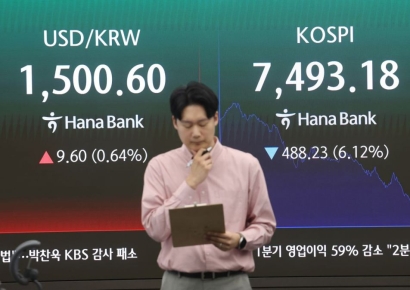 After Topping 8,000 Instead of Hitting 10,000... KOSPI Plunges—When Will It Rebound?
- "Samsung and Hynix Were Once for the Underachievers"... Hyundai Motor Employee's Lament
- [Breaking] Court Rules Against Samsung Electronics Union...1 Billion Won per Day Penalty for Exceeding Strike Scope
- Stronger Fines for Personal Data Leaks Start Tomorrow... Higher Sales Standards Applied
- "That? It's Already Stashed" Nightlife Scene Crosses the Line [ChwiYak Nation] ③
Choo Kwang-ho, head of the Economic Policy Office at the Korea Economic Research Institute, stated, "Strengthening corporate and income tax in opposition to global trends over the past five years has caused side effects that undermine individual labor and corporate investment motivation. Especially with rising interest rates and soaring international raw material prices, the private sector’s financial burden is considerable, so the new government needs to enhance economic vitality by easing the tax burden."
© The Asia Business Daily(www.asiae.co.kr). All rights reserved.







