"Leading Asia-Pacific Trade with IPEF"... Challenges Include Potential Backlash from China
Yoon Administration Confirms Joining IPEF... Can Lead Trade Norms as Initial Member
'IPEF Promotion TF' Fully Launched This Week... "Developing into Multilateral Negotiations"
No 'Market Opening' Unlike Existing FTAs... Less Burden for Member Countries
China May Oppose US-Led IPEF... Ministry of Industry Also Expresses Concerns
Attention on Joining 'Chip4' Alliance... Countering China's 'Semiconductor Rise'
![[Image source=Yonhap News]](http://www.asiae.co.kr/news/img_view.htm?img=2022041115392424096_1649659163.jpg)
[Asia Economy Sejong=Reporter Lee Jun-hyung] The next government’s decision to join the Indo-Pacific Economic Framework (IPEF) stems from the judgment that it must lead the regional ‘trade arena.’ Unlike existing trade agreements, IPEF, an economic cooperation body led by the United States, is structured so that the agreement form is finalized through member country discussions after its launch. If the joining is delayed, it could become difficult to reflect Korea’s position in IPEF norms. Analysts say that the U.S. repeatedly requested our government to participate in IPEF, which also influenced this decision.
According to related ministries on the 9th, the Ministry of Trade, Industry and Energy (MOTIE) will activate the ‘IPEF Promotion Task Force (TF)’ starting this week. Earlier, MOTIE announced at the 26th Trade Promotion Committee held last month that it would establish the IPEF Promotion TF. MOTIE plans to review necessary matters for joining IPEF with related ministries such as the Ministry of Foreign Affairs, centered on the TF. A MOTIE official said, "The TF formation work has been completed, and operations will be intensified starting this week," adding, "(IPEF) has already evolved beyond bilateral Korea-U.S. issues into multilateral negotiations, so a dedicated organization is necessary."

Lowering Joining Hurdles with 'Module' Style Agreement
Unlike typical trade agreements, IPEF does not include provisions related to ‘market opening.’ This is to lower the joining hurdles and attract as many countries as possible. Binding norms such as tariff elimination in existing Free Trade Agreements (FTAs) inevitably impose burdens on member countries. Provisions directly related to market opening can provoke domestic opposition and require complex administrative procedures such as parliamentary ratification. The U.S. also plans to promote IPEF as an ‘administrative agreement’ rather than a treaty like an FTA.
Another incentive is that the agreement is composed in a ‘module’ style. The U.S. previously presented four pillars as major IPEF agendas: fair and resilient trade, supply chain resilience, and others. Member countries can choose whether to participate in each module and even the degree of ‘binding force’ of the agreement through discussions after IPEF’s launch.
MOTIE: "Possible Chinese Backlash"
The issue is that China may retaliate against joining the U.S.-led IPEF. The core of IPEF is to check China. This is why labor and environmental standards, areas where China is relatively weak, are included in IPEF. Initially, the U.S. proposed IPEF as a measure to counter the Regional Comprehensive Economic Partnership (RCEP) led by China. MOTIE, the main ministry in charge, reported to the now-dissolved Presidential Transition Committee on the 6th that "IPEF was proposed in the context of countering China" and "there is a possibility of Chinese backlash if Korea joins IPEF."
If IPEF, centered on the U.S., pressures China on labor and environmental standards, China could use the ‘Export Control White Paper’ published at the end of last year?which bans overseas exports of core technologies for national security reasons?as a retaliatory card. In this case, Korea, which depends on more than 1,850 raw materials from China, would immediately fall within the scope of impact.
Some analysts argue that the possibility of IPEF membership leading to Chinese export restrictions or other retaliatory measures is low. Professor Jeong In-gyo of Inha University’s Department of International Trade said, "It depends on the structure IPEF takes," adding, "If it remains at the level of strengthening regional cooperation, it won’t be a big problem."

Yeohan-gu, Head of the Trade Negotiations Division at the Ministry of Trade, Industry and Energy, presided over the "Indo-Pacific Economic Framework (IPEF) Public-Private Task Force Meeting" on March 29 at the Korea Chamber of Commerce and Industry in Jung-gu, Seoul. Head Ye stated, "IPEF is expected to be a new opportunity for our country, which has aimed to be an open trading nation, and we are positively considering participation in terms of strengthening cooperation on new trade issues such as regional supply chain stabilization and digital trade." / Photo by Moon Honam munonam@
View original imageWill 'Chip4' Membership Also Accelerate?
Attention is also focused on whether Korea will join the ‘Chip4’ alliance proposed by the U.S. Chip4 is a semiconductor alliance consisting of four countries: the U.S., Korea, Japan, and Taiwan. It reflects the U.S. plan to strengthen cooperation with major semiconductor producers to counter China’s ‘semiconductor rise.’
Hot Picks Today
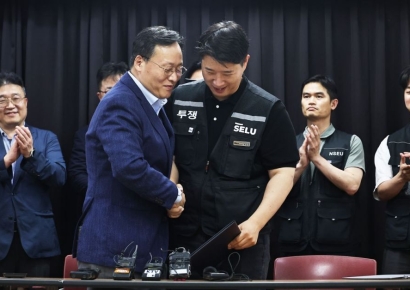 Up to 600 Million Won for Semiconductors, 160 Million Won Bonus for Loss-Making Non-Memory… Samsung Electronics Labor and Management Reach Tentative Deal on Unprecedented Performance Compensation (Comprehensive)
- "Could I Also Receive 370 Billion Won?"... No Limit on 'Stock Manipulation Whistleblower Rewards' Starting the 26th
- "From a 70 Million Won Loss to a 350 Million Won Profit with Samsung and SK hynix"... 'Stock Jackpot' Grandfather Gains Attention
- [Current State of K-Finance for Foreign Nationals]①From Niche to Core... Banks Go All-In on First-Mover Competition
- "Who Is Visiting Japan These Days?" The Once-Crowded Tourist Spots Empty Out... What's Happening?
Lee Chang-yang, the nominee for Minister of Trade, Industry and Energy, recently stated in a written response submitted to Assemblyman Cho Jung-hoon of the Transition Korea party, "The Chip4 alliance should be thoroughly reviewed at the whole-of-government level in a direction that maximizes national interests."
© The Asia Business Daily(www.asiae.co.kr). All rights reserved.