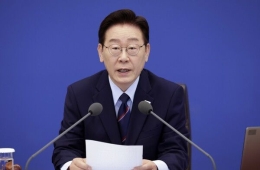
Defense Minister Nominee: "Will Strengthen Regular Exercises for Deployment of US Strategic Assets"

Defense Minister nominee Lee Jong-seop is attending the press conference announcing the appointment of ministerial candidates for eight ministries of the Yoon Suk-yeol administration at the Presidential Transition Committee in Tongui-dong, Jongno-gu, Seoul, on the afternoon of the 10th, responding to reporters' questions. Photo by Transition Committee Press Photographers Group
View original image[Asia Economy Yang Nak-gyu, Military Specialist Reporter] Lee Jong-seop, the nominee for Minister of National Defense, stated his intention to regularly conduct exercises involving U.S. strategic assets after taking office.
In a written response to the National Assembly confirmation hearing on the 3rd, Lee said, "At the level of the Korea-U.S. alliance, we plan to practically activate the Korea-U.S. Extended Deterrence Strategy Committee (EDSCG) and strengthen regular exercises involving the deployment of U.S. strategic assets."
Strategic assets refer to weapon systems that strike enemy rear military bases, large-scale facilities, or cities. In modern warfare, this mainly refers to nuclear weapons. Coordination with the U.S. is necessary for regular exercises. The mention of regular deployment of U.S. strategic assets on the Korean Peninsula, which had previously been deployed irregularly, is interpreted as a necessary measure to strengthen deterrence against North Korea. Lee served as a member of the Foreign Affairs and Security Subcommittee of the Presidential Transition Committee.
When asked whether he had proposed normalizing Korea-U.S. joint exercises and resuming field maneuver exercises, he replied through the written response, "I proposed it after discussions with other transition committee members." He also stated, "To respond to North Korea's increasingly sophisticated nuclear and missile threats, it is very important to maximize the use of U.S. extended deterrence, dramatically enhance our military capabilities, and strengthen the cohesion of the Korea-U.S. military alliance by normalizing joint exercises."
Regarding a question asking him to pick the "three security failures" of the Moon Jae-in administration, he prefaced by saying, "As a ministerial nominee, it is inappropriate to comment on the previous administration’s defense policy," but added, "There is room for improvement in the lack of large-scale field maneuver exercises and the limited Korea-U.S. cooperation on North Korean nuclear and missile threats."
As for "positive aspects," he evaluated, "Efforts to ease tensions with North Korea, fostering the domestic defense industry and achieving export performance, and events such as the repatriation of remains of the Republic of Korea Armed Forces and the U.S. military were positive from a security perspective."
Hot Picks Today
 "Stocks Are Not Taxed, but Annual Crypto Gains Over 2.5 Million Won to Be Taxed Next Year... Investors Push Back"
- "Don't Throw Away Coffee Grounds" Transformed into 'High-Grade Fuel' in Just 90 Seconds [Reading Science]
- Despite Warnings of "Do Not Enter, You May Not Make It Out Alive"... Foreign Tourist Stranded After Unauthorized Climb on Jeju Sanbangsan
- Signed Without Viewing for 1.6 Billion Won... Jamsil and Seongbuk Jeonse Prices Jump 200 Million Won in a Month [Real Estate AtoZ]
- "Even With a 90 Million Won Salary and Bonuses, It Doesn’t Feel Like Much"... A Latecomer Rookie Who Beat 70 to 1 Odds [Scientists Are Disappearing] ③
The transition committee earlier included in the national agenda announced that day a plan to enhance the execution capability of U.S. extended deterrence by establishing a cooperation system for the deployment of U.S. strategic assets through the practical reactivation of the Korea-U.S. EDSCG. The plan also includes resuming Korea-U.S. joint field maneuver exercises (FTX) at the brigade level or higher for the first time in over four years.
© The Asia Business Daily(www.asiae.co.kr). All rights reserved.