IMF Maintains South Korea's Growth Rate at 3.0% This Year: "Bold Measures Needed in Case of Recession"

[Asia Economy Sejong=Reporter Son Seon-hee] The International Monetary Fund (IMF) on the 29th (Korean time) projected South Korea's economic growth rate for this year at 3.0%. This maintains the forecast released in January. However, it suggested that a "bold response" would be necessary if risks of stagflation and economic recession become more concrete.
On this day, the IMF released the "2022 Article IV Consultation Report" containing these details. The IMF's annual consultation is held every year to review the economic situation of member countries. For South Korea, meetings were conducted from January 11 to 25 with related agencies including the Ministry of Economy and Finance, the Bank of Korea, the Financial Services Commission, and the Financial Supervisory Service.
The IMF noted that growth in the first quarter could temporarily slow due to the impact of the Omicron variant but expected that the existing growth forecast could be maintained thanks to the effects of the supplementary budget. Furthermore, it projected next year's economic growth rate at 2.8%.
Regarding inflation, although a high rise was expected early this year, it forecast an inflation rate of 3.1% for this year due to future interest rate hikes, stabilization of energy prices, and recovery of supply chains. For next year, it projected an inflation rate of 2.1%.
Externally, it anticipated that the current account surplus would shrink somewhat due to increased domestic demand.
The IMF particularly evaluated the pace of normalization of South Korea's monetary, fiscal, and financial policies as appropriate but pointed out that a bold response would be necessary if risks of stagflation and economic recession become more concrete.
Additionally, regarding household debt, it welcomed the government's macroprudential measures and stated that further strengthening is needed. It also added that continuous review of real estate tax effects and enhancement of incentives for private sector participation in housing supply are necessary.
Regarding efforts to strengthen fiscal soundness such as the introduction of fiscal rules, it consistently evaluated these efforts and proposed improvements to pensions and reverse mortgages, regulatory reforms, and expansion of female labor force participation.
It also stated that the minimum price for the Emissions Trading Scheme (ETS), the introduction of feebates in high carbon emission sectors, and expansion of the coal tax should be implemented.
Hot Picks Today
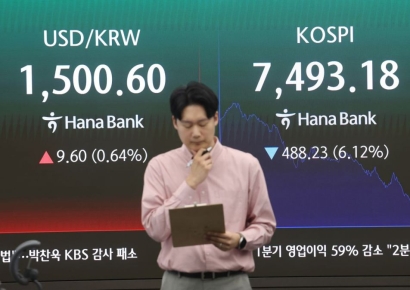 After Topping 8,000 Instead of Hitting 10,000... KOSPI Plunges—When Will It Rebound?
- "Samsung and Hynix Were Once for the Underachievers"... Hyundai Motor Employee's Lament
- [Breaking] Court Rules Against Samsung Electronics Union...1 Billion Won per Day Penalty for Exceeding Strike Scope
- Court Partially Grants Samsung Electronics' Injunction to Prohibit Industrial Action... 100 Million Won Penalty Per Day for Violations
- "That? It's Already Stashed" Nightlife Scene Crosses the Line [ChwiYak Nation] ③
The Ministry of Economy and Finance said, "As geopolitical risks from Ukraine, the spread of Omicron, and inflation due to normalization of major countries' monetary policies are intensifying, the government plans to closely monitor market conditions and respond flexibly to ensure economic recovery and stability." It added, "The IMF's major policy recommendations on real estate, structural reforms, and climate change response largely align with the government's views," and "While striving to stabilize the real estate market, we will steadily implement structural reforms such as the Korean New Deal from a mid- to long-term perspective, secure employment safety nets, enhance labor market flexibility, and respond to climate change."
© The Asia Business Daily(www.asiae.co.kr). All rights reserved.