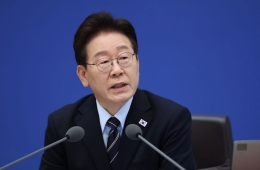
[Interview] Jung Won-oh, Mayor of Seongdong-gu: "Relaxation of 35-Story Limit Along Han River, GTX-C Stop at Wangsimni Station... A Bright Future for Seongdong"
'Removal of the 35-Story Rule' in the '2040 Seoul Urban Master Plan' Boosts Progress of Seongsu Strategic Maintenance Zone Project... Waterfront-Centered Space Reorganization, Undergrounding of Above-Ground Sections of Gyeongui-Jungang Line and Line 2, Securing New Urban Development Momentum... GTX-C Line Stops at Wangsimni Station Confirmed by Ministry of Land, Infrastructure and Transport, Marking a Metropolitan Transportation Hub in the Capital Region
![[Interview] Jung Won-oh, Mayor of Seongdong-gu: "Relaxation of 35-Story Limit Along Han River, GTX-C Stop at Wangsimni Station... A Bright Future for Seongdong"](http://www.asiae.co.kr/news/img_view.htm?img=2021122308424272335_1640216563.jpg)
[Asia Economy Reporter Jongil Park] “The future of Seongdong is even more promising.”
Jung Won-oh, Mayor of Seongdong District, said in an interview with this publication, “Many urban planning policies have gained momentum thanks to the recently announced ‘2040 Seoul Urban Basic Plan’ by the Seoul Metropolitan Government.”
The project that Seongdong District is most looking forward to from this announcement is the development of the ‘Seongsu Strategic Maintenance Zone.’ Previously designated as part of the Hangang Renaissance Project, the Seongsu Strategic Maintenance Zone had faced difficulties due to the ‘35-floor height limit’ regulation.
Mayor Jung said, “We have repeatedly proposed abolishing the ‘35-floor height limit’ and suggested lowering the building coverage ratio while keeping the floor area ratio the same, similar to Singapore. We welcome that Seongdong District’s proposal has been reflected in this plan.” He added, “This will satisfy the demand for high-density development along the Hangang River while securing views, and we expect the Hangang riverside skyline to develop distinctively and harmoniously in the future.”
The creation of waterfront-friendly cultural spaces along the riversides, which is a key focus of Seongdong District’s 7th elected term, aligns with Seoul’s urban planning policy of ‘reorganizing waterfront-centered spaces.’ Mayor Jung said, “The quality of life for residents greatly depends on how the rivers, which serve as urban resting places, are improved.” He continued, “Seongdong District is surrounded by a total of 14.2 km of waterfront along the Hangang River, Jungnangcheon Stream, and Cheonggyecheon Stream. If we create spaces that highlight the charm of each waterfront and improve accessibility, it will positively contribute to urban development.”
So far, Seongdong District has leveraged its environmental advantage of having the longest waterfront in Seoul by expanding sports and leisure spaces such as Salgot-i Baseball Stadium, Eungbong Soccer Stadium, and futsal fields along Cheonggyecheon and Jungnangcheon. It has also promoted ecological restoration of Jungnangcheon, creation of waterfront cultural spaces, development of a Hangang riverside resting area under Oksu Station, and odor reduction projects around Jeonnongcheon, thereby improving urban spaces as ‘resting places.’
On the 7th, the district opened ‘Yongbi Shelter,’ a resting place for cyclists and pedestrians under Yongbi Bridge where the Hangang River and Jungnangcheon meet. It is also carrying out mid- to long-term waterfront-centered projects such as constructing the ‘Seoul Forest Complex Cultural and Sports Center’ at Ttukseom Water Purification Plant, aiming for completion in May.
Additionally, the ‘GTX-C Line stopping at Wangsimni Station,’ which will bring the greatest change to Seongdong’s future, has been virtually confirmed. On the 24th of last month, the Ministry of Land, Infrastructure and Transport officially announced that the preferred bidder passed the private investment feasibility review and that this was reflected in the implementation agreement.
Mayor Jung said, “What everyone thought was impossible has become a reality through the power of all residents.” He added, “If the GTX-C line, part of the national railway network, is connected to Wangsimni Station, where four lines currently run, along with the Northeast Line scheduled to open in 2026, Seongdong District will achieve another leap forward based on its greatest strengths of transportation and location.”
Furthermore, plans to underground the above-ground sections of the Gyeongui-Jungang Line and Line 2, which have been long-standing local demands, and the revitalization of the ‘Seongsu area,’ where new growth industries such as ICT and digital content are rapidly developing, have laid the foundation for making Seongdong a sustainable city. Also, various urban plans for balanced development within Seongdong are progressing smoothly, including the district unit plans for Majang Station area and Geumho district center decided early last year, and the recent establishment of a district unit plan for the Shin Geumho Station area. Notably, on the 28th of last month, an unusual agreement was made at the district level with the Seoul Metropolitan Office of Education to address local educational issues such as the establishment of a middle school in Wangsimni New Town, signaling a green light for regional development.
Hot Picks Today
 "Stocks Are Not Taxed, but Annual Crypto Gains Over 2.5 Million Won to Be Taxed Next Year... Investors Push Back"
- "Don't Throw Away Coffee Grounds" Transformed into 'High-Grade Fuel' in Just 90 Seconds [Reading Science]
- Signed Without Viewing for 1.6 Billion Won... Jamsil and Seongbuk Jeonse Prices Jump 200 Million Won in a Month [Real Estate AtoZ]
- "Groups of 5 or More Now Restricted"... Unrelenting Running Craze Leaves Citizens and Police Exhausted
- "Even With a 90 Million Won Salary and Bonuses, It Doesn’t Feel Like Much"... A Latecomer Rookie Who Beat 70 to 1 Odds [Scientists Are Disappearing] ③
Mayor Jung Won-oh said, “We will do our best to enhance urban competitiveness and create a city where everyone wants to live through active cooperation with Seoul City and distinctive urban planning unique to Seongdong District.”
© The Asia Business Daily(www.asiae.co.kr). All rights reserved.