US-Korea Trade Ministers Visit Semiconductor Supply Chain Site... SK "370 Billion Investment by 2025"
Visit to SK Siltron CSS Factory Highlighting Korea-US Cooperation
"Evaluated as One of the Representative Achievements in Economic Cooperation"
Expectations for Growth in Domestic Supply Chain and New Industry Ecosystem

Yeo Han-gu, Director General for Trade Negotiations at the Ministry of Trade, Industry and Energy, is touring the local production plant of SK Siltron in Michigan, USA, on the 16th (local time) together with Katherine Tai, U.S. Trade Representative (USTR).
View original image[Asia Economy Sejong=Reporter Dongwoo Lee] On the 16th (local time), Yeoh Han-gu, Chief Negotiator of Trade at the Ministry of Trade, Industry and Energy, visited the next-generation power semiconductor wafer factory 'SK Siltron CSS' located in Michigan together with Katherine Tai, U.S. Trade Representative (USTR). This factory is regarded as one of the representative achievements of economic cooperation between the two countries.
This visit was made to commemorate the 10th anniversary of the Korea-U.S. Free Trade Agreement (FTA) coming into effect, marking the first time that the trade chiefs of both Korea and the U.S. visited a key industrial site in the U.S. where Korean companies are investing. Attendees included Chief Negotiator Yeoh, USTR Representative Tai, SK E&S Vice Chairman Yoo Jung-joon, and SK Siltron CEO Jang Yong-ho.
The trade ministers of both countries jointly inspected the Korea-U.S. semiconductor supply chain site and agreed that strengthening investment and economic security cooperation in core supply chains such as semiconductors and batteries is essential for the future of the Korea-U.S. FTA.
Chief Negotiator Yeoh especially praised Representative Tai for successfully mediating the battery dispute between LG and SK last year, which greatly contributed to maintaining the stability of the core supply chains between the two countries. He emphasized, "The priority of future trade policies lies in enhancing the resilience of critical supply chains including semiconductors, batteries, electric vehicles, bio-health, energy, raw materials, and rare metals."
SK Siltron CSS is a company acquired by SK Siltron in 2020 for $450 million (approximately 555.5 billion KRW) from DuPont's wafer business division in the U.S. It produces silicon carbide (SiC) wafers, a core material essential for power semiconductors used mainly in electric vehicles and solar power conversion devices. SK Siltron CSS is currently considered a leading group in the U.S. alongside semiconductor companies Wolfspeed and II-VI in terms of SiC wafer production capacity.
SK Siltron plans to invest an additional $300 million (approximately 370 billion KRW) over three years to expand production lines. They announced plans to contribute to revitalizing the U.S. electric vehicle industry by creating 150 additional jobs.
The Ministry of Trade, Industry and Energy expects that SiC wafers produced in the U.S. will be introduced by domestic small and medium enterprises to be utilized in power semiconductor production, thereby aiding the activation of the domestic electric vehicle industry and the spread of renewable energy. In particular, this is anticipated to contribute to the growth of the domestic supply chain and the domestic new industry ecosystem.
This visit was arranged after the USTR proposed holding a meeting at SK Siltron CSS to commemorate the 10th anniversary of the Korea-U.S. FTA. Previously, Representative Tai mentioned at the Korea-U.S. FTA 10th anniversary event that "SK is creating double the employment and strengthening manufacturing and production capabilities in the electric vehicle sector."
Following the factory visit, the trade ministers of both countries agreed on the importance of supply chain cooperation based on public-private partnerships in key fields such as semiconductors during their meeting in Detroit, Michigan, a site of Korea-U.S. trade and investment. They reached a consensus on the need to expand the scope of the Korea-U.S. FTA framework to cover new trade agendas such as supply chains, new technologies, and digital issues, and agreed to hold the first meeting in the first half of the year with senior officials from both countries serving as chief representatives.
Hot Picks Today
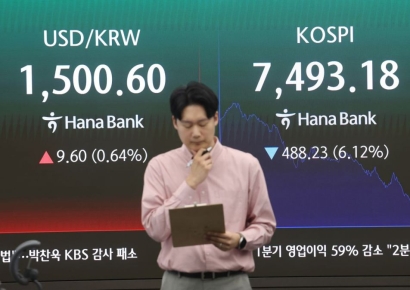 After Topping 8,000 Instead of Hitting 10,000... KOSPI Plunges—When Will It Rebound?
- "Samsung and Hynix Were Once for the Underachievers"... Hyundai Motor Employee's Lament
- [Breaking] Court Rules Against Samsung Electronics Union...1 Billion Won per Day Penalty for Exceeding Strike Scope
- Global Big Tech Joins AI Firms in Full-Scale AI Agent Showdown
- "That? It's Already Stashed" Nightlife Scene Crosses the Line [ChwiYak Nation] ③
Chief Negotiator Yeoh stated, "Korea and the U.S. will closely cooperate in the international community's efforts for multilateral trade measures against Russia, including export controls to Russia and the World Trade Organization."
© The Asia Business Daily(www.asiae.co.kr). All rights reserved.