Seongdong-gu Prepares 'Yongbi Rest Area' for Citizens Visiting Jungnangcheon and the Han River
[Seoul District News] Seongdong-gu Prepares Facilities for Residents Including 159㎡ Restrooms and Rest Areas on the 7th · 'Hard Course' Walking and Bicycle Path, Optimal Location Where Hangang and Jungnangcheon Meet, Safely Designed with Floating Structure ... Nowon-gu Expands Floor Signal Lights to 128 Locations This Year

[Asia Economy Reporter Park Jong-il] Seongdong-gu (District Mayor Jung Won-oh), a waterfront city with the longest 14.2km waterfront in Seoul, opened a ‘rest area’ on the 7th for citizens visiting Jungnangcheon Stream and the Han River.
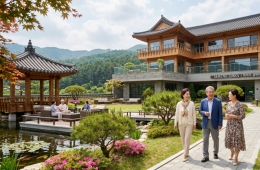
Located under Yongbi Bridge where the Han River and Jungnangcheon Stream meet, this place named ‘Yongbi Rest Area’ is a resting space where citizens can stop by and take a break.
As a structure within the river with a building area of 159㎡, it consists of facilities for residents’ convenience such as restrooms and resting spaces. One corner of the resting area is also equipped with a space where visitors can enjoy bottled water, coffee, beverages, and snacks.
Yongbi Rest Area, welcoming residents with the friendly slogan ‘I live in Seongdong,’ is built with a floating structure to prevent damage to the facility in case of flooding or rising water levels of the Han River and Jungnangcheon Stream during rainy weather, ensuring safety.
Unlike the scenic views encompassing the Han River and Jungnangcheon Stream, the location of Yongbi Rest Area is a ‘hard course’ section of the walking and cycling path with no nearby convenience facilities.
Therefore, the district prepared the rest area at the optimal location where the Han River and Jungnangcheon Stream meet, allowing people to take a short break during walks and quench the thirst of cyclists. It is located on the way to Jungnangcheon Bridge, which leads to Seoul Forest, offering a light step to citizens enjoying the river.
Earlier this year, the district attracted citizens’ attention with the unique scenery of 1,200 purple Kochia plants under Eungbong Bridge on Jungnangcheon Stream and has been striving to expand sports facilities and leisure spaces for a ‘city with rest.’
Although the city was absolutely lacking in sports facilities compared to residents’ demand, since 2015, the district has actively secured not only district funds but also national and city funds to invest in expanding sports facilities. Centered around Salgoti and Eungbong Sports Parks along Jungnangcheon Stream, outdoor sports facilities such as Salgoti Baseball Field, Eungbong Tennis Court, soccer field, futsal field, and jokgu (foot volleyball) court have been greatly increased, allowing residents to enjoy various sports and gaining high popularity.
For the convenience of residents using the 10.55km bicycle road and walking path along Jungnangcheon Stream from Gunja Bridge through Seongdong Bridge to Yongbi Bridge, the district has created flower paths with tulips, zinnias, cosmos, etc., by section and season. A district official explained that Yongbi Rest Area will become a ‘hot place’ this month where people can fully feel spring with Eungbongsan, a famous forsythia spot, as the backdrop.
Nam, a resident of Geumho-dong who enjoys cycling with his children along the waterway from the Han River to Jungnangcheon Stream, said, “There was no convenience facility where you could buy a bottle of water along Jungnangcheon Stream, so it’s really great to have such a place now.” He added, “Yongbi Rest Area will now be a base where we can take a break to eat snacks and decide whether to go to Seoul Forest or Cheonggyecheon.”
Jung Won-oh, Mayor of Seongdong-gu, said, “I hope residents exhausted by the prolonged COVID-19 pandemic can feel convenience and comfort in this nature-friendly place,” and added, “We will continue to make efforts so that Seongdong-gu’s rivers can become healing spaces harmonized with residents’ lives.”

Nowon-gu (District Mayor Oh Seung-rok) will expand the installation of ground traffic lights this year to ensure pedestrian safety.
Ground traffic lights are auxiliary pedestrian traffic signals installed at pedestrian waiting lines that change color between green and red LED panels according to the crosswalk traffic light changes.
Since pedestrian signals are displayed on the ground, they reduce accident risks for pedestrians such as the so-called ‘smombie’ group who walk while looking at their smartphones without paying attention to their surroundings. They also clearly distinguish roads and crosswalks on rainy or dark days and are very useful when it is difficult to see the opposite traffic light.
The district analyzed traffic accident trends over three years in 2020 and began pilot installation and operation of ground traffic lights at five locations in two spots with high traffic accident rates. Reflecting residents’ responses, the installation steadily expanded until 2021, and currently, ground traffic lights have been installed at a total of 37 locations and 92 spots.
The district plans to add 36 more ground traffic lights at 19 locations by April this year, expanding the total to 56 locations and 128 spots.
Looking at this year’s installation sites, elementary schools account for the largest number with 12 locations, followed by one middle school, one high school, and five locations with heavy traffic and pedestrian flow such as in front of Dobong Driver’s License Test Center and Gwangwoon University Station intersection.
To build a safe walking environment, the district is also promoting the installation of ‘pedestrian signal voice guidance auxiliary devices’ along with ground traffic lights.
The auxiliary device not only announces the change of pedestrian signals but also detects if a pedestrian enters the roadway during signal waiting through sensors and issues a warning voice saying, “It is dangerous, please move to the sidewalk.” This helps prevent dangerous behaviors such as jaywalking, running out before the signal changes, or standing on the road waiting for the signal.
So far, 88 devices have been installed mainly in child protection zones within the district, and this year, 10 more devices will be added at three locations.
In addition, the district continues to promote maintenance of traffic facilities such as safety fences and color blocks in child protection zones and safety signs to build a safe traffic environment.
As a result, traffic accident statistics per 100,000 population in Nowon-gu decreased from 317 cases in 2019 to 277 cases in 2020, ranking sixth lowest among Seoul’s autonomous districts.
Hot Picks Today
![[Exclusive] "What? I Used It for Fried Eggs and Kimchi Pancakes, but It Wasn't Edible?"... Raw Pork Lard Supplied to Department Stores, Causing Stir](https://cwcontent.asiae.co.kr/asiaresize/93/2026042216151436513_1776842114.png) [Exclusive] "What? I Used It for Fried Eggs and...
[Exclusive] "What? I Used It for Fried Eggs and...
- [Report] "Professionals in Their 30s and 40s With at Least 2 Billion Won in Cash...
- "375 Won Per Share" SK hynix to Pay 26.58 Billion Won Cash Dividend
- No More Updates on 'Star' Wolf Neugoo for Now... Was the Pressure from Fans Over...
- "Chairman Chey Tae-won's Warning Comes True"... Laptop Prices Already Up 1 Milli...
Oh Seung-rok, Mayor of Nowon-gu, said, “We will continue to make efforts to establish a safe system for preventing traffic accidents.”
© The Asia Business Daily(www.asiae.co.kr). All rights reserved.