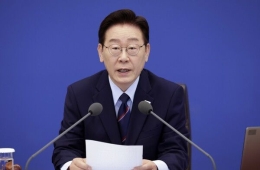
[Lee·Yoon Economic Nomics Analysis] Lee's Transitional Fair Growth vs Yoon's Dynamic Innovative Growth
"Seongjang" Seems Like a Goal... Lee "Focus on Public Regulatory Reform and Investment" vs Yoon "Emphasizes Virtuous Cycle Led by Private Sector"
![[Lee·Yoon Economic Nomics Analysis] Lee's Transitional Fair Growth vs Yoon's Dynamic Innovative Growth](http://www.asiae.co.kr/news/img_view.htm?img=2022022311181855336_1645582699.jpg)
[Asia Economy Reporter Baek Kyunghwan] The economic blueprints of the two major presidential candidates, known as the ‘Nomics’ competition, are heating up. The candidates’ plans are distinguished as ‘Lee Jae Nomics (Lee Jae-myung + Economics)’ and ‘Y Nomics (Yoon Seok-yeol + Economics),’ revealing significant differences in their views on the role of government. Depending on who wins, the government's role in economic policy is expected to change dramatically.
According to the Democratic Party and the People Power Party on the 23rd, the economic theories of Lee Jae-myung of the Democratic Party and Yoon Seok-yeol of the People Power Party share the same framework of ‘growth.’ The basic structure of regulatory reform and investment is also similar. However, there are differences in the methods to achieve growth. Candidate Lee emphasizes regulatory reform and investment led by the public sector, while Candidate Yoon stresses a virtuous cycle of growth and distribution driven primarily by the private sector.
Claiming to be an economic president, Candidate Lee revealed specific economic goals such as a KOSPI index of 5000, a national income of $50,000, and ranking 5th in comprehensive national power worldwide. These are tangible growth targets that have appeared for the first time in 15 years since former President Lee Myung-bak’s MB 747 (7% annual growth, $40,000 national income, entry into the world’s top 7 advanced countries) goals.
While Candidate Lee set the condition of ‘government-focused investment in areas where the private sector does not perform well,’ Candidate Yoon prioritized ‘private sector-led growth.’ Rather than government investment, he aims to stimulate corporate investment, jobs, and growth by reforming systems such as regulatory innovation and labor market reform. Ultimately, although the government will provide direct support such as research and development assistance to companies, the basic idea is to first create the market foundation and environment for private sector innovation.
Hot Picks Today
 "Stocks Are Not Taxed, but Annual Crypto Gains Over 2.5 Million Won to Be Taxed Next Year... Investors Push Back"
- "Don't Throw Away Coffee Grounds" Transformed into 'High-Grade Fuel' in Just 90 Seconds [Reading Science]
- Despite Warnings of "Do Not Enter, You May Not Make It Out Alive"... Foreign Tourist Stranded After Unauthorized Climb on Jeju Sanbangsan
- Signed Without Viewing for 1.6 Billion Won... Jamsil and Seongbuk Jeonse Prices Jump 200 Million Won in a Month [Real Estate AtoZ]
- "Even With a 90 Million Won Salary and Bonuses, It Doesn’t Feel Like Much"... A Latecomer Rookie Who Beat 70 to 1 Odds [Scientists Are Disappearing] ③
Political and industrial circles expect that the roles of the public and private sectors in the economy will change significantly depending on the presidential election outcome. Since the Moon Jae-in administration’s income-led growth policy, which aimed to increase the income of ordinary citizens and use it as a growth engine to transform the economy dependent on exports, has effectively failed, either the public or private sector must take the lead in reform and investment policies. The ongoing discussions within each camp on detailed economic branches for growth are in the same context.
© The Asia Business Daily(www.asiae.co.kr). All rights reserved.