Is Spring Coming Again for Semiconductor Stocks?
As Fear from Ukraine Subsides
Continuous Sharp Decline Turns to Rebound
Experts Note "Favorable Demand"

[Asia Economy Reporter Minji Lee] Semiconductor stocks, which had been weighed down by fears of interest rate hikes and the war between Ukraine and Russia, are drawing attention as to whether they can rebound, supported by favorable demand forecasts for the memory (DRAM, NAND flash) semiconductor market.
As of 10 a.m. on the 16th, Samsung Electronics was trading at 74,500 KRW, up 1% from the previous trading day. SK Hynix also rose 3.15% to 131,000 KRW. On the U.S. stock market on the 15th local time, Nvidia (10%), Micron (6.83%), and Qualcomm (5%) surged, leading the Philadelphia Semiconductor Index to rebound 5.5% in one day, spreading positive momentum to domestic semiconductor stocks. The news that Russia withdrew some troops deployed near Ukraine had a positive impact, and since the stocks had plunged due to excessive concerns, the rebound was significant.
Since the beginning of this month, the semiconductor index has shown the weakest performance among all sectors. The KRX Semiconductor Index fell 5.44% during this period, the largest decline among KRX indices. This reflects negative views that semiconductor production could be disrupted due to the increased possibility of military conflict between Russia and Ukraine ahead of the U.S. Federal Reserve's interest rate hike next month. Major semiconductor companies import most of the rare materials essential for semiconductor production, such as neon and palladium, from Russia and Ukraine. If war breaks out, normal production activities will inevitably become difficult.
Although the fear of war has not been completely resolved, securities experts say attention should be paid to the favorable demand for semiconductors. While stock prices fluctuate depending on domestic and international environments, ultimately, they must reflect customers’ inventory reductions and increased usage for servers and PCs. In the case of DRAM, the price increase trend is strengthening faster than expected. According to market research firm DRAMeXchange, PC DRAM (DDR4 8Gb) is currently at $3.864, rebounding $0.69 from the yearly low of $3.168 in November last year. Spot prices are usually reflected in fixed prices 4 to 6 months later and are used as a leading indicator to gauge the DRAM market conditions.
Hot Picks Today
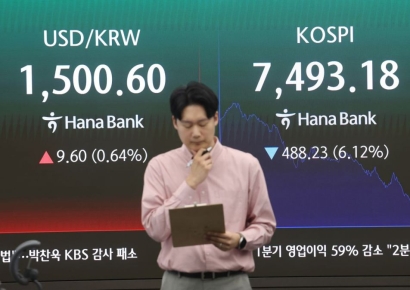 After Topping 8,000 Instead of Hitting 10,000... KOSPI Plunges—When Will It Rebound?
- "Samsung and Hynix Were Once for the Underachievers"... Hyundai Motor Employee's Lament
- [Breaking] Court Rules Against Samsung Electronics Union...1 Billion Won per Day Penalty for Exceeding Strike Scope
- Six Economic Organizations Urge Withdrawal of Samsung Electronics Strike Plan...Warn of National Loss of Opportunity
- "That? It's Already Stashed" Nightlife Scene Crosses the Line [ChwiYak Nation] ③
NAND is also expected to show an improvement in market conditions faster than anticipated. Following the lockdown of Samsung Electronics’ Xi’an plant and the raw material contamination accident at the joint production line of Western Digital and Kioxia, production has become insufficient, creating a favorable environment for suppliers in the second-quarter NAND fixed price negotiations. Park Yoo-ak, a researcher at Kiwoom Securities, said, “Production disruptions account for about 4% of total NAND industry production, which will resolve the oversupply and stabilize NAND prices,” adding, “Companies included in the NAND supply chains of Samsung Electronics and SK Hynix are also likely to benefit.”
© The Asia Business Daily(www.asiae.co.kr). All rights reserved.







