[Biz View] Why Did the EU Cite 'Energy Security' as the Reason?
EU Opposes Korea Shipbuilding and Daewoo Shipbuilding Merger Over LNG Carrier Monopoly Concerns
Renewable Energy Transition Highlights LNG Alternatives
"Rising LNG Carrier Prices Could Hinder Transportation"
Unclear Correlation Between LNG Freight Rates and Prices... Less Link to Shipping Costs

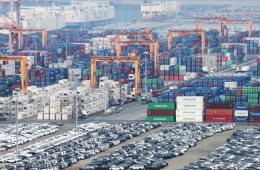
Daewoo Shipbuilding & Marine Engineering Okpo Shipyard in Geoje-si, Gyeongnam (above) and large cranes installed at Hyundai Heavy Industries Shipyard in Dong-gu, Ulsan City
[Asia Economy Reporter Choi Dae-yeol] The European Union (EU) has opposed the merger of Hyundai Heavy Industries and Daewoo Shipbuilding & Marine Engineering, citing the reason of a potential “(European) energy security threat.” Europe aims to reduce carbon energy sources like oil and transition to renewable energy to address climate change and environmental regulations. In this transition process, liquefied natural gas (LNG), which emits relatively fewer pollutants, is expected to play an intermediate role. This view is shared by many countries, including South Korea.
Europe meets most of its regional LNG demand through imports from outside the region. The European Commission’s assessment was that if shipping companies based in Europe pay high prices to secure vessels to transport LNG, the cost burden on European energy consumers could increase. They believe that if the two Korean shipyards merge and increase their market share in LNG carriers, it could become more difficult to secure stable LNG supply.
After peaking over ten years ago and then declining, Europe’s LNG demand has recently been rising again. According to EU trade statistics, the EU’s LNG imports, which exceeded 60 million tons in 2011, dropped to 26 million tons in 2016, less than half. Since then, imports have increased again to 56.29 million tons in 2019 and remained at 41.36 million tons in 2020, when regional energy demand fell due to COVID-19. Imports up to September last year are expected to be around 29.69 million tons, similar to the previous year.
What stands out is the steep rise in import prices. Calculating the average from Europe’s LNG import volume and total import value, the price per ton rose about 57% from 258 euros in 2020 to 407 euros (average from January to September last year). In September alone, the price surged to 599 euros per ton, more than doubling.

The price increase is the result of various complex factors, but the main cause relates to LNG supply and demand. Russia, Europe’s main LNG supplier, reduced its supply. There were also talks of “political” moves to obtain pipeline permissions. Uncontrollable climate factors played a role as well. Early last winter, cold weather increased heating demand, and insufficient LNG stockpiling combined with inadequate renewable energy generation from wind and other sources further boosted gas demand.
On the other hand, it is unclear how LNG transportation costs have affected LNG prices. As of the end of the third quarter last year, the spot freight rate for 160,000 cubic meter LNG carriers was $70,750 per day, about 24% higher than the previous week. However, compared to the beginning of the year, it was about 27% lower. LNG freight rates typically fluctuate significantly due to seasonal demand variations. Yearly fluctuations are also observed: from $100,000 in 2018 to $91,000 in 2019, then rising again to $145,500 in 2020. By the end of last year, rates had fallen to the low $140,000s.

President Moon Jae-in visited the Okpo Shipyard of Daewoo Shipbuilding & Marine Engineering in Geoje, Gyeongnam, in 2018 to inspect LNG cargo tanks and then moved to an icebreaking LNG ship. The government is focusing on LNG ships as a key sector of the domestic shipbuilding industry and is providing support in various ways.
This suggests that LNG price fluctuations are more related to production and supply-demand factors such as imports and exports rather than transportation costs. Furthermore, assessing the impact of ship purchase prices on transportation costs is practically a more difficult task. Especially for maritime transportation prices, EU competition authorities monitor and exercise some degree of control.
Hot Picks Today
 No Bacteria Detected in Arisu After 24 Hours of Repeated Drinking from a Tumbler
- "I Feel Uncomfortable Being Filmed"... Cheerleaders Distressed by Commercial Fan Cam Practices
- "What Have I Been Doing All This Time?" Even Celebrities Can't Escape 'FOMO' Amid KOSPI Rally
- "Not Just Fuel Prices: Whale Collision Risks Surge as Hormuz Blockade Reroutes Ships"
- Police Officer Cycling on Day Off Rescues Woman Attempting to Jump from Hangju Bridge
The criticism that the EU only considered the interests of shipowners when reviewing the merger of Hyundai Heavy Industries and Daewoo Shipbuilding stems from this background. Coincidentally, LNG carrier prices, which had been at a low for several years, began to rise slightly last year, surpassing $200 million. LNG carrier prices were around $200 million even ten years ago. The drawn-out review process lasting over two years with unclear reasons and the resulting conclusion give an impression of weak grounds.
© The Asia Business Daily(www.asiae.co.kr). All rights reserved.