TSMC Secures Leadership with Record 52 Trillion Won Investment This Year
Goal to Increase Production Capacity by 47%
Samsung Also Plans 171 Trillion Won Investment
Semiconductor Companies Compete in Expansion
![[Image source=Reuters Yonhap News]](http://www.asiae.co.kr/news/img_view.htm?img=2021111010384414881_1636508324.jpg)
[Asia Economy Reporters Kwon Jae-hee and Kim Heung-soon] Taiwan's TSMC, the world's largest foundry (semiconductor contract manufacturing) company, is solidifying its lead through its largest-ever investment. With strong semiconductor demand expected to sustain this growth trend for some time, both TSMC and Samsung Electronics have announced investment plans, igniting a competition among semiconductor companies to expand production capacity.
According to the Wall Street Journal (WSJ) on the 13th (local time), TSMC announced in its Q4 2021 earnings report that it plans to invest between $40 billion and up to $44 billion (approximately 52 trillion KRW) this year.
This investment scale by TSMC is the largest ever, significantly exceeding last year's investment of $30 billion. Through this, TSMC aims to increase its production capacity by 47% compared to the previous year.
In response to TSMC's aggressive investment, Samsung Electronics has declared an investment plan worth 171 trillion KRW, aiming to become the world's number one system semiconductor company by 2030. A significant portion of this investment is expected to be poured into expanding foundry production lines. Investments will be concentrated mainly in Korea and the United States. This year alone, Samsung plans to complete its third semiconductor production plant, 'P3,' at its Pyeongtaek campus in Gyeonggi Province, and proceed with the construction of the fourth production line 'P4' and a new foundry plant in the U.S. Industry insiders estimate that the total investment cost for P3, scheduled for completion in the second half of this year, will reach 50 trillion KRW. P3 boasts the world's largest single semiconductor line, with a cleanroom (dust- and bacteria-free production facility) area equivalent to 25 soccer fields. Advanced processes using extreme ultraviolet (EUV) equipment costing over 200 billion KRW per unit will dominate production here. Construction of the P4 line is expected to start this year and be completed around 2024. Additionally, the new foundry plant planned for Taylor, Texas, announced last November, is scheduled to begin construction in the first half of this year, with production targeted for the second half of 2024. A total of $17 billion (approximately 20 trillion KRW) will be invested in this production line.
Industry experts predict that Samsung Electronics' foundry division will achieve an operating profit margin in the mid-teens percentage range this year, significantly surpassing the single-digit margins recorded over the past three years. This is attributed to increased foundry sales prices due to the global supply chain crisis and the reflection of sales from advanced 5nm (nanometer; 1 nanometer = one billionth of a meter) processes.
TSMC, headquartered in Taiwan, recorded Q4 sales of 438.19 billion Taiwan dollars, a 21.2% increase compared to the same period last year. Net profit for the same period rose 16% to 166.23 billion Taiwan dollars. Both sales and net profit marked quarterly record highs.
Buoyed by strong semiconductor demand, TSMC expects its growth trend to continue this year.
TSMC CEO Wei Zhejia stated, "We expect TSMC's sales to grow by at least 25% compared to last year."
Hot Picks Today
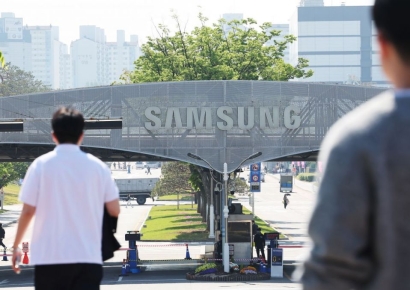 "Now Our Salaries Are 10 Million Won a Month" Record High... Semiconductor Boom Drives Performance Bonuses at Major Electronic Component Firms
- "Not Everyone Can Afford This: Inside the World of the True Top 0.1% [Luxury World]"
- While All Eyes Were on Samsung and Hynix, This Company Surged 50% to New Highs in Four Days [Weekend Money]
- "Heading for 2 Million Won": The Company the Securities Industry Says Not to Doubt [Weekend Money]
- Experts Already Watching Closely..."Target Price Set at 970,000 Won" Only Upward Momentum Remains [Weekend Money]
Meanwhile, TSMC is building a new plant in Phoenix, Arizona, with an investment of $12 billion, and has also started constructing a plant in Kumamoto Prefecture, Japan, with a $7 billion investment. Furthermore, TSMC is reportedly planning to expand production capacity in Nanjing, eastern China.
© The Asia Business Daily(www.asiae.co.kr). All rights reserved.