Yoon Seok-yeol "Electricity Price Hike in April Canceled... Moon Administration Irresponsible"
On the 13th, 'Yoon Seok-yeol's Promise: Cancellation of the Scheduled April Electricity Rate Hike' Press Conference Held

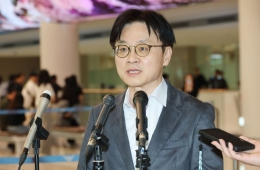
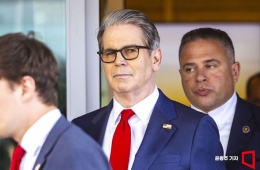
Yoon Seok-yeol, the presidential candidate of the People Power Party, is removing his mask on the 13th at the party headquarters in Yeouido, Seoul, to announce the pledge of "Cancellation of the April electricity rate hike and establishment of a power supply plan based on science and common sense." Photo by Yoon Dong-ju doso7@
View original image[Asia Economy Reporter Kum Bo-ryeong] Yoon Seok-yeol, the presidential candidate of the People Power Party, has pledged to completely cancel the scheduled electricity rate hike in April. This is because an increase in electricity rates during the COVID-19 crisis could place a heavy burden on self-employed business owners.
On the 13th, Yoon held a press conference titled "Yoon Seok-yeol's Promise: Complete Cancellation of the Scheduled April Electricity Rate Hike" at the People Power Party headquarters in Yeouido, Seoul. He stated, "The Moon Jae-in administration announced plans to raise electricity rates in April, but this is an irresponsible decision that shirks responsibility for the Korea Electric Power Corporation's (KEPCO) deficits and debts caused by the hastily pushed nuclear phase-out policy and shifts the burden of electricity rate increases entirely onto the people. I will first completely cancel the electricity rate hike plan."
Previously, KEPCO had decided on a 10.6% increase in electricity rates for April. According to data submitted by KEPCO to the National Assembly’s Industry, Trade, Energy, Small and Medium Enterprises Committee last year, KEPCO’s cumulative deficit for the third quarter of last year was 1.5 trillion won. Including fourth-quarter losses, it is estimated to be 4.3 trillion won. As of June last year, the debt stood at 137 trillion won, with a debt ratio of 197%. During the four years of the nuclear phase-out policy, debt increased by 32 trillion won.
Yoon argued, "If electricity rates are raised excessively, it will cause significant damage to the people. Among them, small and medium-sized enterprises and small business owners will suffer. Their sales have plummeted due to COVID-19, and now they have to bear the burden of increased electricity rates as well."
He added, "Digital industrial innovations such as artificial intelligence (AI), autonomous driving, and big data bring enormous electricity demand. The electricity used by a single semiconductor factory is comparable to that of a large city. Maintaining electricity prices at an appropriate level is an essential competitive factor for becoming a digital innovation powerhouse."
Yoon plans to establish an electricity supply plan based on science and common sense. He explained, "The Moon Jae-in administration forcibly pursued an ideological nuclear phase-out policy. Under the pretext of renewable energy, certain individuals were given preferential treatment in solar power projects. We will investigate and correct the nuclear phase-out and solar power corruption that undermined the science-based electricity supply system. We will establish an electricity supply plan based on fairness and common sense, not ideology or factional logic."
After the press conference, when asked by reporters how he views the worsening KEPCO deficit due to the cancellation of the electricity rate hike, Yoon responded, "KEPCO’s deficit can occur due to the nuclear phase-out and fluctuations in international prices of energy raw materials. We need to continuously adjust prices within a range that does not shock the industry. Leaving it as is and then suddenly raising prices right after the presidential election is not a science- and common sense-based electricity supply and price adjustment, but rather based on ideology, faction, and political logic, which should not be done."
Hot Picks Today
 No Bacteria Detected in Arisu After 24 Hours of Repeated Drinking from a Tumbler
- "We Can't Just Let Them Be Damaged Inside"... Samsung Electronics Removes 360,000 Wafers in Preparation for Strike
- "Up to 100 Trillion Won in Losses Feared, It's Not About Second Place but Catastrophe"... Industry Minister: 'Emergency Mediation Unavoidable If Samsung Strike Occurs'
- Wife in $6.7 Million Debt Took Out $3 Million in Husband's Life Insurance, Poisoned Him... US Court: "She Can Never Be Released"
- "He's Handsome, It's Such a Pity?"... Lawyer Responds to Bizarre 'Appearance Evaluation' of High School Girl Murder Suspect
Regarding the specifics of the plan based on scientific common sense, he said, "Electricity supply should be planned by considering the cost and efficiency of the energy mix of four sources: nuclear power, liquefied natural gas (LNG), coal, and renewable energy, to determine which energy mix is most suitable."
© The Asia Business Daily(www.asiae.co.kr). All rights reserved.