Shutdown of the 'World's Factory' in China Due to Omicron Spread
Supply Chain Disruptions Due to Tianjin Infection Spread
Samsung Electronics, Toyota, and Others Halt Production Lines
Local Lockdown Policies May Tighten Further
Central Banks Likely to Accelerate Tightening
![[Image source=Reuters Yonhap News]](http://www.asiae.co.kr/news/img_view.htm?img=2022011211021696659_1641952936.jpg)
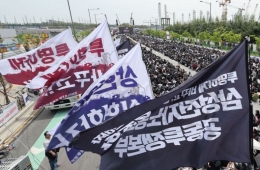
[Asia Economy Reporter Kwon Jae-hee] As the Omicron variant spreads rapidly from Tianjin, one of the two pillars of the global economy and known as the "world's factory," China, a global supply chain emergency has been triggered. There are growing concerns that the supply shortages that paralyzed the world last year may be repeated.
According to the Wall Street Journal (WSJ) on the 11th (local time), Chinese authorities have imposed lockdown measures from Xi'an in Shanxi Province to Anyang in Henan Province due to the Omicron spread originating from Tianjin. With the Beijing Winter Olympics scheduled for February 4 next month, Chinese authorities, on high alert, are maintaining a "zero tolerance policy" to prevent the spread of COVID-19.
As a result, major manufacturers with factories in China, including Samsung Electronics, Toyota, Volkswagen, Nike, and Adidas, have reportedly begun shutting down their plants. Since the 23rd of last month, Samsung Electronics has been struggling to secure the necessary workforce at its Xi'an plant in China, raising concerns about reduced production. Micron Technology, a U.S. company with a factory in Xi'an, also announced that the lockdown measures causing labor shortages would impact the production of DRAM memory chips. Toyota announced a complete suspension of operations at its Tianjin plant on the 10th and 11th. Volkswagen's Tianjin plant also halted operations on the 11th, and its plant in Ningbo was officially reported to have stopped as well. In Ningbo, Sunzhou International Group, a supplier for Nike, Adidas, and Uniqlo, has reportedly closed some production lines since the 3rd.
Concerns are growing about the ripple effects these measures by Chinese authorities could have on the global economy. Among experts, pessimism is emerging that, due to Omicron's high transmissibility, the consequences this time will be even more severe.
Frederick Neumann, Co-Head of Asia Economic Research at HSBC, stated, "The risks posed by the Omicron variant could be more serious in terms of supply chain bottlenecks."
Some economists predict that China will further strengthen its lockdown policies, with some even raising the possibility of a nationwide lockdown not seen since April 2020.
Experts have diagnosed that as Omicron sweeps through Europe and spreads to the U.S. and Asia, it will put upward pressure on inflation and increase the likelihood that central banks such as the Federal Reserve (Fed) will accelerate monetary policy tightening.
According to research by supply chain consulting firm Russell Group, a one-week delay in trade at Ningbo Port, the closest port to Tianjin, could disrupt exports worth $4 billion. Ningbo Port's container terminal was closed for two weeks last August after a single infection case was detected.
Hot Picks Today
 "Now Our Salaries Are 10 Million Won a Month" Record High... Semiconductor Boom Drives Performance Bonuses at Major Electronic Component Firms
- Experts Already Watching Closely..."Target Price Set at 970,000 Won" Only Upward Momentum Remains [Weekend Money]
- "Heading for 2 Million Won": The Company the Securities Industry Says Not to Doubt [Weekend Money]
- 'Still Hesitant? If You're Wondering Whether KOSPI Will Rise, This Is the Number You Must Watch [Weekend Money]'
- Is It Really Like an Illness? "I Can't Wait to Go Again"—Over 1 Million Visited in Q1, Now 'Busanbyeong' Takes Hold [K-Holic]
Meanwhile, on the 10th (local time), Goldman Sachs downgraded China's 2022 growth forecast from 4.8% to 4.3%.
© The Asia Business Daily(www.asiae.co.kr). All rights reserved.