Last Year Agricultural and Marine Food Exports Surpassed $10 Billion... Record High
Health Foods like Kimchi and Ginseng, Ramen... Notable Growth in Convenience Food Exports
Seaweed Exports Increase for 11th Year... "Result of Exporters' Efforts"
![[Image source=Yonhap News]](http://www.asiae.co.kr/news/img_view.htm?img=2021020911065569547_1612836415.jpg)
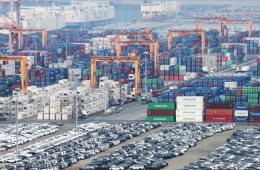
[Sejong=Asia Economy Reporter Moon Chaeseok] Last year, the export value of agricultural and marine food products surpassed $10 billion (approximately 11.975 trillion KRW) for the first time in history.
The Ministry of Agriculture, Food and Rural Affairs and the Ministry of Oceans and Fisheries announced on the 5th that the provisional export value of agricultural and marine food products last year recorded $11.36 billion, a 15.1% increase compared to 2020.
The export value of agricultural and livestock products was $8.54 billion, and marine food products were $2.82 billion, increasing by 12.9% and 22.4% respectively from the previous year.
In the agricultural food sector, the popularity of health foods and HMR (Home Meal Replacement) led to an increase in exports of both fresh agricultural products and processed foods. By item, health foods such as ginseng products (16.3%) and kimchi (10.7%), along with convenience foods such as beverages (18.2%), rice processed foods (18.1%), sauces (14.7%), and ramen (11.8%) showed high growth rates.
The export growth rates of grapes (24.1%) and strawberries (20.0%), which the government designated as 'star items' and supported through product development, localization, and promotion, were also high. Grapes are sold at high prices in China due to strict quality control of sweetness and size, and strawberries are mainly exported to Hong Kong and Singapore, where they are sold in local luxury hotels.
In the marine food sector, the representative export item, gim (seaweed), was exported worth about $700 million, a 15.4% increase from the previous year. Gim export value has increased for 11 consecutive years since recording $105.2 million in 2010.
Especially, thanks to the Korean Wave, countries that had not imported Korean gim before, such as Portugal, Cyprus, and Bhutan, have joined the ranks of gim importers. As a result, the number of gim export countries expanded to a total of 114. The Ministry of Agriculture, Food and Rural Affairs evaluated that this was the result of multifaceted efforts, including gim exporters developing high value-added products such as organic gim bugak (seaweed chips), vegetarian gimbap gim, seasoned gim flakes, and conducting Korean Wave marketing.
Tuna exports increased by 9.7% to $579 million as demand for sashimi and steak in countries like Japan and France grew, and canned tuna exports also increased. Oyster exports decreased to Japan, a major export country, due to the impact of COVID-19, but exports increased by 12.0% due to growing demand in the United States.
Hot Picks Today
 No Bacteria Detected in Arisu After 24 Hours of Repeated Drinking from a Tumbler
- Despite Surprising $23 Billion Earnings, Cisco to Lay Off 4,000 Employees for Expanded AI Investment
- High-Net-Worth Investors Increase Stock Holdings: "Samsung and SK hynix Are Basic, Now Searching for the Next Opportunity" [Investment Strategies of the Wealthy] ⑧
- "Not Just Fuel Prices: Whale Collision Risks Surge as Hormuz Blockade Reroutes Ships"
- "My Wife Is Missing"... Woman in Her 50s Still Unaccounted for Nearly a Month After Climbing Bukhansan Mountain
Kwon Jaehan, Director of the Food Industry Policy Office at the Ministry of Agriculture, Food and Rural Affairs, said, "Despite difficult conditions, we achieved the highest performance ever," adding, "The efforts of farmers, food companies, and exporters combined with public sector policy support have produced effective results."
© The Asia Business Daily(www.asiae.co.kr). All rights reserved.