[Reporter’s Notebook] Are Salaries Paid with Taxes Even for Civil Servants Without Assigned Duties?

On the afternoon of the 21st last month, Ahn Ho-young, chairman of the Environment and Labor Committee Employment and Labor Law Review Subcommittee at the National Assembly, is seen striking the gavel. (Photo by Yonhap News)
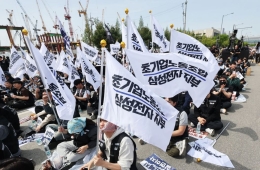
View original image[Sejong=Asia Economy Reporter Moon Chaeseok] On the 4th, the ruling and opposition parties passed an amendment to the Public Officials and Teachers Union Act that allows the application of the time-off system to public sector workers such as public officials and teachers. This opens the way for public officials, who receive taxpayers' money, to be paid salaries without performing their main duties if they serve as full-time union officials. It is estimated that if the time-off system is introduced, about 60 billion won will be paid to approximately 1,100 full-time union officials of public officials and teachers.
This decision is widely perceived as election-oriented, given that there was hardly any deliberation at the National Assembly level and all specific implementation details were deferred to the government. As the scope of working hours exemption increases to a maximum of 2,000 to 6,000 hours depending on the number of union members, the time for labor-management negotiations and handling workers' grievances will be correspondingly guaranteed. It was a decision made without much consideration to gain union votes. Critics argue that it prioritizes internal members of the public service over the general public.
Moreover, concerns arise as the pro-union stance of the government and political circles has been reaffirmed. While the government and ruling and opposition parties hastened the passage of the expansion of the time-off system and the introduction of labor directors in public institutions?longstanding demands of the labor sector?they have ignored the easing of the Serious Accident Punishment Act, a demand from the management side among labor issues. This has drawn criticism for setting a precedent that distorts the decision-making system among labor, management, and government.
Moon Sung-hyun, chairman of the Economic, Social and Labor Council (ESLC), appointed by the government as the leader of the tripartite grand compromise, has consistently emphasized "labor system improvement based on the tripartite grand compromise" throughout his term. The implication was that overcoming social polarization is possible only with such a grand compromise. Currently, the ruling and opposition parties are running independently in the exact opposite direction of this message.
Hot Picks Today
 No Bacteria Detected in Arisu After 24 Hours of Repeated Drinking from a Tumbler
- "I Feel Uncomfortable Being Filmed"... Cheerleaders Distressed by Commercial Fan Cam Practices
- High-Net-Worth Investors Increase Stock Holdings: "Samsung and SK hynix Are Basic, Now Searching for the Next Opportunity" [Investment Strategies of the Wealthy] ⑧
- "Not Just Fuel Prices: Whale Collision Risks Surge as Hormuz Blockade Reroutes Ships"
- Police Officer Cycling on Day Off Rescues Woman Attempting to Jump from Hangju Bridge
![[Reporter’s Notebook] Are Salaries Paid with Taxes Even for Civil Servants Without Assigned Duties?](http://www.asiae.co.kr/news/img_view.htm?img=2017122808571314896_1514419036.jpg)
© The Asia Business Daily(www.asiae.co.kr). All rights reserved.