Sudden Halt to Quarantine Pass... "Protecting the Unvaccinated" vs "Violation of Basic Rights" Debate Heats Up
Court Suspends Quarantine Pass Effectiveness "Even Unvaccinated Individuals' Right to Bodily Autonomy Must Be Respected"
Quarantine Pass Debate Shifts from 'Age' to 'Basic Rights Violation'... Potential for Multiple Lawsuits
Government: "Quarantine Pass Aims to Protect Unvaccinated and Preserve Healthcare Capacity... Please Understand"

On the first day of the quarantine pass validity period on the 3rd, citizens are checking the validity status of their quarantine passes at the National Museum of Modern and Contemporary Art in Jongno-gu, Seoul. Photo by Moon Honam munonam@
View original image[Asia Economy Reporter Park Hyun-joo] As the court has put a brake on the government's vaccine pass (proof of vaccination or negative test) for private academies, study rooms, and study cafes, the debate over the COVID-19 vaccine pass has intensified. The court's reference to the principle of equality as grounds for suspension has strengthened the argument that the vaccine pass, a core element of the current government's quarantine policy, infringes on fundamental rights.
On the afternoon of the 4th, the Seoul Administrative Court partially accepted the suspension (temporary suspension of effect) request filed by parent groups including the Coalition for Private Education Together, who oppose the youth vaccine pass, against the Minister of Health and Welfare.
Accordingly, unvaccinated adults or those who have not completed vaccination will be able to use private academies, study rooms, and study cafes starting that evening. This will be maintained until the first trial ruling on the main administrative lawsuit is issued.
The court, citing Article 11 of the Constitution on the principle of equality, stated, "It is recognized that there is an urgent need to prevent irreparable damage to the applicants caused by including private academies, study rooms, and study cafes as facilities subject to mandatory vaccine pass application," and judged, "It is difficult to conclude that suspending its effect would seriously affect the public welfare."
The court further pointed out, "Considering the considerable number of so-called breakthrough infections among vaccinated individuals, it cannot be said that unvaccinated persons pose a significantly higher risk of spreading COVID-19 to the extent that facility use should be restricted."
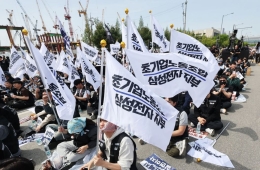
![On the morning of the 15th of last month, parents and citizens are protesting against the quarantine pass and COVID-19 vaccination for adolescents in front of the Seongdong-Gwangjin Education Support Office in Seongdong-gu, Seoul. [Image source=Yonhap News]](http://www.asiae.co.kr/news/img_view.htm?img=2022010422325887201_1641303178.jpg)
On the morning of the 15th of last month, parents and citizens are protesting against the quarantine pass and COVID-19 vaccination for adolescents in front of the Seongdong-Gwangjin Education Support Office in Seongdong-gu, Seoul. [Image source=Yonhap News]
View original imagePreviously, the debate over the vaccine pass centered around age groups. On the 3rd of last month, the government announced that starting March 1, the vaccine pass would be applied to youths aged 12 to 18 for private academies, study rooms, and study cafes to encourage vaccination among adolescents.
However, with this court ruling, the debate over the vaccine pass has shifted to the issue of 'infringement of fundamental rights.' Although this injunction was filed to protect the learning rights of youths, the court's citing of learning and vocational choice rights and self-determination as grounds for suspension has shifted the focus of the debate to 'fundamental rights.'
In particular, there is considerable opposition to the new application of the vaccine pass to large stores, marts, and department stores starting from the 10th, given that these are essential facilities selling daily necessities.
Public protests have also continued. On the 31st of last month, 1,023 general citizens, including medical professionals such as Professor Jo Doo-hyung of Yeungnam University College of Medicine, filed a collective administrative lawsuit at the Seoul Administrative Court against the Minister of Health and Welfare, the Director of the Korea Disease Control and Prevention Agency, and the Mayor of Seoul. They opposed the introduction of the vaccine pass, arguing that the government is effectively forcing vaccination by restricting unvaccinated individuals from using daily life facilities such as restaurants, cafes, and private academies.
Hot Picks Today
 No Bacteria Detected in Arisu After 24 Hours of Repeated Drinking from a Tumbler
- "I Feel Uncomfortable Being Filmed"... Cheerleaders Distressed by Commercial Fan Cam Practices
- 'With 13% of GDP at Stake,' Massive Losses Loom from Samsung Electronics Strike... Government Faces Emergency Mediation Dilemma [Why&Next]
- "Not Just Fuel Prices: Whale Collision Risks Surge as Hormuz Blockade Reroutes Ships"
- Police Officer Cycling on Day Off Rescues Woman Attempting to Jump from Hangju Bridge
Meanwhile, the government emphasizes that the vaccine pass is a measure to protect unvaccinated individuals. Son Young-rae, head of the Social Strategy Division of the Central Disaster and Safety Countermeasure Headquarters, urged understanding of its inevitability during the COVID-19 regular briefing that morning, stating, "The vaccine pass aims to minimize infections among the unvaccinated to protect them and also to preserve the capacity of the healthcare system, which is heavily burdened by unvaccinated patients," and called for understanding of its necessity.
© The Asia Business Daily(www.asiae.co.kr). All rights reserved.